
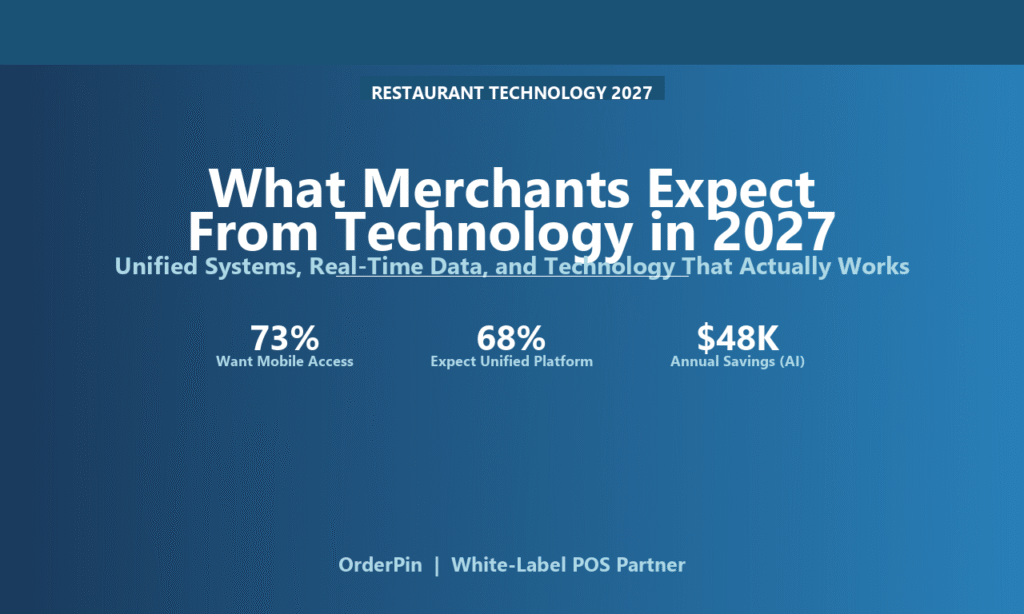
The restaurant merchant of 2027 isn’t asking if they need technology — they’re asking which technology they can trust to actually work. Today’s operators want unified systems that talk to each other, real-time data they can check from anywhere, and AI-assisted insights without the complexity. The POS isn’t just a register anymore — it’s the nerve center of the entire operation.
Access
Platform
from Automation
Walk into any independent restaurant in 2027 and you’ll see something striking: the owner is on their phone checking sales numbers between plating dishes. They’re texting their manager about tonight’s staffing. They’re glancing at an alert about a vendor delivery. And they’re doing all of this without logging into a desktop computer or sitting down at a back-office terminal.
The restaurant merchant of 2027 has changed. They’ve been through the pandemic, survived labor shortages, watched delivery platforms eat their margins, and learned — sometimes the hard way — that technology is no longer optional. But they’ve also become far more discerning. They know the difference between software that actually helps and software that’s just another subscription bill.
So what are these merchants actually looking for in 2027? This article breaks down the five expectations that are reshaping how restaurant technology gets evaluated — and what it means for anyone building or selling in this space.
1. Unified Systems Over Fragmented Tool Stacks
Ask a restaurant owner about their technology setup in 2024 and you’ll often get the same answer: “It’s… a lot of things.” They might be running one app for taking orders, another for processing payments, a third for managing inventory, a spreadsheet (or two, or five) for scheduling, and a completely separate system for generating reports. Each app has its own login, its own data, and its own idea of the “truth.”
This fragmentation isn’t just inconvenient — it’s expensive. Every time a server has to re-enter an order from a handheld device into a separate payment terminal, there’s a risk of error. Every time an owner has to manually reconcile sales data from one platform with labor data from another, they’re spending time on work that software should be doing for them. And when something breaks — a charge doesn’t process, an inventory count doesn’t sync — the owner is left playing detective across five different support queues.
The merchants who are thriving in 2027 aren’t the ones with the most tools. They’re the ones who’ve found a unified platform where ordering, payments, inventory, and reporting all live in the same place. When you can see your food costs, your labor ratio, and your top-selling items in a single dashboard, you stop managing spreadsheets and start running your restaurant.
For restaurant technology buyers — whether you’re an ISO evaluating POS platforms for your portfolio or an MSP building solutions for clients — this is a decisive factor. The platforms that win in 2027 will be the ones that consolidate, not the ones that add another integration.
2. Real-Time Visibility: The Non-Negotiable Expectation
The modern restaurant owner doesn’t stop working when they leave the building. They might be at their kid’s soccer game when they get a gut feeling that Saturday night is going to be busy — and they want to be able to check their labor cost percentage from their phone right then. They might be on vacation when a key employee calls in sick, and they need to see the schedule to figure out coverage before they can enjoy dinner.
Real-time visibility has moved from a nice-to-have to a non-negotiable expectation. Merchants want to see their sales, their labor costs, their table turns, and their inventory levels from any device, at any time. They want alerts when something looks off — when food costs spike, when a category underperforms, when a delivery is running late — before it becomes a crisis rather than after.
This shift is partly cultural and partly generational, but it’s mostly practical. Independent restaurant owners are often working in their businesses, not just on them. They’re expediting on a busy Friday, doing the deposit on Monday morning, and checking the numbers on Sunday before the week starts. Technology that only works when you’re at a dedicated workstation — that requires you to be in the restaurant to have any visibility — is technology that’s already behind the times.
Cloud-based platforms have made this possible, and merchants have noticed. The question is no longer can I access my data remotely? It’s why can’t I? Any platform that requires on-premise servers or limited-access reporting is going to face serious scrutiny from operators who’ve seen what cloud-first systems can do.
3. AI-Assisted Decisions Without the Complexity
Here’s a phrase you’ll hear a lot in restaurant technology conversations in 2027: “I don’t want a dashboard. I want a recommendation.”
Restaurant operators are busy. They’re running one, two, sometimes five concepts, and they don’t have time to sit down with a business intelligence tool and figure out why their Wednesday lunch numbers are down 12 percent. What they want is for the system to say: “Hey, your Wednesday lunch is trending down. It looks like the past three Wednesdays had rain. Here’s what happened last time, and here’s what we suggest.”
AI in restaurant technology is moving from back-office analytics to front-line assistance. Demand forecasting that tells a manager how much to prep. Inventory ordering that suggests quantities based on historical patterns and upcoming events. Scheduling optimization that flags when you’re overstaffed for a Tuesday lunch or understaffed for a holiday weekend. These aren’t science fiction features — they’re becoming table stakes in modern restaurant software.
But here’s the critical insight: merchants don’t want AI that’s in their way. They don’t want pop-ups interrupting service. They don’t want to configure machine learning models. They want the intelligence to work quietly in the background and surface at the right moment, with a clear, actionable suggestion. The technology that’s winning on AI makes the merchant feel like they have a smart assistant — not a data scientist breathing down their neck.
4. Mobile-First Everything
The terminal at the end of the counter — the big grey box with the bulky card reader — is not dead, but it’s no longer the center of the restaurant experience. In 2027, the center of the experience is wherever the customer and the staff happen to be.
Merchants are asking for tableside ordering on tablets, so servers can take orders at the table without walking back to a terminal. They’re asking for mobile payment processing so they can close a tab at a customer’s seat. They’re asking for QR-code-based ordering for quick-service environments where speed matters more than table service. And they’re asking for mobile staff management tools so their kitchen and front-of-house teams can see the pass, check the schedule, and communicate without being chained to a workstation.
This isn’t just about convenience — it’s about speed. Every step a server saves by not walking back and forth to a terminal is time they can spend on the floor, upselling, checking on guests, and creating the kind of experience that earns repeat business. In a world where labor is expensive and every dollar of table turn matters, mobile-first technology isn’t a luxury. It’s a margin driver.
For technology providers, this means the hardware conversation has changed. It’s no longer about which terminal has the best screen. It’s about which platform gives staff the most freedom to operate from anywhere in the restaurant — and which integration paths support the hardware form factors that match each concept’s style of service.
5. Support That Actually Responds
This one is deceptively simple, but it comes up in almost every conversation with restaurant operators. When something goes wrong with their technology — a payment won’t process, a report is showing incorrect data, a staff member locked out of the system — they need help now, not in 48 hours.
The traditional model of restaurant technology support — submit a ticket, wait for an email response, maybe get a callback in a day or two — doesn’t work for a business where a Friday dinner rush is happening in four hours. Merchants in 2027 know this, and they’re vocal about it. They share horror stories about support tickets that went unanswered over a weekend, calls that got routed to someone in a different timezone who clearly had never seen a restaurant POS, and resolution times measured in weeks instead of hours.
The operators who stick with a technology platform long-term are the ones who feel supported. Not just technically supported — genuinely supported. They know who to call. They get the same person on the phone who knows their account. And when they have a question about a new feature or a workflow change, they can get an answer the same day.
For ISOs and MSPs who sell restaurant technology, support quality is increasingly a competitive differentiator. A platform can have the best features on paper, but if the merchant feels abandoned when something goes wrong, they’ll leave at contract renewal — or sooner. The trust that’s built in a crisis is what creates the long-term relationships that matter.
What This Means for Your Technology Choices in 2027
Here’s the bottom line: restaurant merchants in 2027 are making technology decisions with eyes wide open. They’ve been burned by shiny tools that didn’t deliver. They’ve watched platforms get deprecated. They’ve learned that the cheapest option often has the highest hidden cost — in time, in errors, and in the attention they have to divert away from running their restaurant.
When you’re evaluating restaurant technology — whether you’re an ISO building out your vendor portfolio, an MSP designing a client solution, or a merchant choosing your own tools — these five expectations give you a clear framework. Ask not just whether a platform has the features you need today, but whether it’s built for the way operators actually work in 2027: mobile, unified, intelligent, and always-on.
The merchants who choose well are the ones who’ll be running their restaurants, not fighting their software. And that difference — between technology that empowers and technology that frustrates — is the whole ballgame.
Frequently Asked Questions
Q1: What technology do restaurants need most in 2027?
In 2027, restaurants need a cloud-based, unified platform that consolidates ordering, payments, inventory, and reporting into a single system. Beyond that, mobile access and AI-assisted insights have moved from nice-to-have to expected. The days of cobbling together five different apps are over — merchants want one platform that actually talks to itself.
Q2: How will AI change restaurant operations?
AI in restaurant operations is shifting from passive analytics to active assistance. Instead of dashboards full of raw data, merchants want actionable recommendations — when to order more inventory, how many staff to schedule for a given shift, which menu items to promote based on demand patterns. The goal isn’t to replace restaurant managers; it’s to give them the same insights a seasoned operator would have, instantly, without needing a background in data science.
Q3: What does unified restaurant software mean?
Unified restaurant software means a single platform where all core functions — point of sale, payment processing, inventory management, employee scheduling, and reporting — operate from the same database and the same interface. No more manual exports between systems, no more conflicting numbers between platforms, and no more logging into four different apps to get a complete picture of how your restaurant is running.
Q4: How can merchants get real-time visibility into their restaurant operations?
Real-time visibility comes from choosing a cloud-based restaurant POS platform with a mobile-accessible dashboard. Modern systems push sales data, labor costs, and inventory levels to the cloud as transactions happen, so merchants can check their numbers from any device — a phone in the walk-in cooler, a tablet on the floor, a laptop at home. The key is making sure the platform supports the real-time alerts and customizable views that let an operator act fast when something needs attention.
Q5: What support should restaurants expect from POS vendors in 2027?
Restaurants should expect responsive, knowledgeable support — not just a ticket queue. When your POS goes down during a dinner rush, you need a human who answers the phone, understands restaurant operations, and can help you resolve the issue fast. Merchants are increasingly unwilling to accept 24- to 48-hour response times, and platforms that offer same-day resolution, dedicated account support, and multiple contact channels (phone, chat, text) are the ones earning long-term loyalty.
Restaurant merchants in 2027 are clear about what they want: one platform that works, real-time access from anywhere, AI that makes decisions easier not harder, mobile tools that speed up service, and support that actually shows up. The technology providers who get these five things right will earn the trust — and the long-term business — of the operators who are building the future of dining.
OrderPin is a restaurant POS software ISV that helps independent restaurant operators modernize their technology stack with cloud-based, unified solutions built for the way modern restaurants actually work.