
TL;DR ??Quick Summary
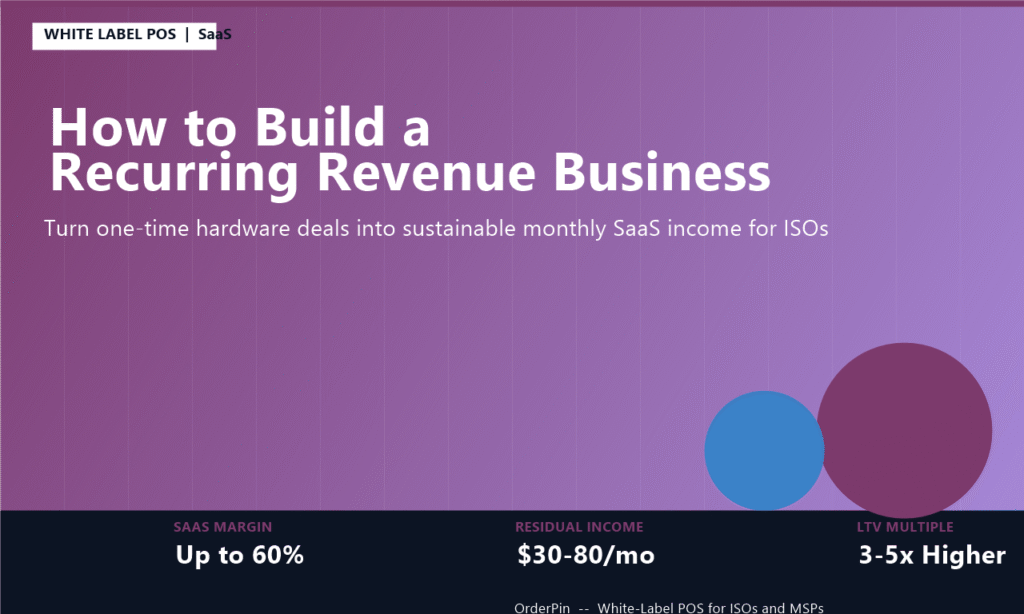
- ISO SaaS margins reach up to 60%, compared to 8-15% residual on traditional merchant accounts.
- Recurring revenue per merchant averages $30-80/month in residual income under a white-label model.
- ISOs should build a white-label POS platform to capture the full transaction margin, not just referral fees.
What Is a Recurring Revenue Business Model for ISOs?
Recurring revenue in the POS industry means building a business where merchants pay you monthly or per-transaction fees on an ongoing basis ??not a one-time referral commission. For ISOs (Independent Sales Organizations) and MSPs (Merchant Service Providers), this is a fundamental shift from the legacy residual model.
According to McKinsey, companies with recurring revenue streams grow 3x faster than product-only businesses. For POS resellers, a white-label POS platform transforms a transactional referral business into a scalable SaaS company with predictable monthly income.
Why the Traditional ISO Model Is Broken
Traditional ISO residual income works like this: you sign a merchant, earn a one-time bonus (say $300-500), then receive 8-15% of the merchant’s monthly card processing volume as residual. The problem? You have zero control over pricing, data, or merchant relationships.
Your ISO aggregator owns the merchant contract, the data, and the pricing. You’re a distribution channel ??and one contract renegotiation can wipe out 40% of your monthly income overnight.
The White-Label POS Difference
How to Build Recurring Revenue with White Label POS
Step 1: Choose the Right White-Label Platform
Look for a POS provider that offers a complete white-label program. The platform should handle the heavy lifting ??payment processing infrastructure, PCI compliance, hardware procurement ??while you control the branding, pricing, and merchant experience.
Key requirements:
- Full API access for custom integrations
- No direct competition (they don’t sell to merchants directly)
- Flexible pricing for ISOs (monthly platform fee + transaction margin)
- Multi-tenant dashboard to manage all your merchants
Step 2: Structure Your Pricing for Maximum Margin
With white-label POS, you set the merchant pricing. A typical structure for ISOs:
| Pricing Component | Traditional ISO | White-Label POS | Your Margin |
|---|---|---|---|
| Monthly Platform Fee | $0 | $49-99/month | 100% |
| Processing Rate (Markup) | 0.10-0.20% | 0.30-0.50% | 3-5x higher |
| Transaction Fee | $0.05-0.10 | $0.10-0.20 | 2x higher |
| Hardware Markup | Minimal | $50-150/unit | Significant |
Step 3: Add Recurring Value Services
Once merchants are on your platform, layer in recurring value services:
- Online ordering ??$25-75/month per restaurant
- Inventory management ??$20-50/month
- CRM and loyalty ??$15-30/month
- Analytics dashboard ??included or $10-20/month
Step 4: Build a Merchant Acquisition Engine
Focus on high-volume merchants (QSR, casual dining) where your per-merchant revenue is highest. A restaurant doing $50,000/month in card transactions at a 0.35% markup generates $175/month in processing residual ??plus platform fees and add-ons.
Real Revenue Numbers: ISO White-Label POS
Here’s what a realistic ISO portfolio looks like with white-label POS:
ISO Portfolio Scenario: 50 Restaurants
- 50 restaurants ? avg. $30,000/month transactions = $1.5M monthly volume
- Processing residual at 0.35% markup: $5,250/month
- Platform fees ($69/month ? 50): $3,450/month
- Online ordering add-on ($49/month ? 30 restaurants): $1,470/month
- Total Monthly Recurring Revenue: $10,170/month
- Annual Recurring Revenue: $122,040/year
FAQ: Building Recurring Revenue as an ISO
Frequently Asked Questions
How much capital do I need to start a white-label POS business?
Most white-label POS programs require minimal upfront capital ??often a platform setup fee of $1,000-5,000 and basic sales tools. Hardware costs can be passed to merchants or financed. According to industry data, most ISOs reach profitability within 3-6 months with 15-20 active merchants.
What’s the difference between an ISO and a POS reseller?
An ISO (Independent Sales Organization) typically refers to payment processing sales, while a POS reseller sells point-of-sale software and hardware. A white-label POS model combines both ??you sell the software and capture the processing margin under your own brand. This dual revenue stream typically generates 3-5x more income than traditional ISO-only models.
How long does it take to get merchants live on a white-label platform?
With OrderPin, most restaurants are fully operational within 24-48 hours of onboarding. The platform includes pre-configured hardware, plug-and-play software, and dedicated onboarding support to minimize time-to-revenue for your merchants.
Can I keep my existing merchant portfolio when switching to white-label?
Yes ??most white-label POS platforms support merchant migration from existing systems. Migration typically takes 1-3 days per location with zero downtime for the merchant. The key is choosing a platform with robust data migration tools and hardware that works with existing payment terminals.
Conclusion
The shift from traditional ISO residual income to a white-label POS recurring revenue model is not optional ??it’s survival. ISOs who don’t adapt will continue to see eroding margins as aggregators consolidate and processors cut residual rates.
A white-label POS platform lets you:
- Capture 100% of the transaction margin instead of 8-15%
- Own the merchant relationship and data
- Add recurring SaaS revenue streams on top of processing
- Build an asset that can be sold for 3-5x annual revenue
About OrderPin
OrderPin is a white-label POS platform built for ISO and MSP partners. We offer full data ownership, flexible pricing, and seamless API integrations to help you build a recurring revenue business under your own brand. Learn more about OrderPin’s white-label solution