
Most restaurant failures aren’t about bad food — they’re about blind spots that quietly drain cash flow long before owners notice. The operators who survive five years or more share one habit: they look at their numbers every single day. Beyond that, it’s inventory discipline, smart scheduling, and treating loyal customers as the most valuable asset on the floor.
1. Flying Blind: Why Most Owners Don’t See Their Numbers
Walk into any independent restaurant on a Tuesday afternoon and ask the owner what their food cost was last week. You’d be amazed how many will hesitate, change the subject, or admit they’ve “got a rough idea.” That rough idea is killing them.
Restaurant margins are famously thin — typically 3–9% for a healthy operation. On a $1 million annual volume, that’s $30,000 to $90,000 of profit. The difference between thriving and surviving often comes down to a few hundred dollars a week that quietly slips through the cracks. The problem is, when you’re not checking your daily sales report, your labor cost percentage, and your food cost breakdown every single day, you don’t see that leak until the hole is enormous.
Most owners opened their restaurant because they love food, hospitality, and people. The financial review part? That’s the part that feels like homework. But here’s the uncomfortable truth: you can’t manage what you don’t measure. By the time monthly financials arrive, thirty days of small problems have compounded into a significant loss. Daily reporting is the x-ray that catches fractures early.
The owners who last a decade or more have a non-negotiable morning habit. Before the lunch rush, they pull yesterday’s sales, check labor hours against revenue, and scan for anything that’s running off track. It takes fifteen minutes. It changes everything.
2. Inventory Chaos: The Silent Profit Killer
Food cost is the single largest controllable expense in a restaurant. Most operators know their target — somewhere between 28% and 35% of food sales — but far fewer know where they actually stand on any given week. The gap between those two numbers is where profit goes to die.
Inventory chaos has three layers. First, waste: prep errors, over-production, spoilage from poor rotation. Second, shrinkage: theft by staff or vendors, portion sizes that creep upward over time. Third, blind purchasing: ordering based on memory or panic instead of actual usage data. Each layer quietly erodes margins in ways that feel normal until the numbers become impossible to ignore.
Consider a restaurant doing $15,000 in weekly food sales with a 35% food cost. That’s $5,250 in food cost. If waste and shrinkage push the real number to 40%, the owner is losing $750 every week — nearly $39,000 a year — before they’ve made a single strategic mistake. The tragedy is that most of this is preventable. Consistent inventory counts, pars set by actual usage, and daily waste logging can recover most of that lost margin.
The operators who win on inventory treat their walk-in like a warehouse. Every tomato, every pound of beef, every bottle of oil has a cost attached to it, and that cost is tracked consistently. It’s not glamorous work. But it’s the work that keeps the doors open.
3. Scheduling by Guesswork, Not Data
Labor is typically 30–35% of gross revenue in most full-service restaurants. That’s the second biggest line item after food cost, and yet the majority of independent operators still build their weekly schedule based on gut feel, tradition, or whoever happened to ask for time off first. It’s one of the most expensive habits in the industry.
Over-scheduling during slow periods is an invisible drain. You’re paying full wages to servers standing around, and those dollars come straight out of the tips your actual guests are tipping on. Under-scheduling during peak hours is the other side of the same coin — it creates long ticket times, overwhelmed staff, bad reviews, and customers who don’t come back. Both mistakes are completely avoidable with even basic historical data.
There’s also the turnover problem. The National Restaurant Association estimates that replacing one front-line restaurant employee costs $1,500–$5,000 in recruiting, onboarding, and lost productivity. With industry turnover hovering around 75% annually for servers, those costs add up fast. A good schedule doesn’t just save on labor — it keeps your team stable by not burning people out with inconsistent shifts and understaffed weekends.
4. Ignoring the Customers You Already Have
The restaurant industry has a fascination with new customers. We post on Instagram, run promotion campaigns, chase food bloggers and influencers — all in pursuit of new bodies in chairs. Meanwhile, the customers you already have are quietly walking out the door and not coming back.
Research consistently shows that 20–30% of a restaurant’s customer base churns each year — customers who simply stop coming without any dramatic complaint. Some had a mediocre experience. Some had to wait too long. Some never felt recognized. The common thread: they didn’t feel like it was their restaurant.
The economics are stark. Acquiring a new customer costs $200–$300 in marketing and promotional spend. Retaining an existing one costs $5–$10 in a loyalty program or a genuine thank-you note. A restaurant with 500 regular weekly guests that loses 25% of them is spending tens of thousands of dollars to refill those chairs with strangers who haven’t yet learned to love the place. The math is brutal, and it’s entirely avoidable.
5. Buying Technology, Using 30% of It
Most modern point-of-sale systems are remarkably powerful. They can track every item sold, calculate food costs automatically, manage employee schedules, monitor inventory in real time, and surface daily reports that would have cost a small fortune in consultants twenty years ago. The problem is that the average restaurant uses only about a third of what they’ve already paid for.
Feature underutilization starts at setup. POS systems are typically installed with defaults, rushed through a basic training, and left to the staff to figure out over time. Nobody goes back to optimize the menu module, configure the reporting dashboard, or train the team on the scheduling tool. Six months later, the owner is still manually counting inventory in a notebook while the software they paid for has that data sitting unused in the background.
The cost isn’t just the wasted software investment. It’s every decision made in the dark because the data was never surfaced. The POS is there. The data is there. The habit of using it isn’t. That gap between capability and practice is where money quietly disappears every single day.
The Pattern: All Five Mistakes Compound
Here’s what makes these mistakes so dangerous individually: they don’t exist in isolation. They reinforce each other in ways that are difficult to see from the inside. You don’t check your numbers, so you don’t notice the food cost creeping up. Your inventory is a mess, so your orders are either too large or too small. You’re over-ordering because you don’t trust your counts, which means more waste, which pushes food cost higher. Meanwhile, you’re scheduling by guesswork because you don’t have historical data to model against.
All of this creates cash flow pressure, which means there’s no budget for staff training, no investment in the systems that could pull you out of the pattern, and no time for the owner to step back and see the whole picture. You’re in the restaurant seven days a week, but you’re not actually running it — you’re reacting to it. The compounding effect is why so many owners describe the same experience: things felt normal, and then suddenly they weren’t.
Breaking the cycle doesn’t require fixing everything at once. It requires one honest look at the numbers. Start there. Build the habit of daily visibility, and the rest of the pieces start falling into place with far less effort than you’d expect.
Frequently Asked Questions
Q1: What’s the #1 mistake restaurant owners make?
The deepest mistake is not reviewing financial data regularly. Everything else — waste, overstaffing, churn — is visible in the numbers before it becomes a crisis. If you only change one habit, make it a daily check of your sales, food cost, and labor reports.
Q2: How much does poor inventory control cost a restaurant?
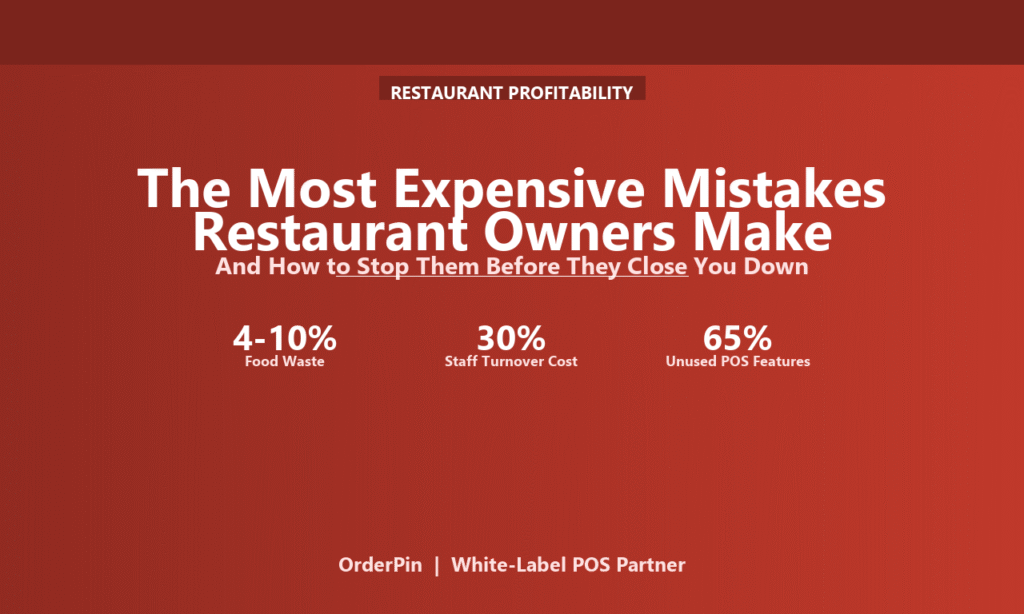
On average, food waste and shrinkage account for 4–10% of total food revenue. For a restaurant doing $800,000 in annual sales, that’s $32,000–$80,000 a year lost to poor inventory management — before accounting for the operational chaos that comes from not knowing what you have on hand.
Q3: How can a POS system prevent these mistakes?
A well-configured POS system gives restaurant owners daily visibility into sales trends, food cost calculations, and labor hour tracking. The key is ensuring the system’s reporting features are actively used — not just enabled. When data is reviewed consistently, owners can spot problems within days instead of discovering them at the end of the month.
Q4: What’s a realistic food cost percentage target?
For most full-service restaurants, a food cost between 28% and 35% of food sales is considered healthy. Fine-dining operations can run a bit higher due to premium ingredients and lower cover counts, while fast-casual concepts may target the lower end. The most important benchmark, however, is your own historical trend — improvement against your baseline matters more than hitting an arbitrary industry number.
Q5: How often should restaurant owners review their reports?
Daily is the gold standard. At minimum, review a daily sales and labor snapshot every morning before service. Weekly food cost checks and inventory counts keep the big picture on track. Monthly deep-dives into profit and loss statements are essential for long-term strategy. Anything less frequent than weekly means you’re managing from a rearview mirror.
None of these mistakes are exotic. They’re common, predictable, and — with the right habits — fixable. The owners who last aren’t the ones with the best food or the most capital. They’re the ones who see their business clearly, every single day, and act on what they see.
OrderPin is a restaurant POS software ISV (Independent Software Vendor) offering POS hardware and management tools designed for independent restaurant operators. For restaurant owners looking to improve daily operational visibility and streamline reporting, exploring a purpose-built restaurant POS solution may be a practical starting point.