
The restaurants in the top 10% don’t win by working longer hours. They win by building systems that make the right information unavoidable, turn repetitive work into repeatable playbooks, and reward decisions backed by numbers instead of hunches. If you want to close the gap with the best operators in your market, start with visibility, then standardize, then automate, then review relentlessly.
Quick Stats
Data Visibility
The most efficient restaurants treat visibility as a non-negotiable foundation rather than a nice-to-have report that someone requests once a quarter. Before any meaningful optimization can happen, operators need to see precisely what is occurring across every shift, every station, and every menu item in real time. Data visibility means more than owning a dashboard — it means the right metrics reach the right people at the moment those metrics matter. Top operators connect their point-of-sale, kitchen display, labor scheduling, and inventory systems so that a single, trustworthy source of truth emerges from what used to be disconnected silos.
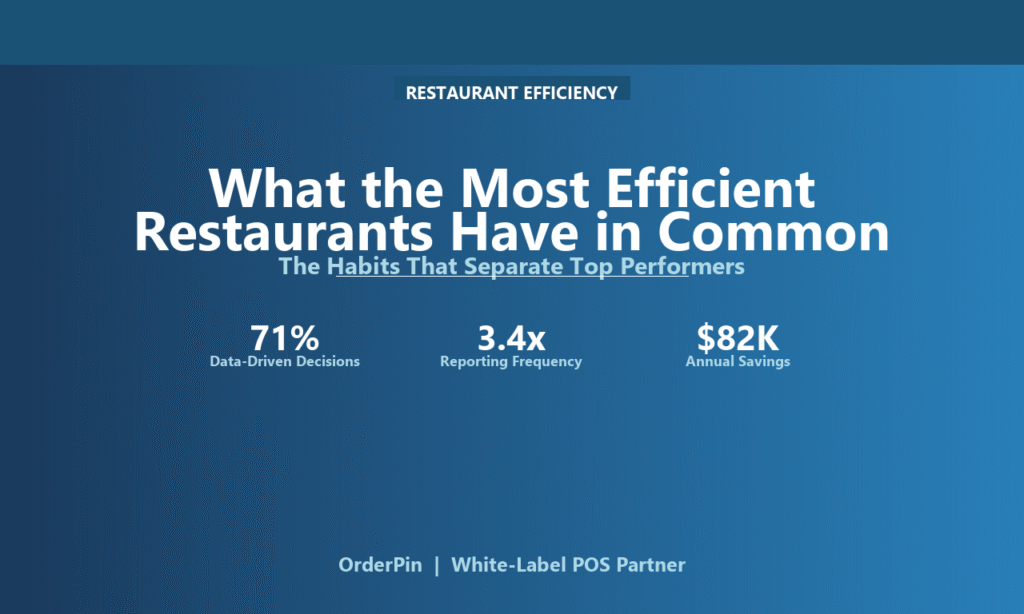
When a manager can see which items are selling, which servers are turning tables fastest, and where waste is spiking, decisions stop being educated guesses and become informed calls. According to recent operator benchmarks, the top-decile restaurants make roughly 71% of their decisions using hard data instead of intuition. That single shift — from gut feel to measured fact — changes how the entire team operates. Strong visibility also eliminates the quiet blind spots that steadily drain margin: a slow-moving ingredient that ties up cash, a recurring voided ticket that signals a training gap, or a happy-hour promotion that never paid for itself.
By surfacing these patterns automatically, efficient operators catch problems while they are still small and inexpensive to fix. The objective is not to drown employees in charts but to deliver one clear, actionable signal for each role. A shift leader needs to know if labor is trending over budget before the night ends. An owner needs weekly food cost without waiting for a monthly close. When visibility is built into the daily rhythm, the restaurant stops reacting and starts steering.
Standardized Workflows
Once the right data is visible, the next differentiator is consistency. The most efficient restaurants document and standardize the tasks that happen every single day, from opening procedures to expediting during the dinner rush. Standardized workflows remove the variability that comes from relying on each employee to “just know” how things should be done. A new line cook should be able to step into a station and follow the same prep list, recipe card, and plating standard that a three-year veteran uses, because the playbook is written down and reinforced through training.
This consistency protects quality, reduces errors, and makes it far easier to onboard staff during the inevitable churn that defines the industry. Operators who standardize also gain something less obvious: a baseline they can actually measure against. When every shift runs the same way, deviations become visible immediately, and improvement becomes a matter of refining a known process rather than guessing why two nights felt different. The best operators turn their standards into checklists, templates, and automated reminders inside their systems so that following the playbook is the path of least resistance.
They review those standards quarterly and update them when the data shows a better way. Standardization is not about stripping personality from a restaurant; it is about freeing the team to deliver the experience customers expect without reinventing the wheel every service. The restaurants that win on efficiency are rarely the most creative on a whiteboard. They are the most disciplined about repeating what already works, night after night, with minimal drift.
Technology Integration
Visibility and standardization only scale when the underlying technology actually talks to itself. The most efficient operators resist the temptation to bolt on a dozen disconnected apps that each solve one small problem and create three new ones. Instead, they prioritize integrated systems where the point-of-sale, online ordering, kitchen display, payments, loyalty, scheduling, and inventory all share the same data layer. Integration is what turns individual efficiencies into compound ones.
When a sale automatically updates inventory, when a forecast pulls from historical sales, and when labor scheduling reads projected covers, the restaurant stops paying people to re-key data between tools. Efficient operators also choose technology that surfaces insight, not just records transactions. A modern POS should tell you which menu engineering changes lifted margin, not merely print a receipt. The discipline here is restraint: adopt tools that integrate cleanly, retire tools that create duplicate work, and insist that any new system earns its place by removing manual effort or surfacing a decision you could not make before.
Technology integration is also a culture issue. Teams adopt tools only when leadership demonstrates the workflow and removes the friction of switching. The restaurants pulling ahead are those where the stack feels like one connected organism rather than a drawer full of mismatched remotes. The payoff is measurable: fewer errors, faster closes, and the kind of real-time visibility that makes every other efficiency effort possible.
Strong Reporting Culture
Systems and tools only matter if people actually look at the output and act on it. The most efficient restaurants build a reporting culture where reviewing numbers is a scheduled, expected part of the week, not an afterthought reserved for tax season. Benchmark data shows the top operators report and review performance roughly 3.4 times more frequently than their peers, and that cadence is itself a competitive advantage. A weekly review of food cost, labor percentage, voids, and comps catches small leaks before they become monthly disasters.
A daily flash report keeps the management team aligned on the metrics that moved. Crucially, a strong reporting culture is non-punitive; it is about finding the process problem, not assigning blame to a person. When a number looks off, the team asks what in the system allowed it to happen and how the standard should change. This reframing is what keeps employees engaged with the data instead of afraid of it. Leadership reinforces the habit by celebrating wins that the reports revealed, whether that is a server who improved attachment rate or a kitchen that cut waste below target.
Over time, the reporting rhythm becomes the restaurant’s nervous system, transmitting signals fast enough to adjust mid-week rather than after the fact. The restaurants that treat reporting as a living practice, rather than a static document, are the ones that compound their gains quarter after quarter and stay ahead of competitors who only discover problems when cash flow forces the conversation.
Continuous Optimization
The final trait that ties the others together is a refusal to declare victory. The most efficient restaurants treat optimization as a permanent operating posture rather than a one-time project with a finish line. They run small, frequent experiments: a menu price tweak, a redesigned prep sequence, a new shift handoff, a fresh upsell prompt at the POS. Because they already have visibility, standards, integration, and a reporting cadence, they can test a change, measure the result against a clean baseline, and keep what worked.
This scientific loop is where the $82K in average annual savings attributed to analytics-led changes comes from — not from a single heroic fix but from dozens of incremental improvements that accumulate. Continuous optimization also means being honest about what the data says, even when it contradicts a long-held belief about the business. The efficient operator is willing to drop a “signature” menu item that loses money or change a beloved schedule that no longer fits demand. They institutionalize feedback, capturing ideas from servers and cooks who see the friction first, then validating those ideas with numbers.
Perhaps most importantly, they protect the gains they make by updating standards and retraining, so efficiency does not quietly erode as staff rotate. The top 10% are not dramatically smarter or better funded than everyone else. They have simply built a machine that learns, and they feed it consistently. That is the real secret hiding in plain sight.
Frequently Asked Questions
How do I start improving restaurant efficiency if I have no reporting today?
Begin with visibility before attempting optimization. Connect your POS to a basic reporting view that shows daily sales, food cost, and labor percentage, then commit to a weekly review. You do not need a perfect system; you need a consistent one. Once you can see the numbers reliably, standardize the few workflows that repeat most often, and let the data guide your next step.
What is the single highest-impact metric to watch?
For most operators, prime cost — which combines food and labor as a percentage of sales — is the most revealing single number because it captures the two largest controllable expenses. Tracking it weekly gives you an early signal when either side drifts, long before it shows up as a cash-flow problem at month end.
Won’t standardizing workflows make my restaurant feel robotic?
Standardization protects consistency so your team can deliver the experience customers expect without reinventing basics every shift. It frees creative energy for the moments that matter, like hospitality and menu innovation, rather than spending it re-deciding how to open or close. The best restaurants standardize the routine and personalize the experience.
How often should an efficient restaurant review its numbers?
The most efficient operators review a daily flash report and a deeper weekly performance meeting, roughly 3.4 times more frequently than average peers. The exact cadence matters less than consistency; the goal is to catch small issues while they are cheap to fix rather than after they compound.
Is restaurant efficiency mostly about cutting costs?
No. The top operators use efficiency to protect margin so they can invest in guest experience, staff wages, and growth. Savings from analytics-led changes, averaging around $82K annually, are often redeployed into marketing or training rather than simply trimmed from the bottom line.
Conclusion
The restaurants pulling away from the pack share a surprisingly repeatable formula: make the right data unavoidable, turn repetitive work into documented standards, integrate the technology so it compounds, review performance on a steady cadence, and never stop refining. None of these require a bigger budget than your competitors; they require discipline and the right systems underneath you. OrderPin is a restaurant POS software ISV focused on helping merchants streamline operations. If you build the operating rhythm described above, the gap between your restaurant and the top 10% becomes a matter of execution rather than mystery.