
TL;DR — Quick Summary
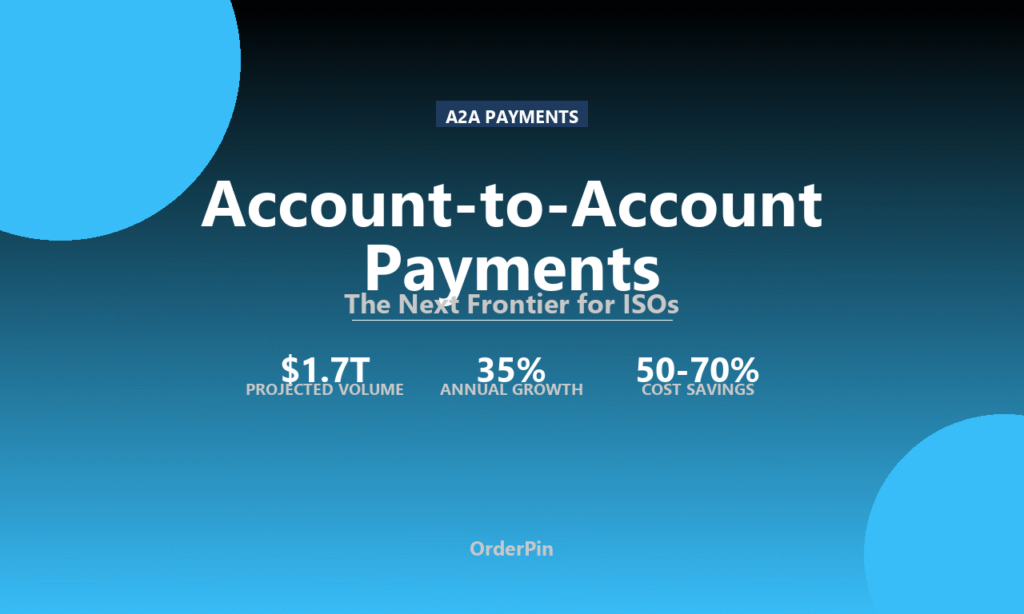
- A2A payments are projected to reach $1.7 trillion globally by 2027, growing at 35% CAGR — making them one of the fastest-growing payment methods worldwide.
- Open banking regulations in the U.S., UK, and EU are driving A2A adoption, with 40% of e-commerce transactions expected to use A2A by 2028.
- ISOs who offer A2A payment options can reduce merchant processing costs by 50-70% on bank transfer transactions vs. credit card interchange.
What Are A2A Payments and Why Do They Matter?
Account-to-Account (A2A) payments are digital payments where funds transfer directly from one bank account to another, bypassing traditional card networks entirely. Unlike ACH (which can take 1-3 days), modern A2A payments leverage real-time payment rails like FedNow, RTP (The Clearing House), and open banking APIs to settle in seconds.
A2A payments are not new — bank transfers have existed for decades. What is new is the combination of open banking regulations, real-time settlement, and consumer-friendly user interfaces that make A2A payments as easy as tapping a credit card. Services like Pay by Bank (U.S.), Pay.UK (UK), and SEPA Instant (EU) are driving adoption from 5% of e-commerce transactions in 2023 to a projected 40% by 2028.
For ISOs, the A2A opportunity is about offering merchants a lower-cost alternative to credit cards. Card interchange fees average 1.5-3.5% per transaction. A2A payments typically cost a flat $0.25-1.00 per transaction — regardless of transaction size. For merchants with high average order values (B2B, professional services, wholesale), the savings are transformative.
How A2A Payments Work for Merchants
The A2A payment flow for a merchant POS or e-commerce checkout is:
- Customer selects “Pay by Bank” at checkout — on a POS terminal, online, or through an invoice link.
- Customer authenticates through their banking app using biometrics or a one-time passcode — no card number, CVV, or expiry date needed.
- Payment is initiated via open banking API — the merchant’s POS or payment gateway sends a payment request to the customer’s bank through an open banking platform (e.g., Plaid, Yodlee, Finicity).
- Settlement occurs in seconds — funds move from the customer’s bank account to the merchant’s account via FedNow (U.S.), RTP, or SEPA Instant, with instant confirmation sent back to the POS.
Real-World A2A Use Cases
- B2B Invoicing: A $50,000 B2B invoice costs $750-1,750 in card fees. With A2A, it costs $0.50-1.00. Instant settlement means no 30-60 day wait for payment.
- High-Ticket Retail: Furniture, electronics, and luxury goods stores save $150-500 per $10,000 transaction by offering A2A as an alternative to cards.
- Subscription Services: A2A eliminates card-on-file expiry issues. No more declined recurring payments because a customer’s card expired.
- Professional Services: Lawyers, accountants, and consultants can accept $5,000-20,000 payments for $0.50 instead of $75-300 in card fees.
The Cost Comparison: A2A vs. Cards vs. ACH
| Metric | Credit Card | Traditional ACH | A2A (FedNow/RTP) |
|---|---|---|---|
| Fee Structure | 1.5-3.5% + $0.10-0.30 | $0.25-1.50 flat | $0.25-1.00 flat |
| Settlement Time | 1-2 business days | 1-3 business days | Seconds |
| Cost for $100 Transaction | $1.60-3.80 | $0.25-1.50 | $0.25-1.00 |
| Cost for $1,000 Transaction | $15.10-35.30 | $0.25-1.50 | $0.25-1.00 |
| Chargeback Protection | Buyer can dispute up to 120 days | Limited (60 days for unauthorized) | Limited (customer must get bank authorization) |
| Consumer Adoption | 80%+ of online shoppers | Low (requires routing/account numbers) | Growing (projected 40% by 2028) |
How ISOs Can Offer A2A Payments Today
Adding A2A payments to your ISO offering requires integrating with an open banking platform or payment gateway that supports A2A. Here is the practical approach:
1. Partner with an A2A-Ready Payment Gateway
Leading payment gateways (Stripe, Adyen, Checkout.com) now offer A2A payment options through open banking integrations. For U.S. merchants, look for gateways supporting FedNow and RTP. OrderPin’s white-label platform includes A2A payment options that route through FedNow and RTP rails.
2. Target the Right Merchant Segments
A2A payments are not for every merchant. The best targets are: B2B companies (invoice payments), high-ticket retail ($500+ average order), professional services (law, accounting, consulting), and subscription businesses. These merchants save the most on card fees and benefit most from instant settlement.
3. Offer A2A as an Alternative, Not a Replacement
Most merchants will still want to accept credit cards for customer convenience. Position A2A as a cost-saving option for: invoice payments, large purchases, recurring subscriptions, and repeat customers. Merchants save on interchange, and consumers get faster settlement and no card information sharing.
4. Educate Merchants on the ROI
Use a simple calculator: for a merchant processing $1M/year in card transactions at 2.5% average interchange, annual card fees = $25,000. If 30% of their volume moves to A2A ($300K), they save 2.5% × $300K = $7,500 minus $300 in A2A fees = $7,200/year net savings.
How OrderPin Helps ISOs Offer A2A Payments
Built-In A2A Payments
OrderPin’s white-label POS includes A2A payment options via FedNow and RTP. Merchants can accept Pay by Bank at checkout with no additional integration.
Instant Settlement
A2A payments settle in seconds, not days. Your merchants get same-day access to funds. No more waiting 1-3 business days for ACH or 24-48 hours for card settlement.
50-70% Lower Processing Costs
Offer your merchants a payment option that costs them 50-70% less than credit cards. Higher merchant satisfaction, lower churn, and a unique competitive differentiator.
The Future of A2A Payments for ISOs
A2A payments are still in their early adoption phase, but the trajectory is clear. By 2028, industry analysts project A2A will account for 40% of e-commerce transactions globally. The drivers are powerful:
- FedNow adoption: 12,000+ financial institutions enrolled by 2026, with volume growing 400% in 2025.
- Open banking expansion: The CFPB’s Section 1033 open banking rule (effective 2025-2026) requires banks to share consumer financial data with authorized third parties, making A2A payments easier to initiate.
- Mobile-first consumer behavior: Younger consumers (Gen Z, young millennials) prefer banking app authentication over entering card details online.
For ISOs, the message is clear: A2A payments are not a fringe option — they are becoming a mainstream expectation. Merchants who serve B2B customers, high-ticket consumers, or subscription businesses will increasingly ask for Pay by Bank options. ISOs who offer A2A today will have a competitive advantage that grows over time.
Frequently Asked Questions
Is A2A the same as ACH?
Not exactly. ACH is a type of A2A payment, but modern A2A payments use real-time rails (FedNow, RTP) instead of the batch-processed ACH network. The key differences are settlement speed (seconds vs. 1-3 days), payment confirmation (instant vs. next-day), and user experience (mobile app authentication vs. sharing routing/account numbers).
Do merchants need special equipment to accept A2A payments?
For in-person payments, yes — merchants need a POS system that supports A2A QR code or NFC-based authentication. For e-commerce, no special equipment needed — just a checkout page with a “Pay by Bank” option. OrderPin’s white-label POS includes built-in A2A support for both in-person and online channels.
What is the chargeback risk with A2A payments?
A2A payments have significantly lower chargeback risk than credit cards. Because the consumer must authenticate through their banking app (using biometrics or OTP), they cannot later claim the transaction was unauthorized. Limited dispute rights apply only to technical failures or bank errors. Merchants using A2A typically see 80-90% fewer chargebacks compared to card transactions.
What is the ISO margin on A2A payments?
ISO margins on A2A payments are lower on a percentage basis (typically 0.1-0.3% markup vs. 0.3-0.5% for cards) but comparable or higher in dollar terms because A2A flat fee pricing leaves room for per-transaction margins. For high-value transactions, ISOs can negotiate per-transaction fees that generate $0.50-2.00 per $1,000 in volume — similar to card residuals.
Will A2A replace credit cards?
No. A2A payments complement cards rather than replacing them. Credit cards offer rewards, credit features, and buyer protection that A2A does not. The likely future is an “and” scenario — merchants offer both options, and consumers choose based on the transaction type, size, and their preference for rewards vs. lower merchant costs (which may translate to consumer discounts).
Conclusion
A2A payments represent one of the most significant payment infrastructure shifts in a generation. For the first time, merchants have a viable alternative to card interchange that costs 50-70% less, settles in seconds, and eliminates chargeback risk.
For ISOs, offering A2A payments is not just a value-add — it is a competitive necessity. As open banking expands and consumer awareness grows, merchants will increasingly demand Pay by Bank options. ISOs who add A2A to their payment portfolio today will capture the first wave of adoption, building merchant loyalty and differentiating from commodity processors.
The technology is ready, the infrastructure is in place (FedNow, RTP, open banking APIs), and consumer adoption is accelerating. The question is not whether A2A payments will matter — it is whether you will be the ISO who helps your merchants capture the savings.
OrderPin makes it easy to add A2A payments to your ISO offering. Built-in FedNow/RTP support, instant settlement, and seamless integration with your existing white-label POS platform. Your merchants save money. You earn residuals. Everyone wins.
About OrderPin
OrderPin is a white-label POS and payment platform for ISO and MSP partners. Our platform includes A2A payment options via FedNow and RTP, giving your merchants instant settlement and 50-70% lower processing costs on eligible transactions.
Learn more about OrderPin’s A2A payment solutions