ISO Guide

An Independent Sales Organization (ISO) is a third-party company authorized by acquiring banks and payment processors to market, sell, and manage merchant services, such as credit card processing and point-of-sale (POS) systems. They act as intermediaries, enabling businesses to accept payments and offering tailored support, often for higher-volume merchants.

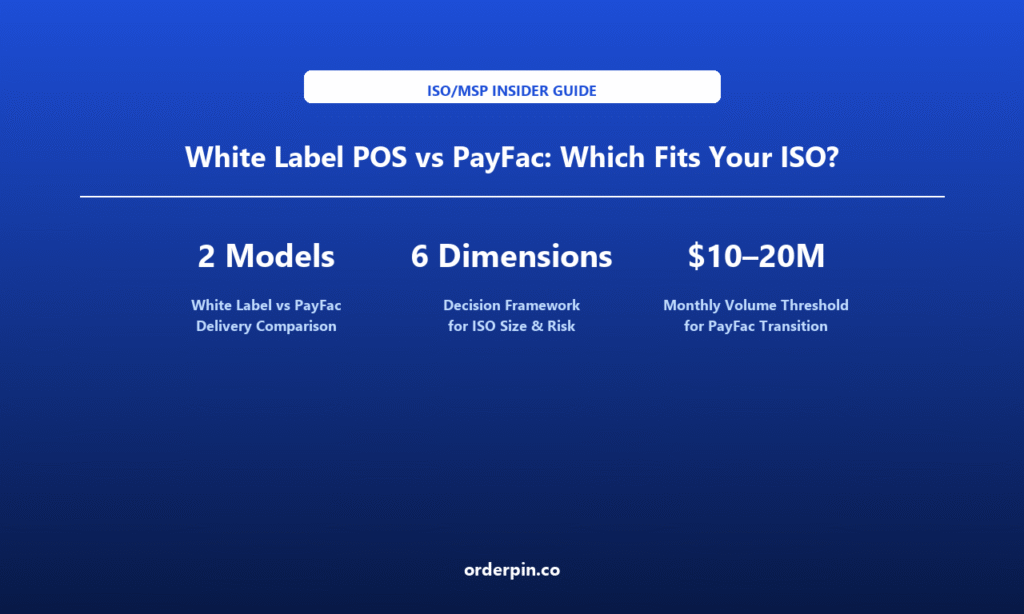
MLS vs ISO vs PayFac: Which Model Fits Your Business in 2026?

TL;DR — Quick Summary Key Takeaway 1: PayFac models now account for 40%+ of new merchant acquisitions, but ISOs who add white-label technology earn 2–3x more per merchant than traditional MLS agents. Key Takeaway 2: ISO residuals average $30–$80/merchant/month, while PayFac platform fees can reach $50–$150/merchant/month — but PayFac requires significantly more capital and compliance …

MLS vs ISO vs PayFac: Which Model Fits Your Business in 2026? Read More »

Smart Terminal Wars: PAX, Verifone, and Dejavoo Compared for ISOs

TL;DR — Quick Summary Key Takeaway 1: The smart POS terminal market exceeds $120 billion, and ISOs who choose the right terminal partner gain a 20–30% advantage in merchant acquisition and retention. Key Takeaway 2: PAX leads global shipments, Verifone offers the deepest enterprise integration, and Dejavoo provides the best ISO channel margins — each …

Smart Terminal Wars: PAX, Verifone, and Dejavoo Compared for ISOs Read More »

Why Operational Simplicity Is the New Competitive Advantage

TL;DR The restaurants winning today aren’t the ones with the most features — they’re the ones that run with the least friction. Operational simplicity compresses staff training from days to hours, automates the repetitive work that burns managers out, and gets new locations profitable faster. For ISO/MSP resellers, selling simplicity over complexity is the pitch …

Why Operational Simplicity Is the New Competitive Advantage Read More »

AI-Powered Fraud Detection: What Works and What’s Hype in 2026

TL;DR — Quick Summary AI fraud detection reduces false positives by 60% and saves $0.20 per transaction, but only 35% of POS systems currently use real-time AI-based fraud prevention. ISOs who add AI fraud tools to their POS offering can reduce merchant chargebacks by 40-70%, improving retention and reducing ISO liability. The key differentiator: choose …

AI-Powered Fraud Detection: What Works and What’s Hype in 2026 Read More »

Contactless Payment Adoption in 2026: Stats Every ISO Should Know

TL;DR — Quick Summary Contactless payments now account for 62% of all in-person card transactions in the U.S., up from 38% in 2022 — driven by consumer habit and Tap to Pay on iPhone/Android. Merchants without NFC-enabled terminals risk losing 15–22% of younger customers who choose a competitor over swiping or inserting a card. ISOs …

Contactless Payment Adoption in 2026: Stats Every ISO Should Know Read More »

How Consumer Expectations Are Reshaping Merchant Operations

TL;DR — Quick Summary What’s changed: 71% of customers now expect same-day service; 65% prefer restaurants with native online ordering; loyalty members generate 3x more repeat purchases. The ISO opportunity: Merchants running legacy POS systems are leaving thousands of dollars per year on the table — ISOs who supply integrated modern platforms capture that gap. …

How Consumer Expectations Are Reshaping Merchant Operations Read More »

Why Merchant Technology Decisions Are Becoming Boardroom Discussions

TL;DR Merchant technology purchasing used to happen in the back office. Not anymore. 67% of merchants with 10+ locations now involve C-suite executives in POS decisions, and franchise groups are committing $50K–$200K annually to technology infrastructure. ISOs who can speak to CFOs and boards — not just operations managers — are capturing enterprise accounts while …

Why Merchant Technology Decisions Are Becoming Boardroom Discussions Read More »

How ISOs Can Build a Recurring Revenue Business Model

TL;DR ISOs built on transaction fees alone carry a hidden vulnerability: their income rises and falls with merchant volume, and merchants leave when a competitor drops a rate quote. Recurring revenue flips that dynamic — predictable monthly income, higher merchant retention, and a business that investors value 3x higher than a pure processing book. Here’s …

How ISOs Can Build a Recurring Revenue Business Model Read More »

What Payment Methods Should My Small Business Accept in 2026?

TL;DR — Quick Summary In 2026, merchants should accept at least 5 payment types: credit cards, debit cards, contactless wallets (Apple Pay/Google Pay), BNPL solutions, and ACH/bank transfers. Card payments still dominate at 62% of in-store transactions, but digital wallets grew 40% year-over-year and now represent 28% of POS volume. ISOs who help merchants choose …

What Payment Methods Should My Small Business Accept in 2026? Read More »

Scroll to Top