
TL;DR — Quick Summary
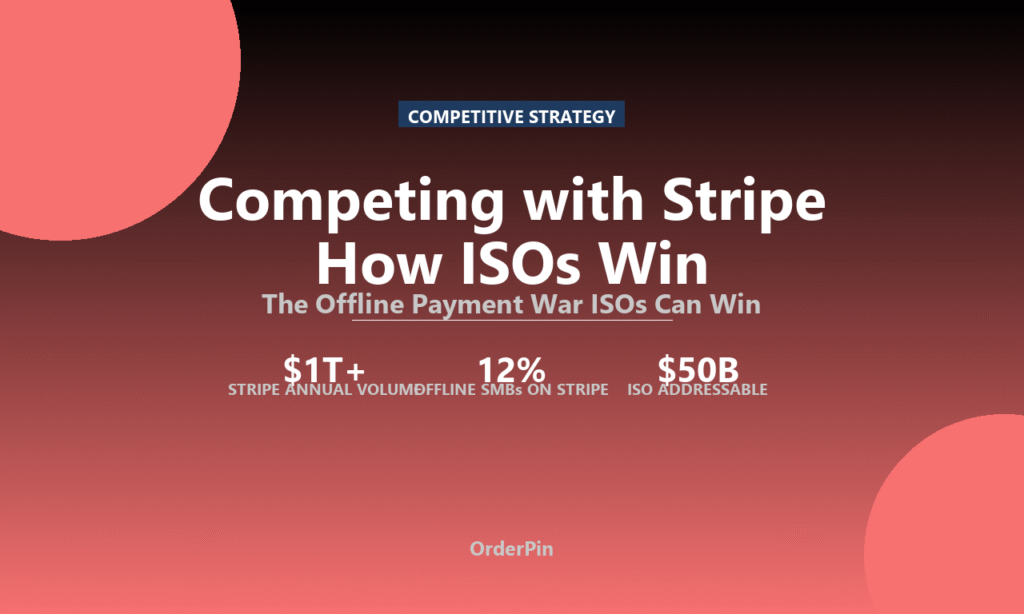
- Stripe processes over $1 trillion annually and dominates online payments — but only 12% of offline SMBs use Stripe, leaving 88% of small businesses still served by traditional ISOs and payment providers.
- ISOs win by focusing on industries Stripe struggles with: high-risk merchants, complex billing models, B2B invoicing, and businesses that need hands-on support rather than self-serve platforms.
- The real opportunity is hybrid: offering both online payment capabilities and in-person POS solutions that Stripe cannot match in complexity and compliance support.
The Stripe Threat Is Real — But the Narrative Is Overblown
Stripe is the most celebrated payment company in the world. With $1 trillion+ in annual payment volume, a $95 billion valuation, and a product that developers love, Stripe has fundamentally changed the online payments landscape. It is natural for ISOs to wonder: is there room for anyone else?
The short answer is yes — and not just in the margins. While Stripe dominates online payments among tech-forward companies, the broader small business market tells a very different story.
According to Census Bureau data and Stripe’s own annual reports, only 12% of offline small businesses (brick-and-mortar, local service businesses, restaurants, retail shops) use Stripe. That means 88% of offline SMBs are still served by traditional payment providers, including ISOs. And in-person commerce still represents the majority of total payment volume in the U.S. economy.
More importantly, Stripe’s strengths — developer-first design, self-serve onboarding, API-driven integration — are also its weaknesses when it comes to serving traditional SMBs. Most local businesses do not have developers. They need hands-on training, compliance support, and someone to call when their terminal goes down at 9pm on a Friday. That is the ISO advantage.
Where ISOs Have Clear Advantages Over Stripe
1. High-Risk and Complex Industries
Stripe has strict policies against serving high-risk merchants: adult content, firearms, gambling, CBD/cannabis, multi-level marketing, and debt collection. ISOs who specialize in high-risk payment processing can serve entire industries that Stripe will not touch. For these merchants, Stripe is not an option — they need an ISO who understands their industry’s compliance requirements.
2. Hands-On Service and Support
Stripe’s model is self-serve. You sign up online, integrate via API, and resolve issues through documentation or email support. Most traditional SMBs — especially those without dedicated tech teams — need more: in-person training, 24/7 phone support, and someone who understands their specific business. ISOs who provide white-glove service are competing in a different market than Stripe.
3. Complex Billing Models
While Stripe excels at simple e-commerce transactions, it struggles with complex billing: subscription management with proration, invoicing with net-30 terms, retainers, progress billing, and multi-party payment splits. ISOs who offer payment platforms designed for complex billing models — law firms, construction, professional services — serve markets Stripe finds difficult.
4. In-Person POS Integration
Stripe has made significant inroads in POS with Stripe Terminal, but it remains a relatively small part of their business. ISOs who offer integrated POS + online payment solutions for omnichannel merchants (a restaurant with online ordering, a retailer with both a store and e-commerce site) can offer deeper integration and simpler management than juggling Stripe + a separate POS provider.
5. B2B Payments
B2B payments are fundamentally different from consumer e-commerce. They involve net-30 to net-90 payment terms, purchase orders, accounts payable/receivable, and ACH/wire transfers. Stripe’s consumer-focused product does not serve B2B billing well. ISOs who build B2B payment solutions — with features like automated invoicing, PO matching, and credit management — operate in a space Stripe has not penetrated.
| Capability | Stripe | Traditional ISO |
|---|---|---|
| Developer-Friendly API | Best in class | Varies by provider |
| Self-Serve Onboarding | Fully automated | Requires application review |
| High-Risk Merchant Support | Very limited | Specialized programs available |
| In-Person POS | Limited (Stripe Terminal) | Full POS ecosystem |
| B2B Invoicing/Net Terms | Limited | Specialized solutions exist |
| 24/7 Human Support | Email/chat only, business hours | Phone support available |
The Hybrid Strategy: Online + In-Person
The most successful ISOs in the Stripe era are not trying to beat Stripe at its own game. They are playing a different game entirely: the omnichannel hybrid.
Consider the typical SMB: a restaurant with a physical location and online ordering, a retailer with a storefront and e-commerce site, a service business with mobile payments and invoicing. These merchants need both online payment processing and in-person POS — and managing Stripe + a separate POS provider creates complexity.
ISOs who offer unified platforms that handle both — with a single merchant account, one statement, one support number — eliminate this friction. And for merchants who also want an online presence (most do), OrderPin’s white-label platform gives ISOs the ability to offer e-commerce payment processing alongside POS, under the same ISO brand.
ISOs Winning Against Stripe by Specializing
- Medical and dental practices: Need HIPAA-compliant billing, insurance integration, and payment plans. Stripe is not built for healthcare.
- Legal and professional services: Require trust account management, client billing, and A2A payments. Complex B2B workflows that Stripe’s consumer-focused product cannot handle.
- High-risk industries: Adult entertainment, firearms, CBD, gambling — entire industries that Stripe explicitly prohibits. ISOs with high-risk programs serve these markets exclusively.
- Regional hospitality: Hotels, restaurants, and entertainment venues with complex split payments, event deposits, and membership billing. Stripe Terminal is insufficient for these use cases.
How OrderPin Helps ISOs Compete with Stripe
Unified Online + POS Platform
OrderPin gives ISOs a white-label platform that handles both online payments and in-person POS — a unified solution Stripe cannot match for complex SMB needs.
High-Risk Merchant Support
OrderPin supports high-risk merchant categories that Stripe prohibits. ISOs can serve entire industries — CBD, firearms, adult, gaming — that Stripe will not touch.
B2B and Complex Billing
OrderPin supports B2B invoicing, net-30/60/90 terms, automated ACH, and split payments — workflows Stripe’s consumer-focused platform struggles to handle.
What ISOs Should NOT Try to Do Against Stripe
Just as important as knowing where ISOs win is knowing where they should not compete:
- Do not try to out-develop Stripe. Stripe has thousands of engineers and has been building payment infrastructure for 15 years. Their API is genuinely best-in-class. Competing on developer experience is a losing game.
- Do not try to beat Stripe on price for standard e-commerce. Stripe’s pricing is competitive and transparent. ISOs who compete purely on price will lose to Stripe’s scale advantages.
- Do not ignore Stripe’s ecosystem. Many merchants use Stripe AND an ISO for different parts of their business. Rather than fighting this, position your ISO offering as complementary: “Stripe handles your online checkout, and we handle everything else.”
Frequently Asked Questions
Should ISOs offer Stripe as a product alongside traditional processing?
This is increasingly common. Some ISOs act as Stripe referral partners, earning referral fees for directing tech-forward merchants to Stripe for online payments while they handle in-person POS. This lets ISOs serve merchants who want Stripe for online without losing the relationship entirely. The risk: once a merchant is on Stripe, they may migrate all their payment volume there. The opportunity: maintain the relationship, cross-sell POS and services, and earn referral income.
How do merchants with both online and offline needs choose between Stripe and ISOs?
Most merchants who have both online and offline needs end up using multiple providers — Stripe for e-commerce, and a traditional ISO for POS. This is not ideal (multiple statements, multiple support relationships) but it reflects the reality that no single provider excels at both. ISOs who offer unified omnichannel platforms — handling online and in-person payments under one merchant account — solve this pain point and can win these merchants from Stripe.
Is Stripe going to put traditional ISOs out of business?
Not in the near term. Stripe is winning in online payments, but offline commerce still represents the majority of total payment volume in the U.S., and 88% of offline SMBs do not use Stripe. ISOs serve a real market: traditional businesses that need hands-on support, complex billing, high-risk industry expertise, and in-person POS solutions. These are not Stripe’s strengths. However, ISOs who fail to modernize — adding online payment capabilities, better technology, and transparent pricing — will increasingly lose relevance. The threat is real for ISOs who do not adapt.
What is the biggest mistake ISOs make when competing with Stripe?
Competing on price instead of value. Stripe has massive scale advantages and can offer competitive rates for standard transactions. ISOs who try to win on price alone will always be fighting an uphill battle. The winning strategy is specialization: focus on merchant segments and use cases that Stripe cannot serve well (high-risk, complex billing, B2B, hands-on support, specialized compliance), and charge premium rates for that expertise.
How does OrderPin help ISOs win merchants who are currently using Stripe?
OrderPin helps ISOs win Stripe merchants in three ways: (1) offering a unified platform that handles both online and offline payments under one account — eliminating the complexity of using multiple providers, (2) providing specialized solutions for merchant types Stripe struggles with (healthcare, B2B, high-risk), and (3) delivering hands-on support and white-glove service that Stripe’s self-serve model cannot match for traditional SMBs.
Conclusion
Stripe is not going away. It is a formidable competitor that has earned its dominance in online payments. But dominance in online payments is not the same as dominance in the entire payments market — and it is certainly not the same as dominance in the offline, service-based, complex-billing, relationship-driven world that most ISOs operate in.
The 88% of offline SMBs not using Stripe represent a $50+ billion market that ISOs understand better than any tech company. These merchants need solutions, support, and expertise that Stripe’s self-serve platform cannot provide. That is the ISO advantage — and it is not going away.
The ISOs who will thrive in the Stripe era are those who specialize: find the niches, industries, and use cases where their expertise is irreplaceable. Build technology that Stripe cannot easily replicate. Provide the hands-on service that a developer-first company will never prioritize.
Stripe is winning the online payment war. But the offline payment war — which is actually the bigger war — is still being fought. And ISOs have the home-field advantage.
OrderPin helps ISOs compete by providing the technology platform they need: unified online + POS capabilities, high-risk merchant support, B2B billing features, and white-label deployment under the ISO brand. Play to your strengths. Let Stripe have the API-first tech companies. Win everyone else.
About OrderPin
OrderPin is a white-label POS and payment platform for ISO and MSP partners. Our omnichannel platform — covering both online and in-person payments — helps ISOs compete with Stripe by offering unified solutions under their own brand.
Learn more about OrderPin’s ISO partner program