
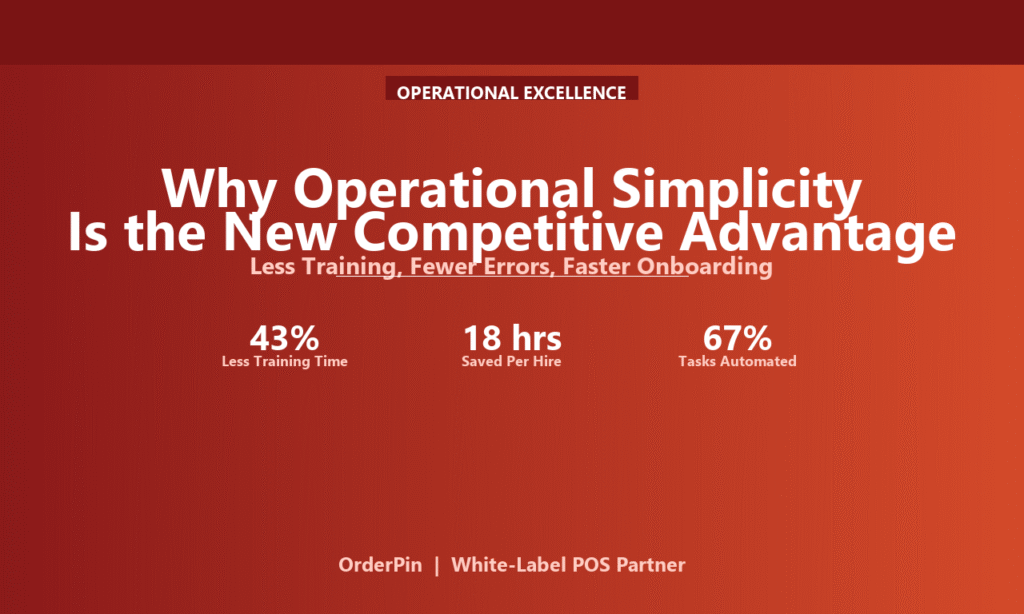
The restaurants winning today aren’t the ones with the most features — they’re the ones that run with the least friction. Operational simplicity compresses staff training from days to hours, automates the repetitive work that burns managers out, and gets new locations profitable faster. For ISO/MSP resellers, selling simplicity over complexity is the pitch owners actually feel in their week.
1. The New Battleground: Simplicity Over Features
For the last decade, restaurant technology has been sold on a feature arms race. More reports. More integrations. More buttons on the screen. But somewhere along the way, the industry confused capability with usability. A system that can do everything is worthless if your line cook can’t figure out how to fire an order during the Saturday night rush.
Operational simplicity is the quiet counter-movement to that arms race. It’s the idea that the best restaurant system is the one your least-trained employee can use without thinking. When the interface is obvious, the workflow is streamlined, and the repetitive work happens automatically, the whole operation moves faster with fewer errors. The competitive advantage isn’t a fancy dashboard — it’s the fact that your team isn’t fighting the software.
Think about what actually separates a thriving restaurant from a struggling one. It’s rarely the recipe. It’s whether the floor runs smoothly when the owner isn’t there. Simplicity is what makes that possible. A streamlined POS, clear workflows, and automated back-office tasks mean the business runs the same way at 7 p.m. on a Saturday as it does at 2 p.m. on a Tuesday. That consistency is the real moat — and it’s built from removing friction, not adding features.
For ISO/MSP resellers, this reframes the entire sales conversation. Instead of listing spec sheets, the winning pitch is now: how many hours will this save your manager this week? That’s a question owners feel in their bones — and simplicity is the only honest answer.
2. Cutting Staff Training From Days to Hours
Restaurant turnover is a fact of life. Servers, hosts, and line staff cycle through constantly, and every departure costs real money to replace. The National Restaurant Association pegs the cost of replacing a single front-line employee between $1,500 and $5,000 once you add recruiting, lost productivity, and ramp-up time. The faster a new hire becomes productive, the less that churn hurts. This is where training simplicity pays for itself.
A complicated POS means a multi-day training arc: menu maps, modifier logic, discount rules, void procedures, end-of-day closing. A simplified one collapses that into a single shift. When the order screen mirrors the physical menu, when common actions are one tap instead of five, and when the system guides the employee through exceptions instead of expecting them to memorize them, a new server is taking real tables by lunch on day one. Operators routinely report training time dropping by roughly 43% after switching to a streamlined workflow.
The second-order benefit is just as valuable: simpler training means you can train with shorter, more frequent sessions instead of pulling a new hire off the floor for a full-day seminar. That keeps labor costs down during ramp-up and gets people confident faster. It also means your best trainer — usually the manager — isn’t chained to a back office walkthrough every time someone new walks in.
For resellers, training reduction is the most demo-able benefit in the room. Hand the owner’s phone to a brand-new employee and watch them ring up a real order in ninety seconds. No feature list survives contact with that kind of proof.
3. Letting Automation Handle the Repetitive Work
Most restaurant busywork is repetitive by definition. The same modifiers fire every day. The same reports get run every morning. The same inventory counts happen on the same schedule. None of it requires human judgment — it just requires human attention, which is the most expensive and error-prone resource in the building. Process automation is the act of moving that attention off people and onto the system.
A simplified, automated POS handles the boring parts invisibly. Auto-applied discounts for loyalty members. Automatic tip pooling calculations at close. Scheduled daily sales and labor summaries emailed to the owner before they wake up. Ingredient-level inventory that decrements with every sale, so pars and reorder points trigger themselves. Each of these used to be a manual task a manager performed — and performed inconsistently, depending on how slammed the shift was.
The compounding effect is what matters. When the repetitive work is automated, it doesn’t just disappear — it stops generating errors. A manually typed discount can be fat-fingered. An automated one can’t. A manually counted inventory can be skipped on a busy night. An automated one never is. Operators who automate the routine see roughly two-thirds of their manual, repetitive tasks vanish — and the errors that rode along with them vanish too.
The strategic point for resellers: don’t sell automation as a tech upgrade. Sell it as the removal of the tasks the owner secretly dreads. Every automated workflow is an hour of their week handed back — and owners remember who gave them that hour.
4. Getting New Locations and New Hires Up to Speed Faster
Onboarding speed is the multiplier that decides whether growth helps or hurts. A second location should be easier than the first, because you’ve already learned the playbook. But for most operators, location two is harder — because every system has to be rebuilt from scratch, every staff member retrained, every workflow re-learned. Simplicity is what makes the second location feel like the first, only faster.
When the operational backbone is simple, it travels. A streamlined POS configuration can be cloned from location one to location two in an afternoon. The training material that worked for your original crew works for the new one. The automated reports that kept you informed at the first site keep you informed at the second without any extra effort. Operators who standardize on simplicity report around 18 hours of onboarding time saved per new hire — and that compounds across every role, at every new opening.
Speed to productivity is the quiet killer of expansion plans. A new location that takes six weeks to reach stable operations is six weeks of negative cash flow the owner has to subsidize. One that reaches stable operations in three weeks is a location that starts paying back sooner. For multi-unit groups, that gap across ten openings is the difference between a growth strategy that funds itself and one that drains the flagship.
Resellers targeting growing operators should lead with this: simplicity scales. The system you install at location one is the template for location ten. That’s not a feature — it’s a growth engine.
5. Freeing Managers to Actually Manage
The single most underused asset in any restaurant is the manager’s attention. A good shift lead should be on the floor — reading tables, coaching servers, solving small problems before they become reviews. Instead, they’re in the back office wrestling with a clunky close-out, rebuilding a schedule in a spreadsheet, or re-keying yesterday’s numbers because the system wouldn’t export them. That’s not management. That’s data entry wearing a manager’s shirt.
Operational simplicity lowers the management burden by pushing the administrative load onto the system. When close-out is a two-tap confirmation instead of a twenty-minute reconciliation, the manager is back on the floor. When schedules build from sales forecasts automatically, they’re coaching instead of guessing. When exceptions surface as alerts rather than hiding in a report nobody reads, problems get fixed in real time instead of at month-end.
The payoff shows up in two places. First, in labor — the same coverage gets delivered with less management overtime. Second, and more importantly, in the guest experience. A manager who is present is a manager who catches the unhappy table, who redirects the overwhelmed server, who keeps the energy on the floor. That presence is the difference between a restaurant that feels alive and one that feels like it’s barely holding on.
For resellers, the management-burden story lands hardest with owners who are still doing every close themselves. Show them a demo where the entire end-of-day takes ninety seconds, and you’ve just sold them their first night off in years. That’s a benefit no feature list can match.
6. Consistency That Customers Can Taste
Every regular has a reason they keep coming back, and almost none of those reasons are about novelty. They come back because the burger tastes the same, the order is right, and the experience is predictable. Consistency is the product. Operational simplicity is what protects it — because consistency is the natural output of a system with fewer moving parts and fewer chances to deviate.
A simplified workflow enforces consistency without nagging. When modifiers are standardized in the POS, every server rings the same allergy note the same way. When portion steps are built into the ticket, the kitchen can’t quietly drift on plate size. When reporting is automatic, the owner catches a creeping food-cost trend before it becomes a permanently changed (and worse) menu. The system becomes the keeper of standards, so the standards survive even on the worst staffed night of the month.
This is the part owners feel most directly in their repeat-business numbers. Customers don’t reward the restaurant with the most features. They reward the one they can count on. And count-on-able is just another word for simple — a business designed so that doing it right is the path of least resistance, not the path that requires heroics from the crew.
For resellers, consistency closes the loop on the whole argument. Simplicity cuts training, automates the routine, speeds onboarding, and frees managers — and all of it converges on the only metric that matures a business: guests who come back without a reason. Sell the comeback, and you’ve sold everything underneath it.
Frequently Asked Questions
Q1: What does “operational simplicity” actually mean for a restaurant?
It means the system and workflows are designed so that the least-trained employee can do the job correctly without heavy supervision. It’s not about having fewer capabilities — it’s about hiding complexity so the daily work flows with minimal friction, errors, and training overhead.
Q2: How much training time can POS automation really save?
Operators who move from a complex legacy POS to a streamlined, guided workflow commonly report training time falling by roughly 40–45%. Instead of a multi-day seminar, a new hire is taking real orders within a single shift because the interface mirrors the menu and common actions are one tap.
Q3: How does operational simplicity speed up onboarding for new locations?
A simple operational backbone can be cloned from an existing site — POS config, training material, and automated reports travel with you. That cuts per-hire onboarding by around 18 hours and shortens the time a new location takes to reach stable, profitable operations.
Q4: Doesn’t “simpler” mean “less capable”?
Not when it’s done right. Simplicity is about presentation and workflow, not raw power. The automation still runs in the background — the owner just isn’t forced to operate it manually. You keep the reporting and controls while removing the daily friction of using them.
Q5: Why should an ISO/MSP reseller lead with simplicity instead of features?
Because simplicity is the benefit the owner feels every week — fewer training hours, less manager overtime, faster openings. Feature lists sound impressive in a demo and vanish by Friday. A simplicity pitch answers the owner’s real question: how much easier will my life be? That’s what closes deals and earns renewals.
Operational simplicity isn’t a softer way to run a restaurant — it’s the harder-edged competitive advantage. It compresses training, automates the routine, accelerates onboarding, frees managers to lead, and bakes consistency into every shift. In a margins-thin industry, the operator who removes friction outperforms the one who collects features. For resellers, that’s the story worth telling.
OrderPin is a restaurant POS software ISV focused on helping merchants streamline operations.