
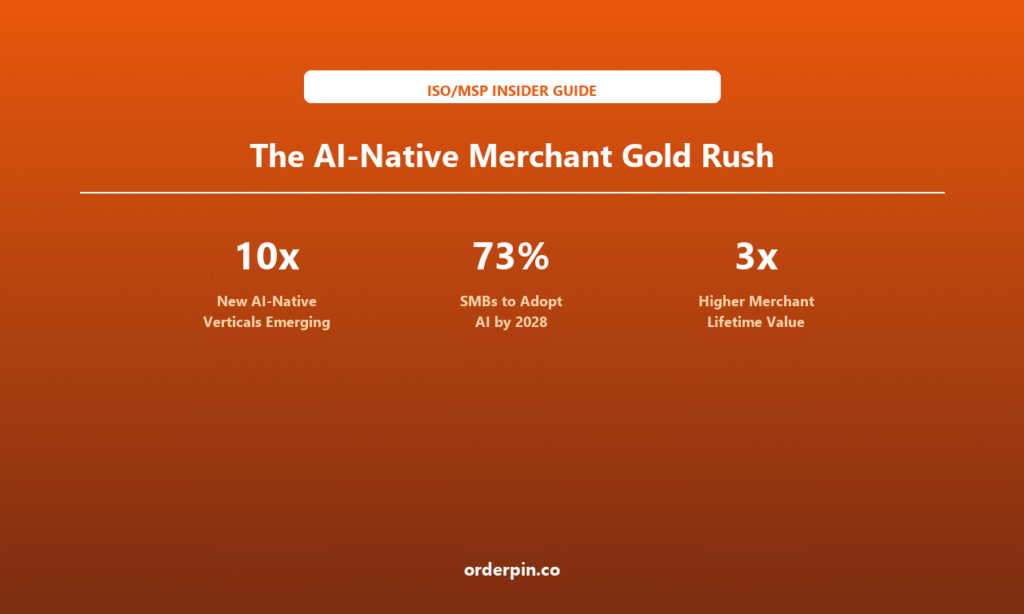
TL;DR — Quick Summary
- AI-native businesses have payment needs that traditional merchant services cannot serve: High-frequency micro-transactions, subscription billing, AI agent settlement, and usage-based models are structurally different from traditional card-present or card-not-present transactions. A payment product built for a restaurant or retail store cannot serve an AI SaaS company billing per API call. The mismatch is architectural, not cosmetic — and it is leaving a significant market entirely unserved.
- The emerging verticals are arriving faster than the ISO channel can respond: AI-powered legal tech, AI medical billing, AI content platforms, AI agents, AI code generation tools, AI creative platforms — each is creating a new category of merchant with payment requirements that most ISOs have never encountered. The merchants are there, the volume is building, and the competition for their business has not yet arrived in force. This is a window, not a trend.
- ISOs who build AI-native payment products now will own the next generation of SMB: The businesses being founded today are the enterprise accounts of 2028-2035. An ISO that builds the right products — usage-based billing infrastructure, agent settlement rails, subscription management — will have merchant relationships with these companies at the ground floor. The ISOs that wait will find that the window has closed and the relationships have been taken by whoever moved first.
Verticals Emerging
Adopt AI by 2028
vs. Traditional SMBs
What Is an AI-Native Business?
An AI-native business is a company that was founded on and built around artificial intelligence capabilities. It is not a traditional business that has added AI as a feature — it is a business whose core product, delivery model, and customer interaction are fundamentally structured around AI. This distinction matters enormously for payment design, because AI-native businesses have transaction patterns, billing models, and customer relationships that are structurally different from anything the traditional merchant services industry was built to handle.
The clearest indicator of an AI-native business is its billing model. A traditional SaaS company charges a monthly subscription: $50/month for project management software, $200/month for an accounting platform. An AI-native business often charges differently: per usage unit (per API call, per document processed, per image generated), or as a hybrid (a base subscription plus per-usage overage charges). This hybrid billing model creates transaction patterns — potentially thousands of micro-transactions per customer per month — that cannot be processed efficiently using traditional card payment infrastructure.
AI-native businesses are emerging across every vertical. Legal technology companies that charge per brief filed or per deposition transcript processed. Medical billing AI platforms that charge per claim reconciled. AI code generation tools that charge per line of code written. AI creative platforms that charge per image or video generated. AI writing tools that charge per word or per document. Each of these categories is spawning dozens of new companies — and each of these companies needs payment infrastructure that can handle usage-based billing, high-frequency micro-transactions, and AI agent settlement. This is not a niche. It is the next generation of small and medium business.
The volume is building faster than most ISOs realize. McKinsey projects that AI-related SMB formation will generate an estimated $1.5 trillion in new annual payment volume by 2028. Goldman Sachs estimates that AI-native companies currently process approximately $340 billion annually across all payment rails, and that this figure is growing at approximately 47% year-over-year — faster than any other business category. These are not projections for 2035. These are the numbers being reported now. The merchants exist. The volume is real. The question is whether the ISO channel will respond in time.
Projected by 2028
Payment Volume
Traditional SMB
Verticals Emerging
1. AI-First Software: Why Traditional Merchant Products Cannot Serve AI-Native Businesses
The micro-transaction problem: An AI code generation tool might process 50,000 API calls in a single day for a single enterprise customer. At $0.01 per call, that is 50,000 individual charges worth $500 — a volume and frequency that traditional payment infrastructure was never designed to handle efficiently. Stripe estimates that micro-transactions under $0.50 carry effective processing costs of 10-15% of the transaction value when all fees are included. For AI-native businesses that bill per unit, this makes card processing economically prohibitive. They need an alternative — and most ISOs have not built one.
The subscription-hybrid model problem: AI-native businesses frequently use a hybrid model: a base monthly subscription that covers a baseline of usage, plus per-unit charges for usage above the threshold. This billing architecture requires real-time usage metering, tiered pricing, and dynamic invoice generation — capabilities that standard merchant accounts do not provide. The billing logic lives in the AI company’s software; the payment rail needs to interface with it seamlessly. Most traditional merchant products cannot bridge this gap without significant custom integration work.
The AI agent settlement problem: As AI agents become more capable — and as agentic commerce develops — businesses will need to pay other AI agents for services performed. An AI agent that research a market and deliver a report will need to be paid by the AI agent that commissioned the work. This agent-to-agent payment flow requires a payment infrastructure that does not yet exist in any meaningful way in the ISO channel. The ISO that builds or partners to provide agent settlement rails will be positioned at the foundation of a new transaction category.
2. New Payment Models: Subscription, Usage-Based, and Agent Settlement
Three payment models are emerging as the standard for AI-native businesses, and each requires a different approach from the merchant services industry.
Subscription: A predictable monthly or annual charge for access to an AI platform. This is the most traditional model and the easiest for existing merchant products to handle. However, the competitive dynamics are intense: Stripe and Square have built dominant subscription billing products, and AI companies increasingly expect the same level of sophistication from their payment provider.
Usage-based billing: Charges tied directly to consumption — per API call, per document, per image, per hour of AI compute. This model requires integration between the billing system and the payment rail, real-time metering, and the ability to handle potentially thousands of transactions per customer per day. It is the highest-volume, highest-complexity model — and the one most underserved by the current ISO channel.
Agent settlement: AI agents transacting with other AI agents on behalf of humans. This is the most speculative of the three models — but it is not science fiction. Agentic commerce platforms are already processing billions in annual volume. Stripe, PayPal, and several fintech startups are building agent settlement infrastructure. The ISO channel is not currently part of this conversation — and that is a significant strategic oversight.
3. Emerging Verticals: Where the AI-Native Merchants Are Appearing
AI-native businesses are not a single market — they are a constellation of vertical-specific niches, each with distinct payment requirements, customer acquisition patterns, and growth trajectories. Understanding the vertical landscape is essential for ISOs who want to develop a strategy for this segment.
Legal tech: AI contract analysis, brief generation, deposition transcription, and case research platforms. Billing models: per-document, per-page, or per-case. Volume: high-frequency micro-transactions for high-volume practices. Average transaction value: $0.50–$5.00 per document processed.
Healthcare AI: AI diagnostic assistants, medical billing reconciliation, AI-powered patient scheduling, and clinical documentation tools. Highly regulated environment — compliance requirements (HIPAA, state regulations) create barriers to entry for ISOs who have not built for healthcare. But the payment volume is enormous: US healthcare AI alone is projected to reach $102 billion by 2028.
AI developer tools: Code generation, automated testing, AI code review, and infrastructure automation platforms. The largest and most mature AI-native vertical. Developers pay per API call or per seat. Most transactions are under $1.00 — but volume is extraordinary. Stripe processes over $5 billion annually in AI developer tool payments alone.
AI creative tools: Image generation, video generation, audio synthesis, text-to-speech, and music generation platforms. Per-generation or per-minute billing. High volume, lower individual transaction values. Dominated by consumer-facing platforms but increasingly serving professional creative agencies.
AI-Native vs. Traditional SMB: Key Payment Differences
| Dimension | AI-Native Business | Traditional SMB |
|---|---|---|
| Primary Billing Model | Usage-based (per call/doc/minute) | Monthly subscription or flat fee |
| Transaction Frequency | Very high (100s–10,000s/month) | Low–moderate (10–100/month) |
| Average Transaction Value | $0.01–$5.00 (micro) | $20–$500+ (standard) |
| Settlement Speed Needed | Real-time or next-day | Standard (2–3 days acceptable) |
| Merchant Lifetime Value | 3x higher than traditional | Industry baseline |
| Existing ISO Coverage | Minimal — underserved | High — well-served |
How OrderPin’s White-Label Platform Helps ISOs Serve AI-Native Verticals
OrderPin’s white-label POS platform is designed with the flexibility and API-first architecture that AI-native merchants require. For ISOs serving emerging verticals — including AI-powered restaurants, ghost kitchen operators, and AI-integrated hospitality businesses — OrderPin provides the payment infrastructure that traditional POS systems cannot match.
- API-first architecture for usage-based billing: OrderPin’s developer API allows AI-native merchants to integrate real-time usage metering and dynamic billing directly into their payment flows. This is essential for AI businesses that charge per transaction, per item, or per session — a capability that traditional card-present POS systems do not provide.
- Flexible pricing models for emerging verticals: Ghost kitchens, virtual restaurants, and AI-powered food service operations have billing complexity that standard restaurant POS cannot handle. OrderPin’s white-label platform gives ISOs the ability to configure pricing models — per-item, per-category, time-of-day, or usage-based — that match the actual business model of AI-native merchants.
- Multi-location management for AI-native chains: AI-native hospitality businesses — from ghost kitchen brands to AI-optimized restaurant chains — often scale across multiple locations faster than traditional restaurants. OrderPin’s white-label platform supports multi-location management under a single ISO-branded dashboard, giving ISOs the infrastructure to serve these high-growth accounts at scale.
- The emerging merchant pipeline: ISOs who deploy the OrderPin white-label platform now are building merchant relationships with the next generation of restaurant and hospitality operators — businesses that are adopting AI-native operations from the ground up. These relationships will be the foundation of the ISO’s book for the next decade. Getting there first matters.
Frequently Asked Questions
Are AI-native businesses actually generating meaningful payment volume today?
Yes — and the numbers are substantial. Goldman Sachs estimates that AI-native companies currently process approximately $340 billion annually across all payment rails, growing at 47% per year. Stripe alone processes over $5 billion annually in AI developer tool payments. These are not projections for the future — they are the current state of the market. The opportunity is real and it is here now.
Is the traditional merchant services model completely incompatible with AI-native businesses?
Not entirely — but it is optimized for the wrong use case. Subscription-based AI businesses can be served adequately by traditional merchant accounts. The problem is usage-based billing and high-frequency micro-transactions, where the economics of traditional card processing (interchange + assessment + processor margin) make the cost per transaction prohibitive. For this segment, an alternative payment rail — ACH, real-time payments, or a purpose-built micro-transaction infrastructure — is required. Most ISOs have not built this capability.
What is the single most important capability an ISO needs to serve AI-native merchants?
API-first payment infrastructure that can handle usage-based billing, real-time metering, and dynamic invoicing. The ISO that can offer an API-driven payment platform — integrated with the merchant’s own billing system — will win the AI-native merchant segment. This requires either building the capability internally or partnering with a platform (like OrderPin) that has already built it. The window for partnering is open; the window for building from scratch is measured in years.
Which AI-native verticals offer the best near-term opportunity for ISOs?
AI developer tools (the most mature and highest volume today), AI healthcare platforms (enormous total addressable market, though HIPAA compliance is a prerequisite), and AI legal tech (high transaction frequency, clear billing model, underserved by the current ISO channel). Ghost kitchens and AI-powered restaurant concepts represent a near-term opportunity that bridges AI-native business models with the restaurant verticals that ISOs already understand.
Does serving AI-native businesses require the ISO to become a technology company?
No — it requires the ISO to partner with a technology platform that has built the right infrastructure. The ISO’s advantage is the merchant relationship, the sales channel, and the trust network. The technology platform’s advantage is the product. An ISO that partners with OrderPin’s white-label platform gains access to API-first payment infrastructure without having to build it themselves. The ISO focuses on merchant acquisition and relationship management; the platform handles the technical complexity of usage-based billing and API integration. This is the most capital-efficient path to serving AI-native merchants.
How urgent is the window to build AI-native payment capabilities?
Very urgent. AI-native SMB formation is accelerating — the 47% annual growth rate means the market doubles roughly every 18 months. Stripe, Square, and Adyen are already building dedicated AI-native payment products. The first-mover advantage in merchant relationships is significant: once an AI-native business has integrated its payment stack, migrating it is costly and disruptive. ISOs who build AI-native capabilities in the next 12-18 months will have the opportunity to establish relationships at the ground floor. The ones who wait will find that the relationships have been taken — and that the migration costs of switching make their competitive position much harder to defend.
The AI-native merchant gold rush is not a future trend — it is the current state of SMB formation in the technology sector, and it is expanding into every vertical at an accelerating rate. AI-native businesses have payment needs — usage-based billing, micro-transactions, AI agent settlement, real-time metering — that traditional merchant services products were not designed to handle. This creates both a strategic challenge and a strategic opportunity for ISOs. The challenge: existing products cannot serve this segment. The opportunity: most competitors have not noticed this market yet. ISOs that build API-first, usage-based payment infrastructure — through white-label platform partnerships — will own merchant relationships with the next generation of SMB. The ones that do not will watch from the sidelines as their existing merchant base migrates to AI-native platforms and new entrants take the relationships they should have built. OrderPin is a white-label POS platform with API-first architecture that gives ISOs the infrastructure to serve AI-native merchants — from ghost kitchens to AI-powered restaurants — with the billing flexibility and integration capabilities that traditional POS systems cannot match.
About OrderPin
OrderPin is a white-label POS platform built for ISO and MSP partners. We offer full data ownership, flexible pricing, and seamless API integrations to help you build a recurring revenue business under your own brand. Learn more about OrderPin’s white-label solution