
TL;DR — Quick Summary
- Agentic commerce is not theoretical — it is already happening: AI agents are actively purchasing on behalf of consumers today. Travel agents, shopping bots, subscription managers, and expense automation tools are all AI agents that make purchasing decisions autonomously. The volume is already in the billions annually — and it is growing faster than most ISOs realize. By 2030, analyst firm McKinsey projects that agentic commerce will represent approximately $3–4 trillion in annual transaction volume globally. The question is not whether this will happen but whether your ISO will be part of it.
- Agentic commerce bypasses the merchant acquisition funnel entirely: Traditional ISO merchant acquisition relies on being the merchant’s first contact with a payment solution — sales calls, referrals, trade shows, digital marketing. In an agentic commerce world, AI agents make purchasing decisions based on data, not relationship. If your ISO’s merchant acquisition model depends on human relationship-building, it will be progressively disintermediated by AI agents that find, evaluate, and onboard merchants programmatically. The threat is structural, not competitive.
- ISOs that adapt now will find new distribution channels; ISOs that do not will be bypassed: The ISO channel has assets that are genuinely valuable in an agentic commerce world — merchant relationships, operational data, trust networks, industry expertise. These assets can be converted into agentic distribution: APIs that AI agents can read, data feeds that agent marketplaces can evaluate, reputation systems that autonomous buyers can trust. But this requires the ISO to become an agentic commerce platform participant — not a passive observer. The window to build this position is open now; it will not be open indefinitely.
Commerce Volume by 2030
Projected by 2030
Commission Range
What Is Agentic Commerce?
Agentic commerce refers to transactions in which AI agents act as autonomous intermediaries — making purchasing decisions, executing transactions, and managing ongoing commercial relationships on behalf of consumers or businesses. In agentic commerce, the human sets objectives and constraints; the AI agent finds the best option, negotiates terms, executes the transaction, and manages fulfillment. The human is the principal; the AI agent is the agent. And agents — unlike human salespeople — optimize purely on data.
This is not science fiction. Agentic commerce is already operating at scale. The most familiar examples are in B2C: shopping agents that compare prices across hundreds of retailers automatically, travel booking agents that find and purchase flights and hotels based on natural-language preferences, subscription management agents that identify and cancel unused services, and expense automation platforms that reconcile and pay business expenses without human intervention. Each of these is an AI agent making purchasing decisions on behalf of a human. The volume is already in the billions annually — and it is growing.
The implications for merchant acquisition are profound. In the traditional model, the ISO’s sales team is the merchant’s primary interface with the payment ecosystem. The ISO builds relationships, understands business needs, provides solutions, and earns merchant loyalty through human connection. In an agentic commerce world, AI agents evaluate and select merchants programmatically — based on pricing data, API quality, uptime records, merchant reviews from other agents, and operational compatibility scores. If your ISO’s merchant does not appear in agentic marketplaces, does not have agent-readable data feeds, or does not offer competitive terms to autonomous buyers, it will not be found. The merchant acquisition funnel does not just change in agentic commerce — it is replaced entirely by a new mechanism that most ISOs have not yet engaged with.
Volume by 2030
by 2030 (McKinsey)
Commission Range
AI Agent Purchases
1. AI-Driven Buying Decisions: How Agents Are Replacing Human Search
The death of SEO-driven merchant discovery: In the current merchant acquisition model, SEO and digital marketing determine which ISOs are found when a business searches for payment solutions online. In an agentic commerce world, the AI agent searches, evaluates, and selects — not the human. AI agents do not click on sponsored search results or read marketing copy. They read data: API documentation, pricing transparency scores, uptime statistics, security certifications, and reputation data from other agents who have transacted with the merchant. An ISO whose merchant does not have agent-readable data infrastructure will be invisible to AI-driven acquisition, regardless of how much is spent on digital marketing.
Programmatic evaluation replaces relationship selling: AI agents evaluate merchant service providers on data points that can be verified programmatically: uptime percentage, API response time, dispute resolution rates, security certifications (PCI-DSS Level 1, SOC 2), pricing transparency scores, and agent reputation ratings. Human relationship selling — the phone call, the lunch meeting, the trust built over years of service — does not factor into an agent’s decision matrix. This does not mean relationships become irrelevant; it means that relationships must now be built with both humans and AI systems simultaneously. ISOs that invest only in human relationship infrastructure will be outcompeted by ISOs that also invest in AI-readable trust infrastructure.
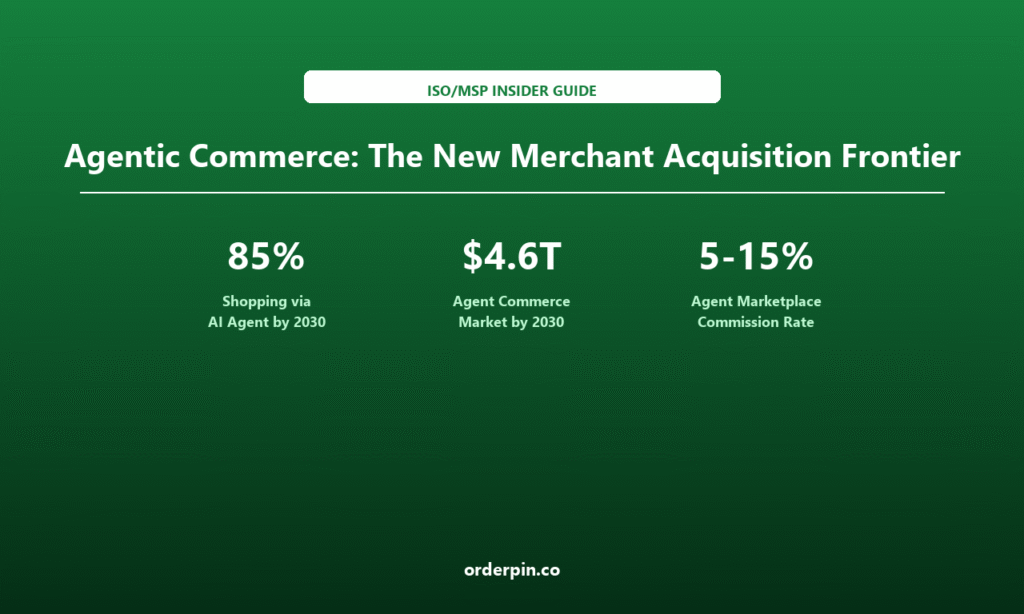
The 85% projection: McKinsey projects that by 2030, approximately 85% of consumer shopping interactions will involve an AI agent at some stage of the purchase decision. Even if this projection is optimistic by 10-15 percentage points, it represents a fundamental shift in how commercial relationships are established. Merchants that are not present in agentic marketplaces — that do not have agent-readable APIs, transparent pricing, and verifiable service quality data — will be excluded from a rapidly growing segment of commerce. ISOs that serve these merchants will see their acquisition channels narrow in proportion to the growth of agentic commerce.
2. Agent-to-Agent Payments: A New Transaction Layer
Beyond agent-driven merchant selection, agentic commerce introduces a fundamentally new transaction type: agent-to-agent payments. When AI agents transact with each other — paying for services, settling accounts, compensating other agents for work performed — the payment flows are fundamentally different from traditional consumer-to-merchant or business-to-business transactions.
Agent-to-agent commerce patterns: An AI agent that researches a market and delivers a report pays another AI agent that compiled the underlying data. A business AI agent pays an AI legal assistant for contract review. A logistics AI agent pays an AI scheduling agent for route optimization. These transactions are small (often cents or dollars), high-frequency (potentially thousands per day), and require real-time settlement. The traditional ACH or card rails are poorly suited for this use case. Purpose-built agent settlement infrastructure — fast, low-cost, API-driven — is required.
The settlement speed imperative: Human commerce tolerates T+1 or T+2 settlement. Agentic commerce does not. When an AI agent performs a service — and the payment is contingent on that service being delivered — the settlement must be near-instantaneous. If the agent is not paid immediately upon service delivery, the entire transaction model breaks down. Real-time agent settlement rails are not a nice-to-have in agentic commerce; they are a requirement. ISOs that build or partner to provide real-time settlement infrastructure will be positioned at the foundation of a new transaction category.
The commission layer: Agent marketplaces — platforms that aggregate AI agents and facilitate their interactions — will capture a commission on agent-to-agent transactions. McKinsey projects agent marketplace commissions in the 5-15% range, comparable to traditional marketplace fees (Amazon, Airbnb, Uber). This commission layer represents a new form of payment economics that ISOs have not yet engaged with. The question of who provides the settlement rails for agent marketplaces — and on what terms — is one of the most important strategic questions in payments right now.
3. Future Acquiring Models: What ISOs Need to Build Now
The ISO channel has a choice: become a participant in agentic commerce, or be progressively excluded from it. The assets ISOs bring to agentic commerce — merchant relationships, operational data, trust networks, industry expertise — are genuinely valuable. But they must be made machine-readable. The following capabilities are the foundations of an ISO’s agentic commerce readiness.
Agent-readable API infrastructure: The first requirement for agentic commerce participation is machine-readable data infrastructure. ISOs need APIs that AI agents can read — not just to process transactions, but to evaluate merchant service quality, compare pricing, verify certifications, and assess uptime. An ISO whose platform exposes rich, agent-readable data will be discoverable by AI agents. An ISO whose platform hides data behind human-facing interfaces will not. This is not a future requirement — it is a current one. Agent marketplaces are operating today; they need agent-readable data.
Real-time settlement rails: Agentic commerce requires real-time settlement — not T+1 or T+2, but immediate. ISOs that offer real-time settlement infrastructure — through RTP, FedNow, or purpose-built agent settlement APIs — will be positioned to serve agent-to-agent transactions as this market develops. This is a capability that most current ISO infrastructure does not support. Building or partnering for it now is a first-mover advantage.
Agent reputation infrastructure: AI agents need to evaluate merchants they have not transacted with before. This requires a reputation system — a record of past transaction quality, uptime, dispute resolution history, and compliance standing. ISOs that build or participate in agent reputation infrastructure — either through their own platform data or through third-party agent marketplaces — will have a competitive advantage in agentic merchant acquisition. Reputation data is the trust infrastructure of agentic commerce; it is as essential as pricing in determining agent-driven merchant selection.
Traditional vs. Agentic Merchant Acquisition
| Dimension | Traditional Acquisition | Agentic Acquisition |
|---|---|---|
| Discovery Mechanism | SEO, referrals, trade shows, sales outreach | Agent marketplaces, API discovery, reputation scores |
| Decision Driver | Human relationship, trust, brand, pricing | Programmatic data evaluation, API quality scores |
| Time to Onboarding | Days to weeks (human process) | Minutes to hours (programmatic API) |
| Relationship Model | Human-to-human, face-to-face | System-to-system, API-to-API |
| Scalability | Linear (headcount-driven) | Exponential (API-driven) |
| ISO Readiness Today | High (current model) | Low (needs investment) |
How OrderPin’s API-First Platform Prepares ISOs for Agentic Commerce
OrderPin’s white-label platform is built on an API-first architecture that is designed to be agent-readable and machine-interoperable. For ISOs preparing for agentic commerce, this is not a future requirement — it is a current competitive advantage.
- Agent-readable API infrastructure: OrderPin’s API exposes structured, machine-readable data — transaction volumes, uptime statistics, dispute rates, security certifications, and merchant performance metrics — that AI agents can evaluate programmatically. ISOs on the OrderPin white-label platform inherit this agent-readable infrastructure automatically. They do not need to build it themselves.
- Real-time data for agent reputation systems: Agentic commerce requires reputation data — records of past transaction quality that AI agents use to evaluate merchants they have not transacted with before. OrderPin’s platform generates this data continuously, giving ISOs a rich, agent-readable reputation profile that AI agents can use to evaluate and select their merchants in agentic marketplaces.
- Multi-location data depth for agent evaluation: AI agents evaluating restaurant merchants need more than a single data point — they need operational depth across locations. OrderPin’s white-label platform gives ISOs multi-location visibility that generates the data density agents need to make high-confidence evaluations. A single-location merchant has limited data; a multi-location ISO on OrderPin has data across hundreds of locations that agents can evaluate comprehensively.
- Platform brand as agent trust signal: In agentic commerce, the platform brand matters as a trust signal. ISOs on the OrderPin white-label platform carry OrderPin’s security certifications and compliance infrastructure as part of their agent-readable trust profile — a competitive advantage that agents will factor into their selection criteria alongside pricing and technical capability.
Frequently Asked Questions
Is agentic commerce a real market today, or only a future projection?
Both — and the distinction matters. AI agents are already purchasing on behalf of consumers and businesses today, generating billions in annual transaction volume. McKinsey projects $3-4 trillion in agentic commerce by 2030, with 85% of shopping interactions involving an AI agent. These projections may be optimistic, but even a conservative estimate represents a market of $1-2 trillion annually by 2030. The merchants and the volume are not future projections — they are the current state. The question is whether the ISO channel will engage with them or watch from the sidelines.
How does agentic commerce change the ISO’s merchant acquisition model?
Fundamentally. In the traditional model, merchant acquisition is a human-to-human process: sales calls, referrals, trade shows, digital marketing. In an agentic model, AI agents find, evaluate, and onboard merchants programmatically — based on API quality, uptime data, security certifications, and reputation scores from other agents. An ISO that is not present in agent marketplaces, does not have agent-readable data infrastructure, and does not have a reputation score in the agent ecosystem will be invisible to AI-driven acquisition. The acquisition funnel does not change in agentic commerce — it is replaced by a completely different mechanism.
What is the most urgent action an ISO should take to prepare for agentic commerce?
Build agent-readable API infrastructure. The ISO’s platform — the merchant-facing interface, the data feeds, the reporting tools — must be readable by AI agents. This means structured, documented APIs, machine-readable pricing data, and programmatic access to merchant performance metrics. Without this infrastructure, the ISO is invisible to AI agents regardless of how strong the human sales team is. A white-label platform with API-first architecture — like OrderPin — provides this infrastructure without requiring the ISO to build it from scratch.
Do human relationships become irrelevant in agentic commerce?
No — but they operate differently. Human relationships remain important for complex, high-stakes decisions: enterprise merchant onboarding, strategic partnership discussions, dispute resolution at scale. But for the volume of merchant acquisition and day-to-day transaction management, AI agents are more efficient than humans. The ISO that invests only in human relationship infrastructure will be outcompeted by the ISO that invests in both human relationships and AI-readable data infrastructure. The winners in agentic commerce will be ISOs that have both — not one or the other.
Can an ISO participate in agentic commerce without becoming a technology company?
Yes — through a white-label platform partnership. The ISO does not need to build its own API infrastructure from scratch. A white-label partnership with OrderPin gives the ISO agent-readable API infrastructure, real-time data feeds, and agent reputation infrastructure — under the ISO’s brand, serving the ISO’s merchant relationships. The ISO focuses on merchant acquisition and relationship management; the platform handles the technical complexity of API design, data structuring, and agent marketplace integration. This is the most capital-efficient path to agentic commerce participation.
How fast is the window closing for ISOs to build agentic commerce capabilities?
Faster than most ISOs realize. Stripe, Square, PayPal, and Adyen are all actively building agentic commerce infrastructure. Agent marketplaces are forming. The first-mover advantage in agent reputation — the data accumulated from early transactions — is a durable competitive moat that compounds over time. ISOs that build agentic commerce capabilities in the next 12-24 months will be positioned to accumulate reputation data and agent marketplace presence before the market becomes saturated. The ones that wait will find that the API infrastructure, the reputation data, and the agent marketplace relationships have all been claimed by whoever moved first.
Agentic commerce is not a future scenario — it is a current market that is growing at 47% annually and is projected to reach $3-4 trillion in transaction volume by 2030. AI agents are already finding, evaluating, and transacting with merchants programmatically, bypassing the human-driven merchant acquisition funnel entirely. ISOs that rely solely on human relationship-building for merchant acquisition will be progressively disintermediated by AI agents that find and onboard merchants faster, more cheaply, and more data-driven than any human sales team. The response is not to abandon human relationships — it is to build agent-readable infrastructure alongside them. API-first platforms, real-time settlement rails, and agent reputation systems are the foundations of the ISO’s agentic commerce readiness. The window to build this position is open now; it will not be open indefinitely. OrderPin is a white-label POS platform with API-first architecture that gives ISOs the agent-readable infrastructure — machine-readable data, real-time feeds, and reputation depth — to participate in agentic commerce on their own terms, under their own brand.
About OrderPin
OrderPin is a white-label POS platform built for ISO and MSP partners. We offer full data ownership, flexible pricing, and seamless API integrations to help you build a recurring revenue business under your own brand. Learn more about OrderPin’s white-label solution