
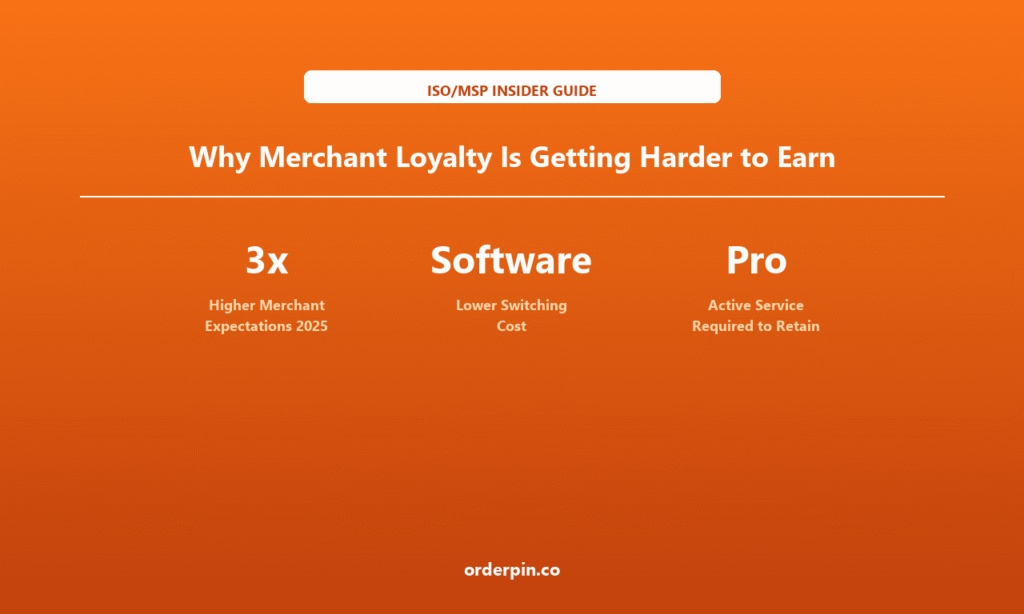
TL;DR — Quick Summary
- Software ecosystems have fundamentally changed what merchants expect from their ISO: Comparison sites, review platforms, and embedded payment integrations have lowered the cost of evaluating alternatives and made switching faster and less disruptive. The merchant who once stayed out of loyalty now has the tools to compare three processors before their contract expires, evaluate their ISO against peer benchmarks, and switch without rebuilding their operations from scratch. The loyalty that sustained merchant relationships in 2016 is not available in 2026 at the same price.
- Merchant expectations have shifted from relational to professional — and most ISOs have not caught up: Today is merchants expect their payment provider to function like their SaaS vendor: proactive outreach, data-driven insights, transparent performance metrics, and a clear escalation path when something goes wrong. The ISO that calls once a year to renew a contract is not providing that experience. The ISO that manages their book with regular data-driven check-ins, merchant success programs, and genuine operational support is — and they are the ones keeping their merchants.
- Earning loyalty in 2026 requires earning it every quarter — not once at contract renewal: The ISOs that retain merchants longest treat customer success as a continuous investment: assigning dedicated relationship managers, running quarterly business reviews, monitoring portfolio data for early warning signals, and investing in the merchant’s growth, not just their own renewal. The switching cost is built through service depth, not just contract length. Merchants that feel genuinely supported do not shop around.
Expectations 2025
Cost Than 2016
Required to Retain
Why Merchant Loyalty Is Getting Harder to Earn
Ask an ISO what their merchant retention rate is and the answer is usually somewhere between 85% and 95% — a number that sounds healthy until you ask what the competitive takeover rate is among the merchants they do lose. Many of those losses are not to another ISO offering a lower rate; they are to a software platform, a bank, or an embedded payment provider that was already embedded in the merchant’s workflow before the ISO knew they were at risk.
The loyalty problem is structural, not relational. The tools available to merchants for evaluating alternatives have improved dramatically. Comparison sites, peer networks, and embedded payment integrations have made it possible to evaluate, negotiate, and switch providers faster than ever before. At the same time, merchant expectations for service quality have risen to match the SaaS era: they expect proactive communication, data-driven insights, and the same responsiveness from their payment provider as from their other vendors. The ISO that still manages their book with an annual call and a rate sheet is not meeting those expectations.
This article maps the structural forces making loyalty harder to earn, explains what merchant expectations actually are in 2026, and outlines the customer success framework that ISOs with the best retention rates are using to earn loyalty every quarter — not just at renewal.
vs Actual at Risk
From 2016 Baseline
for Real Loyalty
Model Required
1. The Structural Forces That Have Changed the Loyalty Equation
Comparison infrastructure has made competitive evaluation a merchant’s quarterly habit: The existence of comparison sites, industry benchmarks, and peer networks means that merchants can evaluate their payment provider’s performance against a reference point that did not exist a decade ago. They know when their rates are above market, when their service is below peer standards, and when a competitive offer is worth considering. This information used to be the ISO’s advantage; it now belongs to the merchant, and it is used against the ISO as often as it is used to validate the relationship.
Software has lowered the switching cost that used to protect merchant relationships: When switching a payment processor meant rebuilding POS infrastructure, renegotiating terminal contracts, and retraining staff, the switching cost was real. Today, many POS platforms make it possible to switch processors within the existing software environment — the merchant keeps their POS, keeps their reporting, and keeps their data. The switching cost is now the rate difference, and rate differences can be arbitraged away by any merchant with a laptop and an afternoon.
2. What Merchants Actually Expect in 2026
Merchants expect their ISO to function like their SaaS vendor — proactive, data-driven, responsive: The reference point for service quality has shifted from the payment industry standard to the broader SaaS standard. Merchants who use Slack, Square, or Shopify expect their payment provider to send them proactive performance insights, not just respond to service tickets. They expect a clear escalation path, not a phone tree. They expect their ISO to know their business — not just their processing volume. The ISO that still manages their book by waiting for the merchant to call is operating on a 2016 service model in a 2026 market.
The relationship type is shifting from personal to professional — and that is harder to maintain: The loyalty of personal relationships was sustained by history, trust, and inertia. The loyalty of professional relationships is sustained by demonstrated value delivered every quarter. The ISO that built their book on personal relationships is now managing a book of merchants who have professionalized their vendor evaluation process. The personal connection still matters, but it is no longer sufficient on its own. Professional value delivery is now table stakes.
3. The Customer Success Model: Earning Loyalty Every Quarter
Customer success is not customer service — it is a proactive investment in merchant retention: Customer service responds to problems; customer success prevents them. A customer success program for an ISO means assigning dedicated relationship managers to the merchant base, running quarterly business reviews that go beyond rate comparisons to include operational insights, monitoring portfolio data for early warning signals (declining volume, increasing chargebacks, seasonal anomalies), and intervening before a merchant decides to shop around. This is not a cost center — it is the most cost-effective merchant retention investment an ISO can make.
The switching cost is built through service depth — not contract length: The most durable switching costs are built through the service depth that makes switching costly in practice, not just in contract terms. A merchant that receives genuine business insights, operational support, and proactive alerts from their ISO every quarter is not going to shop around on a rate comparison site — not because they cannot, but because the cost of replacing that relationship is higher than the savings from a lower rate. Building this depth requires treating customer success as a product, not an overhead line item.
4. The Three Retention Practices That Separate Top ISOs
Dedicated relationship managers with defined portfolios and quarterly touch points: The ISOs with the highest retention rates assign relationship managers to defined merchant portfolios, with documented quarterly touch points and clear retention metrics. They know which merchants are at risk before those merchants know themselves — because they are monitoring the data, not just waiting for the renewal call. The relationship manager is not a salesperson; they are a merchant advocate inside the ISO’s organization.
Data-driven business reviews that deliver genuine operational insights: A business review that consists of rate comparisons and renewal terms is not a business review — it is a sales call with extra steps. The business reviews that build loyalty are the ones that show the merchant something they did not know about their own business: benchmark comparisons, seasonal patterns, underperforming product categories, or growth opportunities the merchant had not considered. The ISO that provides this insight becomes the merchant’s advisor, not just their processor.
Early warning systems that flag at-risk merchants before they start shopping: The merchants most likely to leave are the ones whose volume is declining, whose chargebacks are rising, or whose seasonal patterns have shifted. An ISO that monitors portfolio data continuously can identify these signals and intervene proactively — reaching out with a solution before the merchant has decided to look elsewhere. The ISO that only finds out when the cancellation notice arrives has already lost the retention opportunity.
5. Platform Ownership as the Ultimate Retention Mechanism
The switching cost that no rate comparison can beat is the one built through platform ownership: When the ISO’s white-label POS runs the merchant’s operations — POS, inventory, reporting, customer management — the switching cost is structural, not just contractual. A merchant running on the ISO’s platform cannot be price-shopped by a processor that does not own the platform they are switching to. The switching cost is the cost of rebuilding their operational infrastructure, which is always higher than the rate savings. Platform ownership makes customer success programs more effective because the ISO has the data and the relationship depth to make them genuinely valuable.
The compounding effect: deeper service creates deeper loyalty: Every quarterly business review, every early warning intervention, and every operational insight delivered through the ISO’s platform deepens the merchant relationship and raises the cost of replacing it. Loyalty is not a fixed quantity — it is a function of the investment made in earning it. The ISOs that invest consistently in customer success compound their retention advantage over time: each retained merchant generates the data that enables better service, which generates deeper loyalty, which generates more data. The gap between ISOs that do this and those that do not widens every year.
2016 vs 2026 Merchant Loyalty Dynamics
| Dimension | 2016 Loyalty Model | 2026 Loyalty Model |
|---|---|---|
| Switching Cost | High (POS rebuild required) | Low (platform-agnostic processors) |
| Merchant Information | ISO-controlled | Merchant-controlled (comparison tools) |
| Service Expectation | Reactive (respond when contacted) | Proactive (data-driven outreach) |
| Retention Touch Points | Annual renewal call | Quarterly business reviews |
| Loyalty Driver | Personal relationship + inertia | Professional value + platform switching cost |
| ISO Survival Strategy | Good rates + personal relationships | Customer success + platform ownership |
How OrderPin Helps ISOs Build the Switching Costs That Protect Merchant Loyalty
OrderPin is a white-label POS platform that gives ISOs the platform ownership needed to build structural switching costs — the kind that no rate comparison can beat. When the ISO’s platform runs the merchant’s daily operations, switching away means rebuilding the operational infrastructure, which is always more expensive than any rate savings. Platform ownership also generates the data needed for genuine customer success: transaction patterns, operational insights, and early warning signals that enable the quarterly business reviews and proactive outreach that keep merchants loyal.
- Build structural switching costs: OrderPin runs the merchant’s POS, inventory, reporting, and customer management under the ISO’s brand. Switching the ISO means replacing the operating system of their business — a switching cost that no processor can undercut on rate alone.
- Generate the data for customer success programs: Platform data from OrderPin gives the ISO the transaction patterns, operational benchmarks, and early warning signals needed to run genuine quarterly business reviews — not just rate comparisons, but operational insights that make the ISO indispensable to the merchant’s decision-making.
- Make every touch point count: The ISO that uses platform data to deliver genuine insights at every quarterly touch point builds loyalty that compounds: deeper data enables better insights, which builds stronger relationships, which generates more data and more loyalty over time.
- Retain merchants before they know they are at risk: OrderPin’s portfolio analytics surface declining volume, rising chargebacks, and seasonal anomalies before they become retention emergencies — giving the ISO the early warning window to intervene proactively.
Frequently Asked Questions
Why is merchant loyalty harder to earn in 2026 than in 2016?
Three structural changes: comparison infrastructure has given merchants the information to evaluate alternatives quickly, software has lowered the switching cost that used to protect relationships, and merchant expectations have shifted from relational to professional — they expect proactive, data-driven service from their payment provider, not just a rate and an annual call. The loyalty that sustained relationships in 2016 required personal connection and inertia. Loyalty in 2026 requires demonstrated professional value delivered every quarter.
What is the difference between customer service and customer success for ISOs?
Customer service responds to problems when they arise; customer success prevents them proactively. A customer success program for an ISO means assigned relationship managers, quarterly business reviews with genuine operational insights, continuous portfolio monitoring for early warning signals, and proactive intervention before a merchant decides to shop around. It is the most cost-effective merchant retention investment available — because retaining a merchant costs a fraction of acquiring a new one, and a retained merchant on a platform generates compounding revenue.
How do comparison sites and review platforms change the loyalty equation?
They give merchants the information and the evaluation tools that used to belong to the ISO. Merchants can now benchmark their rates against market, compare service quality against peer experiences, and identify competitive alternatives without relying on their ISO for information. This shifts the information advantage from the ISO to the merchant — and means the ISO must earn loyalty through demonstrated value, not information asymmetry. The ISO that provides the data and insights that comparison sites cannot (operational benchmarks, personalized business reviews, genuine advisory value) retains the relationship advantage.
What is the most durable switching cost an ISO can build?
Platform ownership. When the ISO’s white-label POS runs the merchant’s operations — POS, inventory, reporting, customer management — switching the ISO means rebuilding the operational infrastructure of the business. This is a switching cost that no rate comparison can beat, because the cost of rebuilding the operational layer is always higher than the savings from a lower rate. Platform ownership also generates the data needed for the customer success programs that make the relationship genuinely indispensable.
How does a quarterly business review build loyalty differently from an annual renewal call?
A renewal call is a transaction — the ISO presents a rate, the merchant accepts or negotiates, and the call ends. A quarterly business review is a relationship investment — the ISO brings data, insights, and genuine observations about the merchant’s business that the merchant did not already have. The merchant that receives genuinely useful insights at every quarterly touch point does not need to look for another provider, because they are already getting more value from their current ISO than they could get from a competitive comparison. The loyalty built through quarterly business reviews is professional, not just personal — and it is much harder to break.
What three retention practices separate the ISOs with the best merchant retention rates?
Dedicated relationship managers with defined portfolios and quarterly touch points; data-driven business reviews that deliver genuine operational insights (not just rate comparisons); and early warning systems that flag at-risk merchants before they start shopping. Together, these three practices create the proactive retention infrastructure that keeps merchants loyal in a market where passive relationship management is no longer sufficient.
Merchant loyalty in 2026 is earned differently than it was in 2016 — not through personal relationships and inertia, but through demonstrated professional value delivered every quarter. Software has lowered switching costs, comparison infrastructure has given merchants the tools to evaluate alternatives, and merchant expectations have risen to match the SaaS era. The ISO that still manages their book with an annual renewal call is not meeting the 2026 standard. The ISO that invests in customer success — dedicated relationship managers, quarterly business reviews, portfolio monitoring for early warning signals — earns loyalty that compounds: every touch point deepens the relationship, which makes the next touch point more valuable, which makes switching costlier. The ultimate retention mechanism is platform ownership: when the ISO’s white-label POS runs the merchant’s operations, switching is never just about a rate. OrderPin is a white-label POS platform that gives ISOs the platform ownership needed to build structural switching costs and the data needed for genuine customer success programs — the foundation of merchant loyalty that no rate comparison can break.
About OrderPin
OrderPin is a white-label POS platform built for ISO and MSP partners. We offer full data ownership, flexible pricing, and seamless API integrations to help you build a recurring revenue business under your own brand. Learn more about OrderPin’s white-label solution