
TL;DR — Quick Summary
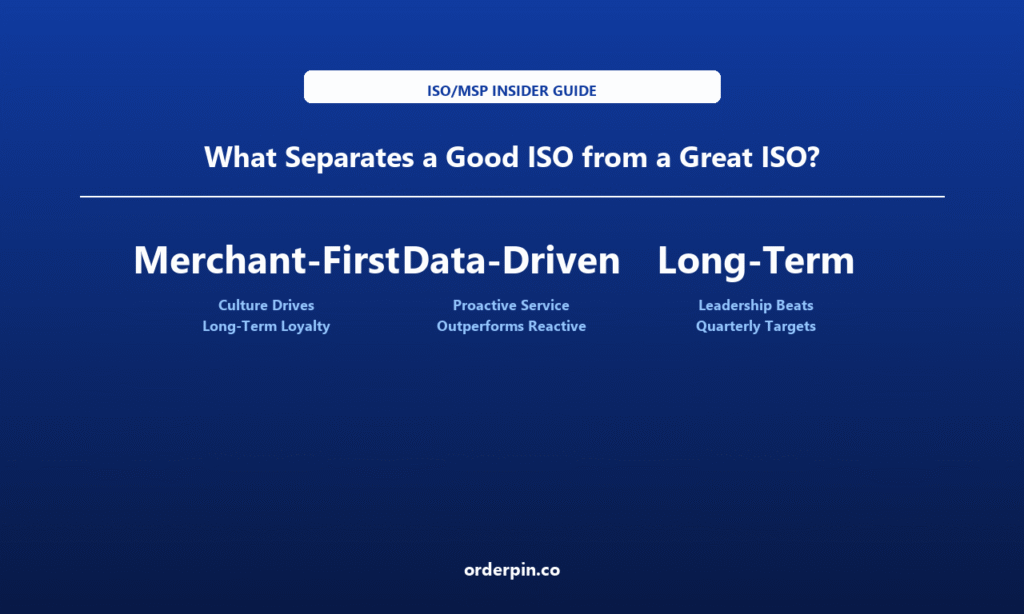
- Greatness in the ISO business is not about size — it is about culture and strategic clarity: The difference between a good ISO and a great ISO is not the size of their portfolio, the sophistication of their tech stack, or the depth of their banking relationships. It is the cultural and strategic decisions that determine whether the ISO is optimizing for the next quarter or building something that lasts. Merchant-first culture, data-driven proactive service, and long-term leadership thinking are the three forces that separate the great from the merely good.
- Merchant-first culture means putting the merchant’s success ahead of short-term revenue: The great ISOs make decisions that are good for their merchants — even when those decisions reduce short-term revenue. They do not pad rates, they do not hide fees, and they do not upsell products that do not serve the merchant’s needs. This merchant-first approach builds the trust that makes their portfolio sticky, generates referrals, and creates the word-of-mouth growth that no sales team can buy. The good ISO optimizes for the transaction; the great ISO optimizes for the merchant relationship.
- Long-term leadership thinking is the compound interest of the ISO business: Every strategic decision — technology investments, hiring, merchant support depth, product choices — is either an investment in the future or a tax on it. The great ISO makes decisions that build compounding advantages: brand equity, data assets, merchant loyalty, and operational capability that becomes more valuable over time. The good ISO makes decisions that are optimal for this quarter, not for the next decade. The gap between them widens every year.
Long-Term Loyalty
Outperforms Reactive
Quarterly Targets
What Separates a Good ISO from a Great ISO?
Most ISOs operate at a competent level: they sign merchants, process transactions, and generate revenue. They meet their targets, service their accounts reasonably well, and maintain relationships with their banking and processor partners. Some of them build something more. The difference between a good ISO and a great ISO is not visible in any single metric — it is visible in the compounding trajectory over years. Great ISOs do not just generate revenue; they build durable businesses that increase in value over time. Good ISOs generate revenue; their businesses are worth more or less the same next year as they are today.
The difference between good and great is not luck, capital, or market position. It is a set of cultural and strategic decisions that can be made deliberately — by any ISO that chooses to make them. Merchant-first culture, data-driven proactive service, and long-term leadership thinking are the three forces that separate the great from the merely good. This article examines each one.
Competitive Moat
Driven by Analytics
Time Horizon
Builds Over Time
1. Merchant-First Culture: The Foundation of Every Great ISO
Merchant-first culture means making decisions that are good for the merchant — even when they reduce short-term revenue: The great ISO does not pad rates, hide fees, or upsell products that do not serve the merchant’s needs. When a merchant is overpaying, the great ISO tells them — and renegotiates. When a competitor offers a better rate, the great ISO helps the merchant evaluate the offer honestly. This approach costs short-term revenue but builds the trust that makes the portfolio sticky, generates referrals, and creates word-of-mouth growth that no sales team can buy.
The trust premium compounds: great ISOs build portfolios that are worth more than their transaction volume suggests: A portfolio built on trust — where merchants stay because they want to, not because they are locked in — is worth more than a portfolio of the same size where merchants stay because the switching cost is high. The trust premium shows up in retention rates, referral rates, and ultimately in exit multiples. A great ISO’s portfolio is not just a revenue stream; it is a compounding asset whose value increases as the trust relationship deepens.
2. Data-Driven Proactive Service: The Operational Advantage of Great ISOs
Data-driven service means knowing when a merchant is at risk before they do: The great ISO monitors their portfolio data continuously — volume trends, chargeback rates, seasonal patterns, product mix — and intervenes proactively when the data signals a problem. A merchant whose volume is declining is a merchant who is considering alternatives. The great ISO reaches out with a solution before the merchant has decided to look elsewhere. The good ISO only finds out when the cancellation notice arrives.
Proactive service is more cost-effective than reactive service — and it builds loyalty that reactive service cannot: The cost of retaining a merchant is always lower than the cost of acquiring a new one. The great ISO invests in proactive service — relationship managers with defined portfolios, quarterly business reviews, early warning monitoring — because the retention ROI is higher than the acquisition ROI. But proactive service also builds a different kind of loyalty: the merchant that receives genuine proactive support does not shop around, because they are already getting more value than any competitor can offer on rate alone.
3. Long-Term Leadership Thinking: The Compounding Advantage
Every strategic decision is either an investment in the future or a tax on it: Technology investments, hiring decisions, merchant support depth, product choices — each of these decisions either builds compounding advantages or extracts value from the future to serve the present. The great ISO makes decisions that build compounding advantages: brand equity, data assets, merchant loyalty, and operational capability that becomes more valuable over time. The good ISO makes decisions that are optimal for this quarter, deferring investments that would compound and taking shortcuts that save money today while degrading the business tomorrow.
The compounding effect makes the gap between good and great widen over time: Every year of merchant-first culture, every data-driven proactive intervention, and every long-term technology investment adds to the compounding advantage of a great ISO. The good ISO, optimizing for the quarter, does not make these investments — and the gap between them widens every year. The great ISO’s merchant relationships become more valuable, their data assets become more predictive, their brand becomes more trusted, and their operational capability becomes more efficient. The good ISO stays the same.
4. The Visible Markers of a Great ISO
Referral rate: great ISOs grow primarily through referrals from their existing merchant base: The most visible marker of a great ISO is their referral rate. Merchants that trust their ISO refer their peers — not because they are incentivized to, but because they genuinely believe in the relationship. A high referral rate is a lagging indicator of merchant-first culture: it shows up after years of trust-building, and it compounds as the merchant base grows. The ISO that grows primarily through cold outreach and paid acquisition is optimizing for volume; the ISO that grows primarily through referrals is optimizing for trust.
Retention rate: great ISOs retain merchants at rates that defy industry averages: Industry average merchant retention for ISOs is 80-90%. Great ISOs routinely report retention rates above 95% — and the difference is not switching costs. Their merchants stay because they want to, because the relationship is genuinely valuable, and because the ISO has invested in their success. The retention rate is a lagging indicator of both merchant-first culture and data-driven proactive service: it reflects years of decisions that prioritized the merchant relationship over short-term revenue.
Exit multiple: great ISOs sell for multiples that reflect their compounding asset value: The ultimate test of whether an ISO has built something durable is the exit multiple. A good ISO’s book is worth 1-2x its annual residual income — because buyers know that a book without compounding advantages is a depreciating asset. A great ISO’s book is worth 5-12x — because the merchant-first culture, the data assets, the platform ownership, and the trust premium translate into retention rates and revenue predictability that buyers will pay a premium for. The gap between good and great is worth real money at exit.
5. The Platform as the Ultimate Expression of Greatness
The white-label platform is the physical expression of merchant-first culture: A great ISO’s white-label POS platform is not just a product — it is the physical expression of everything they believe about merchant success. Every feature is built to serve the merchant’s operations, not to maximize the ISO’s margin. Every integration is chosen because it makes the merchant’s workflow more efficient, not because it generates the highest referral fee. Every support interaction is designed to solve the merchant’s problem, not to minimize the ISO’s support cost. The platform is the proof of the culture.
Platform ownership is the compounding asset that makes a great ISO’s exit multiple exceptional: The white-label platform is also the asset that most dramatically separates great ISO exit multiples from good ones. A platform-owned ISO with a merchant-first culture, strong retention rates, and a trusted brand can exit at 8-15x their annual revenue — because the acquirer is not just buying a merchant book; they are buying a platform, a brand, a data asset, and a culture that will continue to compound after the acquisition. The good ISO sells a book. The great ISO sells a business.
Good ISO vs. Great ISO
| Dimension | Good ISO | Great ISO |
|---|---|---|
| Growth Model | Cold outreach + paid acquisition | Merchant referrals + trust-based growth |
| Retention Rate | 80-90% (industry average) | 95%+ (trust-based, not lock-in) |
| Service Model | Reactive (respond when contacted) | Proactive (data-driven, intervene early) |
| Leadership Time Horizon | This quarter | Next decade |
| Platform Ownership | Reseller (no ownership, no data) | White-label POS (owns platform + data) |
| Exit Multiple | 1-2x annual residual | 5-15x annual revenue (with platform) |
How OrderPin Helps ISOs Pursue Greatness
OrderPin is a white-label POS platform that gives ISOs the foundation for pursuing greatness — not just the tools to process transactions, but the platform to build compounding advantages that separate great ISOs from good ones. Platform ownership is the physical expression of merchant-first culture: every feature, integration, and support interaction is designed around the merchant’s success, not the ISO’s margin.
- Build the platform that proves your merchant-first culture: A white-label POS under your brand is the proof of your commitment to merchant success — not just a processing rate, but an operational platform that makes the merchant’s business better every day.
- Generate the data that enables proactive service: OrderPin gives you the transaction data, operational patterns, and early warning signals that enable the data-driven proactive service that great ISOs deliver — knowing when a merchant is at risk before they do, and intervening before they shop around.
- Build the compounding asset that maximizes your exit multiple: The white-label platform is the asset that most dramatically improves an ISO’s exit multiple. A platform-owned ISO with strong retention and a trusted brand exits at 8-15x annual revenue — not 1-2x — because buyers are acquiring a platform, a data asset, and a culture, not just a merchant book.
- Turn merchant success into referral-based growth: Merchants that succeed on your platform refer their peers. OrderPin’s operational depth — every feature built around merchant success — generates the referral growth that great ISOs rely on, not cold outreach and paid acquisition.
Frequently Asked Questions
What is the single most important quality that separates great ISOs from good ones?
Merchant-first culture — the deliberate decision to make the merchant’s success a priority over short-term revenue. Great ISOs do not pad rates, hide fees, or upsell products that do not serve the merchant’s needs. They make decisions that are good for the merchant — even when those decisions reduce short-term revenue. This culture builds the trust that makes their portfolio sticky, generates referrals, and creates the compounding advantage that widens every year. The good ISO optimizes for the transaction; the great ISO optimizes for the relationship.
How does data-driven proactive service work in practice?
It starts with continuous portfolio monitoring: volume trends, chargeback rates, seasonal patterns, product mix, and any anomalies that signal a merchant is considering alternatives. When the data signals a problem — a merchant whose volume is declining, whose chargebacks are rising, whose product mix is shifting — the great ISO intervenes proactively: reaching out with a solution before the merchant has decided to look elsewhere. This requires both the data infrastructure to generate the signals and the customer success organization to act on them. The good ISO only finds out when the cancellation notice arrives.
What is the exit multiple difference between a good ISO and a great ISO?
Good ISOs typically exit at 1-2x their annual residual income — because buyers know that a book without compounding advantages is a depreciating asset. Great ISOs — particularly those with white-label platform ownership, strong retention, and a trusted brand — exit at 5-15x annual revenue. The difference is the compounding asset value: platform ownership, merchant-first culture, data assets, and trust premium that buyers will pay a premium for, because these assets continue to compound after the acquisition. The good ISO sells a book; the great ISO sells a business.
How does long-term leadership thinking show up in daily decisions?
In every technology investment, hiring decision, and product choice: does this decision build compounding advantages for the next decade, or does it extract value from the future to serve the present? Great ISOs make the technology investments that build platform depth, even when the ROI is not immediate. They hire for culture and long-term fit, even when it takes longer to fill a role. They choose product integrations that serve the merchant’s needs, not the ones that generate the highest referral fees. The good ISO makes the decision that is optimal for this quarter. The compounding effect makes the gap between them widen every year.
What role does platform ownership play in becoming a great ISO?
Platform ownership is the physical expression of merchant-first culture and the most powerful compounding asset an ISO can build. A white-label POS under the ISO’s brand is the proof of their commitment to merchant success — not just a rate, but an operational platform that makes the merchant’s business better every day. It generates the data for proactive service, creates the switching costs that protect retention, and builds the asset value that maximizes exit multiples. The ISO that owns their platform builds compounding advantages in brand, data, and merchant loyalty that cannot be replicated by reselling someone else’s product.
Is greatness in the ISO business a matter of luck, capital, or deliberate choice?
Deliberate choice — made every day, in every decision. Merchant-first culture, data-driven proactive service, and long-term leadership thinking are not natural outcomes of having the right resources or being in the right market. They are choices that any ISO can make, starting now. The great ISOs did not start great; they made the decisions that compounded into greatness over time. The gap between good and great is not about where you start — it is about the decisions you make every day, and whether those decisions are investments in the future or taxes on it.
Greatness in the ISO business is not about size, tech stack, or banking relationships — it is about culture and strategic decisions made every day. Merchant-first culture builds the trust that makes portfolios sticky and generates referral-based growth. Data-driven proactive service builds retention by knowing when a merchant is at risk before they do. Long-term leadership thinking builds compounding advantages that widen every year. The great ISO does not just generate revenue; they build a durable business whose value increases over time — and that durability shows up in exit multiples of 5-15x, not 1-2x. Platform ownership is the physical expression of this culture and the most powerful compounding asset an ISO can build: it generates the data for proactive service, creates structural switching costs that protect retention, and builds the asset value that maximizes exit multiples. OrderPin is a white-label POS platform that gives ISOs the foundation for pursuing greatness — the platform, the data, and the culture to build a business worth more than any transaction volume metric can capture.
About OrderPin
OrderPin is a white-label POS platform built for ISO and MSP partners. We offer full data ownership, flexible pricing, and seamless API integrations to help you build a recurring revenue business under your own brand. Learn more about OrderPin’s white-label solution