
TL;DR — Quick Summary
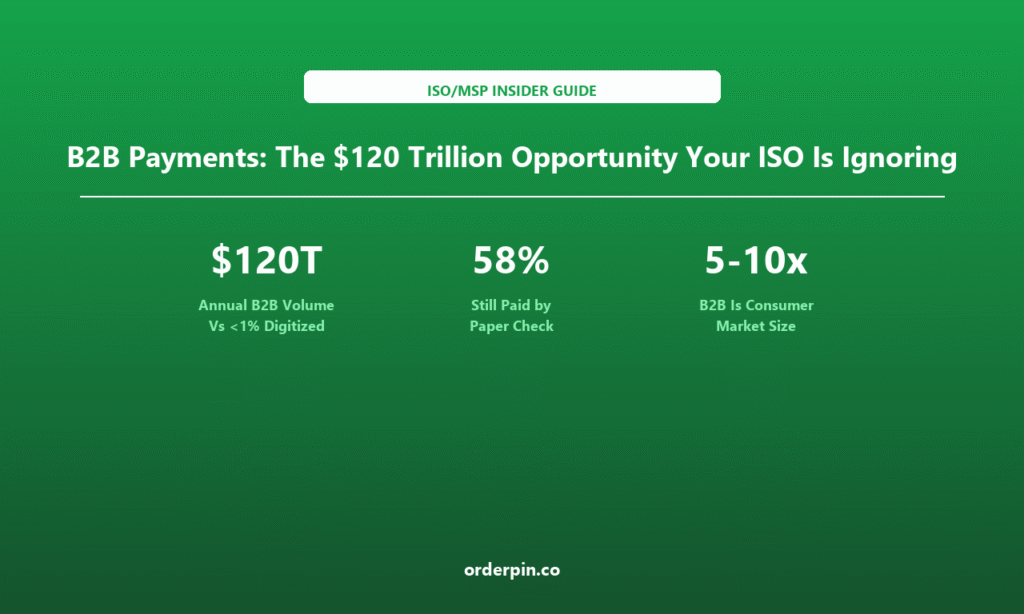
- The B2B payments market is $120 trillion annually — 10x the consumer market — and less than 1% is digitized: The consumer payments market is $10 trillion in annual volume. The B2B payments market is $120 trillion — and it is less than 1% digitized. 58% of B2B payments in the US are still made by paper check. The businesses making and receiving those checks are already your merchants — or they could be, if you offer what they actually need.
- B2B payment automation is the most underpenetrated ISO opportunity — and the entry barrier is an API integration, not a new business model: The B2B payments opportunity is not about becoming a bank. It is about connecting to the systems businesses already use — QuickBooks, Xero, NetSuite, Sage — and offering digital payment rails for the invoices, purchase orders, and payments that already flow through those systems. Accounts payable and receivable automation is the natural B2B extension of a payment platform, and it generates recurring subscription revenue that is not subject to interchange compression.
- Every paper check is a revenue opportunity waiting to be captured: Each paper check represents a business paying float, managing exceptions manually, and losing the working capital advantage that digital payments provide. ISOs that offer AP/AR automation — digital invoicing, virtual card payments, and ERP-connected payment rails — are solving a real merchant pain while building the deepest enterprise relationship in the business. The merchant that relies on their ISO for accounts payable and receivable does not switch processors, because the switching cost of rebuilding the ERP integration is higher than any rate advantage.
10x Consumer Market
Paper Check
Per Transaction
The B2B Payments Opportunity Most ISOs Are Missing
The consumer payments market — card payments for retail, dining, and online shopping — is worth approximately $10 trillion in annual volume in the US. The B2B payments market — payments between businesses, for goods and services — is worth $120 trillion annually, according to the Federal Reserve. That is 10 to 12 times the size of the consumer market. And yet the majority of ISOs focus exclusively on consumer point-of-sale transactions: the swipe, the tap, the card-present payment at the register. They are processing a fraction of the actual payment volume of the businesses they serve.
The reason is historical: consumer card payments were the first digital payment type that ISOs could easily enable. The infrastructure for B2B payments — accounts payable and receivable automation, ERP integrations, virtual card processing, and payment approval workflows — required more sophisticated platform capabilities than most ISOs had built. But that is changing. The platforms that have built deep API integrations — QuickBooks, Xero, NetSuite, Sage — have created a channel into the B2B payment flows that ISOs can now access. This article explains why B2B payments are the most underpenetrated ISO opportunity, what the market structure looks like, and how ISOs can enter it.
10x Consumer Market
Paper Check
to Payment Rail
NetSuite Connected
1. B2B Payments Are 10x the Consumer Market — And ISOs Are Ignoring It
The B2B payments market dwarfs consumer payments in volume — and it is almost entirely unaddressed by ISOs: $120 trillion in annual B2B payment volume in the US versus approximately $10 trillion in consumer card payments. Every restaurant, retailer, and service business that an ISO serves also makes and receives B2B payments — for supplies, services, rent, utilities, and a hundred other categories. The volume they process as card-present consumer transactions is a small fraction of the total payment volume that flows through their business. Most ISOs have not considered entering the B2B payments channel because the historical infrastructure requirements seemed out of reach.
The entry barrier is not a new business model — it is a platform API integration: The B2B payments opportunity does not require the ISO to become a bank, a payment network, or an enterprise software company. It requires connecting to the accounting and ERP platforms that businesses already use — QuickBooks, Xero, NetSuite, Sage — and offering digital payment rails for the invoice, purchase order, and payment flows that already flow through those systems. An ISO with a white-label POS platform that has built deep API integrations is already halfway to a B2B payments capability. The incremental investment is connecting those integrations to a payment rail — virtual card, ACH, or real-time payment — and packaging it as a merchant-facing product.
2. The 58% Paper Check Problem
58% of B2B payments in the US are still made by paper check — and the businesses using them know it is a problem: Paper checks are slow, expensive, and error-prone. The average paper check costs $4-$8 to process when you include labor, float, exception management, and reconciliation. The average B2B check payment in the US takes three to five days to clear. Businesses that still rely on paper checks know these costs — they pay them every week. The 58% figure is not a market that likes paper checks; it is a market that has not been offered a better alternative that fits their existing workflow.
The paper check is a merchant pain point that ISOs can solve with the right product: The businesses that use paper checks are not ideologically committed to them — they are using them because the alternatives have not fit their workflow. AP automation that integrates directly with QuickBooks or Xero, allows digital invoice delivery, and routes payment through ACH, virtual card, or FedNow — with full reconciliation back to the accounting system — solves the paper check problem without requiring the merchant to change their accounting workflow. That is the product ISOs can build: not a generic B2B payments platform, but an integrated AP/AR automation layer that sits on top of the accounting system the merchant already uses.
3. AP/AR Automation as the ISO Entry Point
Accounts payable automation is the natural B2B entry point for ISOs — because it starts with a pain the merchant already has: Every business with employees and vendors has an accounts payable function. Most small and medium businesses manage it with a combination of accounting software, spreadsheets, and paper checks. The pain is manual: entering invoices, matching them to purchase orders, getting approvals, scheduling payments, and reconciling the bank statements. AP automation eliminates the manual work — and every minute saved is a pain point solved. The ISO that offers AP automation through their existing POS platform is solving a real problem that the merchant already pays someone to manage.
AR automation completes the picture: digital invoicing and payment acceptance for the businesses that pay your merchant: Accounts receivable is the other side of the B2B payment flow. A restaurant that pays its food supplier by check, and receives payment from its corporate catering clients by check, is using paper at both ends of the transaction. AR automation gives the restaurant’s clients a digital invoice — with an embedded payment link via ACH, virtual card, or FedNow — and automatically reconciles the payment in the restaurant’s accounting system when it arrives. The ISO that offers both AP and AR automation is offering a complete digital payment workflow for B2B businesses — and owning both sides of the payment flow is the deepest enterprise relationship in the business.
4. Virtual Card Payments and the Revenue Recovery Opportunity
Virtual card payments are a B2B payment method that generates interchange revenue where consumer card payments do not: When a business pays another business with a virtual card — a single-use or limited-use card number generated for a specific invoice — the payment travels over the Visa or Mastercard network and generates interchange revenue. For the ISO that routes that payment, the economics are significantly better than consumer card payments: B2B virtual card interchange rates typically run 1.5-2.5% (vs. 1.5-2.5% for consumer, but without the PIN/signature cost structure), and the volume per transaction is typically much higher. The ISO that captures the B2B virtual card payment flow is generating interchange revenue on transactions that would otherwise travel over ACH or check — at volumes and ticket sizes that consumer card payments rarely reach.
The AP automation product can be structured to route payments over virtual card — generating interchange for the ISO: The merchant that uses an ISO’s AP automation platform to pay their vendors can be routed to pay by virtual card rather than ACH. The vendor receives their payment digitally; the ISO earns the interchange; and the merchant gets the float advantage of virtual card (payment on day one, settlement in 1-2 days) without any additional work. This is a revenue model that has nothing to do with the rate — it is generating interchange on a payment flow that would otherwise travel over a zero-margin ACH or a paper check.
5. Building a B2B Payments Revenue Engine
The ERP integration is the enterprise relationship — and it is the deepest switching cost in the business: Once an ISO’s platform is integrated into a merchant’s QuickBooks or Xero — with AP automation, AR automation, and virtual card payments all flowing through that integration — the switching cost is not a contract, it is a rebuild. Moving to a different payment platform means reimporting all the vendor records, rebuilding the payment approval workflows, and re-establishing all the vendor payment preferences. This is not something a merchant does because a competitor offers five basis points better on their consumer card rate. The ERP integration is the enterprise relationship, and it is the most durable switching cost an ISO can build.
The B2B payments revenue model is subscription + interchange — not interchange-only: Consumer card processing is interchange-only revenue. B2B payment automation can be structured as a subscription — a monthly fee for the AP/AR automation platform — plus interchange on the virtual card payments that flow through it. This is the same business model shift that subscription POS software represents: from a transaction-fee model (that competes on rate) to a subscription-plus-transaction model (that competes on value). The ISO that builds a B2B payment automation platform is building recurring, high-margin revenue that is not subject to interchange compression and does not compete on basis points.
Traditional B2B vs. B2B Digital via ISO Platform
| Dimension | Traditional B2B (Paper/ACH) | B2B Digital via ISO Platform |
|---|---|---|
| Payment Method | Paper check / ACH (manual) | Virtual card / ACH / FedNow (automated) |
| Cost per Payment | $4-$8 per check (labor + float) | $0.50-$1.50 per transaction (digital) |
| ISO Revenue | Zero (checks/ACH bypass card networks) | Interchange + subscription (recurring) |
| ERP Integration | None (manual reconciliation) | QuickBooks / Xero / NetSuite connected |
| Switching Cost | None (no platform dependency) | Very high (ERP rebuild required) |
| Market Size | Already captured by check/ACH providers | $120T opportunity, <1% digitized |
How OrderPin Helps ISOs Build B2B Payments Capabilities
OrderPin is a white-label POS platform that gives ISOs the API integration depth to extend their platform into B2B payment flows — not just card-present consumer transactions, but the accounts payable, accounts receivable, and virtual card payment flows that represent the $120T B2B payments opportunity. Through its white-label POS program and seamless API integrations with accounting and ERP platforms, an ISO can build the B2B automation layer that turns a consumer payment relationship into a complete business payment relationship.
- Extend from consumer POS to B2B AP/AR automation: A white-label POS platform under your brand can be extended to offer accounts payable and receivable automation — connecting to QuickBooks, Xero, and NetSuite — and routing B2B payments over digital rails (virtual card, ACH, FedNow). This is not a new business; it is the same platform, the same relationship, expanded into a larger market.
- Generate interchange on B2B virtual card payments: Virtual card payments generate interchange revenue at B2B rates — on transactions that would otherwise travel over zero-margin ACH or paper checks. The ISO that routes B2B payments over virtual card rails earns interchange on a payment flow that has historically bypassed the card networks entirely.
- Build the deepest enterprise switching cost: Once your platform is integrated into a merchant’s QuickBooks or Xero — with AP automation, AR automation, and virtual card payments flowing through that integration — the switching cost is not a contract. It is a rebuild. The ERP integration is the deepest switching cost an ISO can build, and it comes from the same platform investment required for B2B payment automation.
- Move from interchange-only to subscription-plus-interchange revenue: B2B payment automation can be priced as a monthly subscription, in addition to interchange on virtual card payments. This is the same business model evolution as moving from pure processing to software-plus-processing: recurring, high-margin revenue that is not subject to interchange compression and does not compete on basis points.
Frequently Asked Questions
Why is the B2B payments market so much larger than consumer payments?
Consumer payments represent the final expenditure of individuals on goods and services: approximately $10 trillion annually in the US. B2B payments represent the full value chain of intermediate transactions between businesses — from raw materials to components to finished goods to distribution — before a product reaches the final consumer. Every dollar of consumer spending generates multiple B2B transactions along the supply chain. The $120 trillion figure represents the sum of all these intermediate transactions. It is inherently larger because it captures the entire flow of value through the economy, not just the final consumption point.
Is B2B payments a separate business from consumer card processing?
Not necessarily. The entry point for most ISOs is the same merchant they already serve. The restaurant that processes consumer card payments at the register also pays its food supplier, linen service, and utility company. The retailer that accepts consumer cards also pays its wholesale distributor and landlord. The ISO that already serves these merchants has an existing relationship — and can extend that relationship into B2B payment flows by adding an AP/AR automation layer on top of their existing POS platform. The B2B payments opportunity is not about acquiring new merchants; it is about expanding the scope of the existing merchant relationship.
What is virtual card payments and why do they generate better economics for ISOs?
A virtual card is a single-use or limited-use card number generated for a specific invoice payment. When a business pays another business with a virtual card, the payment travels over the Visa or Mastercard network and generates interchange revenue. The economics are favorable because B2B virtual card interchange rates typically run 1.5-2.5% — comparable to consumer rates — but at ticket sizes that are often 10x to 100x consumer average transaction values. A single $50,000 virtual card payment generates more interchange than most ISOs process in a week of consumer transactions. The AP automation product can route vendor payments over virtual card rails, generating interchange on B2B payment flows that would otherwise travel over zero-margin ACH.
How does the ERP integration create switching costs for the ISO?
Once the ISO’s platform is connected to a merchant’s QuickBooks or Xero — with all vendor records, approval workflows, and payment preferences configured — moving to a different payment platform requires rebuilding all of that configuration from scratch. Vendor records need to be reimported. Approval workflows need to be reestablished. Payment routing preferences need to be recreated. This is not a one-hour setup; it is days of configuration work by the merchant’s accounting team. The switching cost is the reconstruction of a workflow that the merchant has already optimized. It is not contractual lock-in; it is structural lock-in built on the complexity of the integration itself — and it is more durable than any contract.
How does the B2B payments revenue model differ from consumer card processing?
Consumer card processing is a transaction-fee model: the ISO earns a small percentage of each card transaction, and competes primarily on rate. B2B payment automation is a subscription-plus-transaction model: the ISO earns a monthly subscription fee for the AP/AR automation platform, plus interchange on the virtual card payments that flow through it. The subscription revenue is recurring, high-margin, and not subject to interchange compression. The virtual card interchange is earned on payment flows that bypass the card networks in a zero-revenue ACH or check world. The combined economics are significantly better than consumer card processing alone — and they do not compete on basis points.
What is the first step for an ISO that wants to enter B2B payments?
The first step is adding AP/AR automation to the existing POS platform for the merchants already served. This means building the QuickBooks and Xero integration that lets merchants manage their vendor payments through the ISO’s platform — digital invoice delivery, payment routing over ACH or virtual card, and automatic reconciliation in the accounting system. The incremental investment beyond the existing white-label POS platform is the integration connector and the payment routing logic. The incremental revenue is the subscription fee plus the virtual card interchange. The ISO that starts here — with their existing merchant base — can validate the product and prove the economics before expanding into a dedicated B2B payments sales motion.
The B2B payments market is $120 trillion annually — 10x the consumer payments market — and less than 1% is digitized. 58% of B2B payments in the US are still made by paper check, at a cost of $4-$8 per payment in labor and float. Every business that an ISO serves as a consumer payment processor also makes and receives B2B payments — and the ISO that extends their platform into that payment flow is entering a market that dwarfs their current addressable opportunity. Accounts payable and receivable automation — integrated with QuickBooks, Xero, and NetSuite, routing B2B payments over virtual card rails — solves a real merchant pain and generates subscription revenue plus interchange on payment flows that bypass the card networks. The ERP integration is the deepest switching cost in the business: rebuilding a vendor payment workflow is not something a merchant does over a rate dispute. The ISO that owns the B2B payment relationship owns the most durable enterprise relationship in the business. OrderPin is a white-label POS platform that gives ISOs the API integration depth and platform foundation to build that B2B payment capability — extending from consumer card processing into the $120T B2B payments opportunity, under the ISO’s own brand.
About OrderPin
OrderPin is a white-label POS platform built for ISO and MSP partners. We offer full data ownership, flexible pricing, and seamless API integrations to help you build a recurring revenue business under your own brand. Learn more about OrderPin’s white-label solution