
TL;DR — Quick Summary
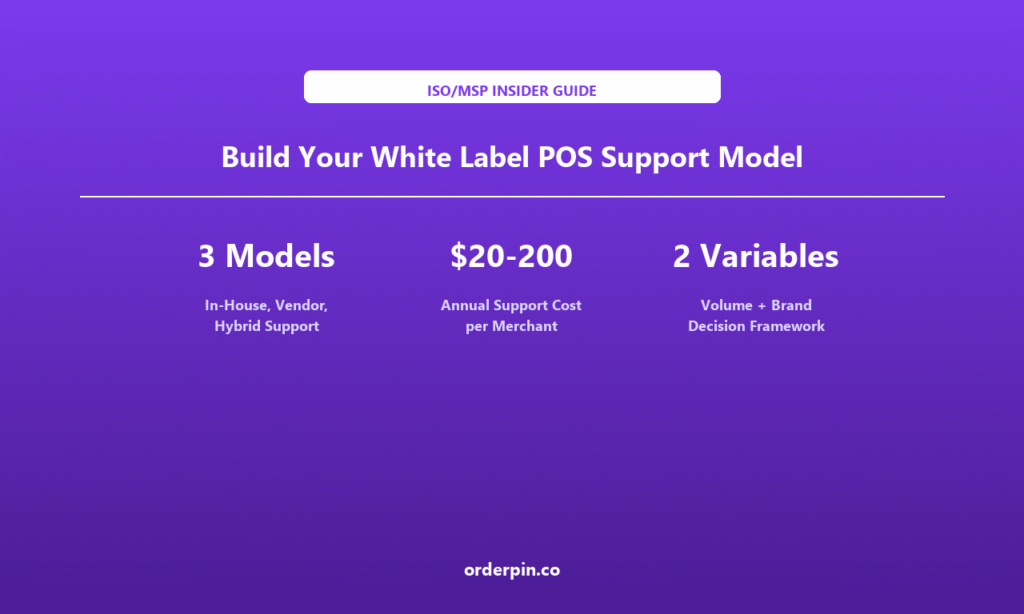
- The white label support model is the third major operational decision after platform selection and delivery model (AD16): the ISO must decide who answers the merchant’s call when the POS is down at 9pm on a Saturday — the ISO’s own team, the vendor’s support desk, or a hybrid where the ISO owns the merchant relationship and the vendor owns the technical resolution. This decision determines support cost, brand control, escalation speed, and ultimately the merchant’s perception of who they are doing business with.
- The three models map to three different cost and control tradeoffs: in-house (full brand control, highest cost — $120 to $200 per merchant per year in fully-loaded support cost at 100 to 200 merchants), vendor-managed (lowest cost — often included in the platform fee or $20 to $40 per merchant per year, but the merchant experiences the vendor, not the ISO), and hybrid (ISO owns the relationship via a customer success layer, vendor owns technical L2/L3 — $50 to $90 per merchant per year, the most common choice for growing ISOs).
- The decision framework uses two variables: merchant volume (which determines whether the ISO has enough scale to justify in-house staff) and brand ambition (whether the ISO wants the merchant to perceive them as a technology company or a reseller). Use the framework in this article to choose, and revisit the model at every 2x volume inflection — the right model at 100 merchants is rarely the right model at 500.
Support Comparison
per Merchant by Model
Decision Framework
The Third Operational Decision
Most ISOs spend their planning energy on two decisions: which white label platform to select (AD9 scoring framework, AD7 due diligence), and whether to deliver as white label or PayFac (AD16). The third decision — how to operate merchant support — gets decided by default rather than by design. The ISO signs the vendor, and whoever the merchant calls first becomes the de facto support provider. By the time the ISO notices the merchant perceives the vendor as their partner, not the ISO, the relationship damage is done.
Support is not a back-office function for a white label ISO — it is the primary ongoing touchpoint with the merchant. The merchant does not interact with the ISO’s sales deck after signing; they interact with whoever answers when the system breaks. The ISO that treats support as a cost center optimizes it away and loses the relationship. The ISO that treats support as the customer success engine builds a defensible, recurring-revenue portfolio. This article helps the ISO choose the support model that matches their scale and their brand ambition.
$120–200 / merchant / yr
$20–40 / merchant / yr
$50–90 / merchant / yr
Clear path required
Model 1 — In-House Support Team
How it works: The ISO builds its own customer success team — support agents, a tier-2 technical escalation layer, and a support manager. The ISO hires, trains, and manages the team, sets the SLA, and owns the merchant relationship end to end. The vendor is invisible to the merchant — every support interaction is with the ISO’s brand.
Staffing math: A single support agent can handle approximately 80 to 120 merchants at a standard support ratio (assuming 2 to 4 contacts per merchant per month, 10 to 15 minutes per contact, plus administrative time). At 100 merchants, the ISO needs roughly 1.0 to 1.5 FTE (agent + part-time manager). At 500 merchants, 5 to 7 FTE. Fully-loaded cost (salary, benefits, tooling, training) runs $50,000 to $75,000 per FTE per year — translating to $120 to $200 per merchant per year in support cost at the 100 to 200 merchant range. The cost per merchant decreases as volume scales (economies of density), but the absolute cost is the highest of the three models.
When it fits: ISOs with a brand ambition to be a technology company (not a reseller), merchants with high-touch needs (multi-location, complex integrations, custom workflows), and portfolios above 300 merchants where the per-merchant cost has scaled down enough to be competitive. The ISO that wants the merchant to say “I’m with [ISO brand], they take care of everything” should run in-house support.
Model 2 — Vendor-Managed Support
How it works: The vendor’s support desk handles all merchant support — L1 (basic questions, how-to) and L2 (technical issues, escalations). The ISO’s role is sales and relationship management, not support delivery. The merchant experiences the vendor’s support brand, not the ISO’s — unless the vendor offers a white-label support layer (where the vendor’s agents operate under the ISO’s brand, a capability the ISO should verify during AD13 configuration and AD7 due diligence).
Cost: Often included in the platform fee, or priced at $20 to $40 per merchant per year for a white-label support layer. This is the lowest-cost model by a wide margin — the vendor amortizes its support infrastructure across all its ISO partners’ portfolios, so the ISO pays a fraction of the true cost. For an ISO below 100 merchants, vendor-managed support is almost always the economically rational choice.
The tradeoff — brand control: The merchant perceives the vendor as their support partner, not the ISO. When the merchant’s POS breaks and a vendor-branded agent resolves it, the merchant’s loyalty accrues to the vendor, not the ISO. This is the portability risk again (see AD8 exit fees and AD7 data portability) — the ISO that cedes support to the vendor cedes a layer of the merchant relationship. The ISO should negotiate a white-label support layer (vendor agents operating under the ISO’s brand) as a contract condition (see AD12 negotiation levers) to capture the brand benefit while keeping the cost advantage.
Model 3 — Hybrid Support
How it works: The ISO owns the merchant relationship through a customer success layer — a small team (or even a single CSM at low volume) that handles onboarding, proactive check-ins, account reviews, and relationship management. The vendor handles technical support (L2/L3) — the actual bug fixes, terminal replacements, and integration troubleshooting. The merchant interacts with the ISO for everything relationship-related and with the vendor (often white-labeled) for pure technical resolution. This is the most common model for growing ISOs between 100 and 500 merchants.
Cost: $50 to $90 per merchant per year — the ISO carries the customer success layer (1 CSM per 150 to 250 merchants, $60,000 to $80,000 fully loaded) and the vendor carries technical support (white-label L2/L3 at $20 to $40 per merchant per year). The hybrid model captures most of the brand-control benefit of in-house (the merchant has a named ISO contact who knows their business) at roughly half the cost.
Escalation path (critical): The hybrid model fails when the escalation path between the ISO’s CSM and the vendor’s technical team is unclear. The ISO must define: what the CSM can resolve without the vendor (onboarding questions, basic how-to, account changes), what triggers a vendor L2 ticket (technical failures, integration errors, hardware faults), the SLA for vendor response (4 hours for severity-1 outages, 24 hours for severity-2), and the escalation contact at the vendor for when the CSM’s ticket stalls. The ISO should formalize this in a support runbook and review it quarterly with the vendor.
Setting SLAs by Model
| Model | First Response | Resolution (Sev-1) | CSM Coverage | Best At |
|---|---|---|---|---|
| In-House | 15 min | 2 hours | Full | Brand control, high-touch |
| Vendor | 1 hour | 4 hours | None | Low cost, sub-100 merchants |
| Hybrid | 30 min | 4 hours | Relationship | Balance of control + cost |
The SLA the ISO commits to should be set one tier below what the model can actually deliver — so the ISO consistently meets or beats it. A hybrid model that can deliver 30-minute first response should commit to 1-hour first response, building a margin of reliability that compounds merchant trust. The ISO should measure actual SLA performance monthly and review vendor SLA credits (negotiated in AD12) when the vendor misses its committed response times.
Decision Framework: Which Model Fits Your ISO?
| ISO Profile | Recommended Model | Why | Transition Trigger |
|---|---|---|---|
| <100 merchants | Vendor (white-label) | In-house cost unjustified; scale insufficient for density | At 100, evaluate hybrid |
| 100–300 merchants | Hybrid | CSM layer affordable; brand control without full cost | At 300, evaluate in-house |
| 300–500 merchants | Hybrid → In-House | Per-merchant cost converging; brand ambition grows | Pilot in-house CSM for top 50 accounts |
| >500 merchants | In-House | Density economics favor owned team; strategic brand asset | Full transition over 6–12 months |
How OrderPin Supports Your Support Model
OrderPin is a white-label POS platform built for ISO and MSP partners — and the support model the ISO chooses depends on the platform’s capabilities. For vendor-managed and hybrid models, OrderPin provides the technical support layer (L2/L3) that the ISO’s CSM escalates to, with clear escalation paths and SLA-backed response times. For in-house models, OrderPin’s API and documentation let the ISO’s technical team resolve issues directly. The ISO should confirm OrderPin’s white-label support-layer capability during the AD13 configuration review and negotiate SLA credits in the AD12 contract. Use this framework to choose the model that matches your portfolio’s scale and your brand ambition today — and revisit it at every 2x volume inflection.
Frequently Asked Questions
Can I switch support models as I grow?
Yes — and you should. The right support model at 100 merchants is rarely the right one at 500. The transition path is usually: vendor-managed (sub-100) → hybrid (100 to 300) → in-house (300+). Each transition requires the ISO to build internal capability (hiring CSMs, documenting the support runbook, negotiating vendor SLA credits) before fully moving off the previous model. The ISO should pilot the next-tier model with its top 20 to 50 accounts before a full transition — this de-risks the switch and builds the internal playbook before the whole portfolio depends on it.
What is the biggest risk of vendor-managed support?
Brand erosion and portability risk. When the merchant’s support experience is entirely the vendor’s (not white-labeled), the merchant’s loyalty accrues to the vendor, not the ISO. At renewal or exit, the ISO’s portfolio is vendor-locked because the merchant has no relationship with the ISO’s support brand (see AD8 exit fees and AD7 data portability). The mitigation is to negotiate a white-label support layer — vendor agents operating under the ISO’s brand — as a contract condition in AD12. This captures the cost advantage while preserving the ISO’s brand presence in the support relationship.
How many CSMs do I need in a hybrid model?
One CSM can manage 150 to 250 merchants in a hybrid model — because the CSM’s role is relationship management (onboarding, proactive check-ins, quarterly business reviews, renewal management), not technical resolution. The vendor handles the technical tickets. At 200 merchants, the ISO needs 1 CSM plus a part-time manager; at 400 merchants, 2 CSMs; at 600 merchants, 3 CSMs plus a support manager. The CSM ratio is the key staffing metric — and it is far more favorable than the in-house ratio (80 to 120 merchants per agent) because the technical load is offloaded to the vendor.
Should I build a customer success team before I have the volume?
No — premature in-house support is the most common support-model mistake. ISOs below 100 merchants that build a support team burn $120 to $200 per merchant per year on a function the vendor provides for $20 to $40. The ISO should run vendor-managed (white-label) support until it crosses 100 merchants, then pilot a hybrid CSM layer. The exception is high-touch merchant segments (multi-location operators, AD17) where relationship management drives retention — but even then, a single CSM can cover 150 to 250 such merchants in a hybrid model before a full team is justified.
How do I measure whether my support model is working?
Track four metrics monthly: (1) SLA attainment (percentage of tickets meeting first-response and resolution SLAs), (2) merchant NPS or satisfaction score (target ≥7 of 10), (3) support-driven churn (merchants that churned with a support-related ticket in the 90 days before leaving — target <5 percent of total churn), and (4) cost per merchant per year (against the model’s benchmark range). The ISO that measures these monthly can detect a model mismatch before it shows up in portfolio churn — and can justify the transition to the next model with data rather than anecdote.
How does support model relate to AD16 and AC46?
AD16 covers the delivery model (white label vs PayFac) — the support model is a sub-decision within the white label path. AC46 covers why every ISO needs a customer success team (the strategic argument for owning the relationship); this article (AD18) covers how to operate that team alongside vendor support (the operational decision). Together, AD16 + AD18 + AC46 give the ISO the full picture: which delivery model to choose, why to own the customer relationship, and how to operate support without carrying the full cost of an in-house team at low volume.
The white label support model is the third major operational decision after platform selection and delivery model — and it should be made by design, not by default. Three models trade off cost and brand control: in-house (full control, $120 to $200 per merchant per year, best above 300 merchants), vendor-managed (lowest cost, $20 to $40, but less brand control unless white-labeled, best below 100 merchants), and hybrid (ISO owns the relationship via CSM, vendor owns technical, $50 to $90, best between 100 and 500). Use the two-variable framework — merchant volume and brand ambition — to choose, and revisit the model at every 2x volume inflection. The ISO that owns the merchant relationship through a customer success layer, whether in-house or hybrid, builds a defensible recurring-revenue portfolio that the vendor cannot extract. OrderPin, a white-label POS platform built for ISO and MSP partners, provides the technical support layer (L2/L3) and white-label support capabilities that make the hybrid and vendor-managed models work — so the ISO can own the relationship without carrying the full cost of an in-house team.
About OrderPin
OrderPin is a white-label POS platform built for ISO and MSP partners. We offer full data ownership, flexible pricing, and seamless API integrations to help you build a recurring revenue business under your own brand. Learn more about OrderPin’s white-label solution