
TL;DR — Quick Summary
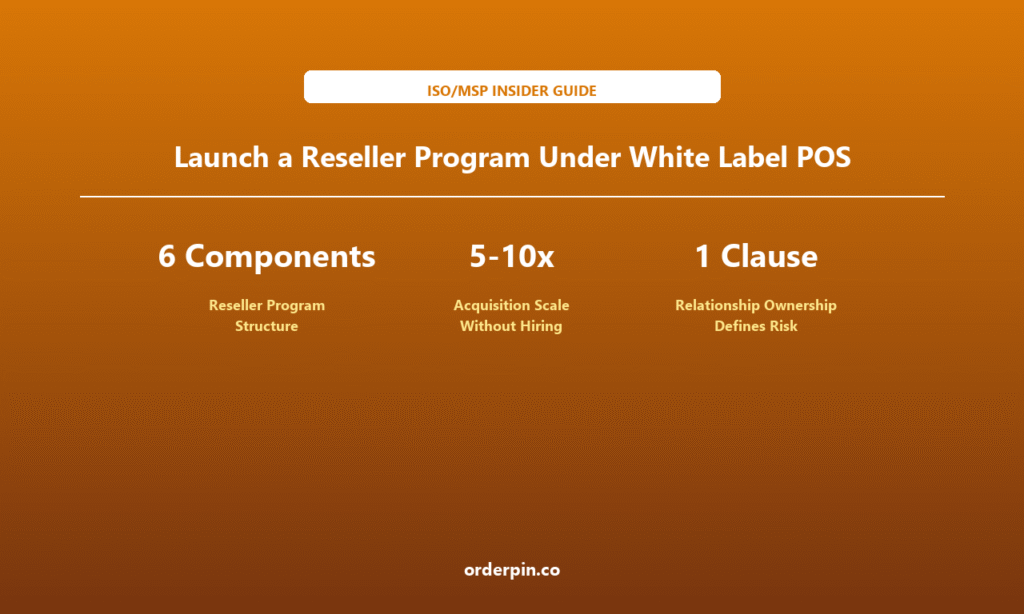
- The white label platform lets the ISO stop being a reseller and become a platform owner: instead of personally signing every merchant, the ISO builds a reseller channel — agents and sub-ISOs who sell under the ISO’s brand and earn residuals on the merchants they bring. This extends the ISO’s reach without the fixed cost of hiring a sales team, and turns the ISO’s white label platform into a distribution network. The ISO that runs a reseller program can scale merchant acquisition 5x to 10x without proportional headcount growth.
- A reseller program has six structural components: commission and residual tiers (how resellers get paid), sub-brand provisioning (how each reseller gets their own branded instance), reseller training (how they learn the platform and the pitch), co-branded materials (marketing assets that carry both the ISO’s and the reseller’s identity), residual tracking (transparent reporting that resellers trust), and compliance (who owns the merchant relationship and the associated liabilities). The ISO that builds all six operates a defensible distribution network; the ISO that skips one creates a leak.
- The most important structural decision is who owns the merchant relationship: if the reseller owns it, the ISO’s portfolio is dependent on reseller loyalty (resellers leave with merchants). If the ISO owns it (the merchant contracts with the ISO, the reseller is a commission agent), the ISO’s portfolio is protected and the reseller is a true commission-based channel, not a competing ISO. The relationship-ownership clause should be the first item in the reseller agreement — and the ISO should verify with the vendor during AD7 due diligence that the platform supports merchant attribution that survives reseller churn.
Structure
Without Hiring
Defines Portfolio Risk
From Reseller to Platform Owner
The ISO’s original position is reseller — it buys a white label platform and sells it to merchants under its own brand. But white label technology unlocks a position most ISOs never reach: platform owner. The ISO can provision sub-branded instances of its platform for agents and resellers, who then sell to merchants under a co-branded identity while the ISO retains the platform, the portfolio, and the economics. This transforms the ISO’s cost structure: instead of carrying the fixed cost of a sales team, the ISO carries a variable cost (reseller commissions) that scales with revenue.
The distinction matters: a traditional agent program (covered in earlier series) makes the agent a commission-based seller who does not own the merchant relationship. A white label reseller program goes further — the ISO can provision the agent their own branded instance, their own merchant dashboard, and their own co-branded materials, while the ISO owns the platform and (critically) the merchant relationship. The ISO that runs this well operates a distribution network that compounds — every reseller the ISO recruits extends reach into a market the ISO could not reach alone.
by volume & tenure
provisioning
onboarding
reporting
Component 1 — Commission and Residual Tiers
The commission structure determines whether resellers recruit and stay. A flat commission (e.g., 20 percent of the ISO’s margin) is simple but does not reward scale. A tiered structure rewards resellers who build volume and stay tenured: a reseller earning below $1,000/month in residuals gets 20 percent; $1,000 to $5,000 gets 25 percent; above $5,000 gets 30 percent. Tenure bonuses (an additional 5 percent after 24 months) reward retention. The ISO should also define the clawback policy: if a merchant churns within 90 days, the corresponding residual is reversed — this prevents resellers from gaming volume with merchants that will not stick.
The ISO’s margin math must work at every tier. If the ISO’s net margin is 20 to 30 bps (per AD16 and AD4), a 25 percent residual payout leaves 15 to 22 bps for the ISO. At the 30 percent tier, the ISO retains 14 to 21 bps. The ISO must confirm that the retained margin covers the platform cost and the ISO’s overhead at the top tier — otherwise the top tier is a loss leader that only makes sense if it drives volume that lowers the ISO’s per-merchant cost (see AD15 TCO and AD10 revenue models).
Component 2 — Sub-Brand Provisioning
Each reseller gets their own branded instance of the ISO’s platform — their own subdomain, their own merchant dashboard, their own branded app (if the platform supports app-store distribution per AD13), and their own receipt and notification branding. This is the white label capability that makes a reseller program possible: the ISO provisions a sub-brand in minutes, and the reseller operates as if they have their own platform. The ISO should verify during AD7 due diligence and AD13 configuration that the vendor supports multi-tier white labeling (ISO brand → reseller sub-brand) without per-reseller setup fees that destroy the economics.
Sub-brand provisioning should be automated — the ISO should be able to provision a new reseller instance through an admin console or API, not through a manual vendor ticket that takes days. The ISO that can provision a reseller in under an hour can recruit resellers at the pace the market supports; the ISO that waits days per reseller loses momentum and recruits to competitors.
Component 3 — Reseller Training
A reseller program fails when resellers do not know how to sell the platform. The ISO must build a reseller onboarding curriculum: platform demonstration (the AD11 demo script adapted for reseller use), the merchant pitch (target merchant profiles, common objections and responses), the onboarding playbook (AD14 single-location and AD17 multi-location), and the compliance basics (who owns the merchant, what the reseller can and cannot promise). The ISO should deliver this as a self-serve portal (recorded sessions + documentation) plus a live onboarding session for each new reseller cohort.
The training investment pays for itself in reseller productivity: a trained reseller reaches first-merchant-signed in 30 to 45 days; an untrained reseller takes 90 to 120 days and churns at twice the rate. The ISO should track time-to-first-merchant by reseller cohort and intervene on resellers that fall outside the 45-day window.
Component 4 — Co-Branded Materials
Resellers need marketing assets that carry both identities — the ISO’s brand (the platform authority) and the reseller’s brand (the local relationship). The ISO provides a co-brand kit: one-page sell sheets, a merchant presentation template, email sequences, and social media assets, all with a reseller-specific co-brand slot. The ISO should maintain brand guidelines that prevent resellers from making claims the platform cannot support (consistent with the content-accuracy rule — no claiming capabilities the vendor does not offer) and from altering the ISO’s core brand elements.
Co-branding also mitigates the relationship-ownership risk: when the merchant sees both the ISO’s and the reseller’s brand on every material, the ISO’s brand is present in the relationship even at the local level. This makes the merchant’s primary loyalty to the platform (the ISO), with the reseller as the local face — not the reverse.
Component 5 — Residual Tracking
Resellers stay when they trust the numbers. The ISO must provide transparent, real-time residual reporting: each reseller sees their merchants’ processing volume, their earned residual, the tier they are in, and the clawback history. The reporting should be accessible through the reseller’s sub-brand dashboard (Component 2) and downloadable as a monthly statement. The ISO that provides opaque or delayed reporting creates distrust that drives reseller churn — and reseller churn takes merchants with it if the relationship-ownership clause is weak.
The residual calculation must match the commission tier structure (Component 1) exactly and must be auditable against the underlying processing data. The ISO should reconcile residual reports against the platform’s processing reports monthly and resolve discrepancies before resellers notice them. A single unresolved discrepancy erodes more trust than a 5 percent commission reduction communicated transparently.
Component 6 — Compliance and Relationship Ownership
The relationship-ownership clause is the structural decision that determines portfolio risk. Two models: (1) ISO-owns-relationship — the merchant contracts with the ISO, the reseller is a commission agent, and the ISO retains the merchant if the reseller leaves. (2) Reseller-owns-relationship — the merchant contracts with the reseller, who is effectively a sub-ISO, and the ISO’s portfolio is dependent on reseller loyalty. Model 1 is almost always better for the ISO’s long-term portfolio value; Model 2 converts the reseller into a competitor who can leave with the book.
Compliance responsibility follows ownership: in Model 1, the ISO carries the compliance obligations (KYC, AML, sponsor bank relationship — the shared compliance burden from AD16) and the reseller is a sales agent subject to the ISO’s oversight. In Model 2, the reseller may carry compliance obligations as a sub-ISO, which introduces liability and oversight complexity for the ISO. The ISO should structure the program as Model 1 and verify with the vendor that merchant attribution survives reseller churn (the merchant stays attributed to the ISO, not the reseller, so the ISO’s portfolio value is protected).
Reseller Program Readiness Checklist
| Readiness Item | Pre-Launch | Why It Matters |
|---|---|---|
| Tiered commission structure defined | Required | Drives reseller recruitment and retention |
| Vendor supports multi-tier white label | Required | Sub-brand provisioning without per-reseller fees |
| Automated reseller provisioning | Required | Recruit at market pace, not vendor-ticket pace |
| Reseller training portal | Required | Time-to-first-merchant under 45 days |
| Relationship-ownership clause (ISO owns) | Required | Protects portfolio if reseller churns |
| Transparent residual reporting | Required | Reseller trust; prevents trust-driven churn |
| Co-brand kit + brand guidelines | Required | Local presence + ISO brand in every touchpoint |
| Merchant attribution survives reseller churn | Required | Verified in AD7; portfolio value protected |
How OrderPin Supports Your Reseller Program
OrderPin is a white-label POS platform built for ISO and MSP partners — and multi-tier white labeling is a core capability for running a reseller program. The ISO can provision sub-branded instances for each reseller (Component 2), automate provisioning through OrderPin’s admin capabilities (Component 2), and use OrderPin’s reporting to power transparent residual tracking (Component 5). The ISO should confirm OrderPin’s multi-tier white-label and merchant-attribution support during AD7 due diligence and AD13 configuration — and verify that merchant attribution survives reseller churn so the ISO’s portfolio value is protected under the ISO-owns-relationship model. Use this six-component framework to build a reseller program that extends your reach without the fixed cost of a sales team.
Frequently Asked Questions
How many resellers do I need before a program is worth it?
The program is worth building once you have the infrastructure — the cost of the six components (commission structure, sub-brand provisioning, training portal, co-brand kit, residual reporting, agreement template) is largely fixed and recovered at 3 to 5 active resellers. Below that, the ISO should recruit resellers ad hoc without formal infrastructure. Above 5 active resellers (each signing 2 to 5 merchants per quarter), the formal program’s infrastructure cost is amortized across enough volume to justify the build. The ISO should set the program-launch trigger at “5 resellers in pipeline” rather than waiting for a specific merchant count.
What if a reseller leaves with my merchants?
This is the relationship-ownership risk, and it is mitigated by the ISO-owns-relationship clause (Component 6) and verified merchant attribution (AD7). If the merchant contracts with the ISO (not the reseller), the reseller’s departure does not move the merchant — the ISO continues servicing the merchant directly or assigns a new reseller. The ISO should also include a non-solicitation clause in the reseller agreement (the reseller cannot solicit the ISO’s other merchants) and a portability confirmation with the vendor that merchant accounts are the ISO’s, not the reseller’s. The ISO that skips these protections converts its reseller channel into a leak.
How do I prevent resellers from undercutting my brand?
Brand guidelines (Component 4) set the rules: resellers may use the co-brand slot with their identity, but may not alter the ISO’s core brand elements, may not make claims the platform cannot support (no claiming capabilities the vendor does not offer), and may not publish pricing that contradicts the ISO’s approved rate card. The ISO should review reseller-published materials quarterly and provide a pre-approved asset library so resellers do not need to create their own. The ISO that gives resellers a complete co-brand kit and clear guidelines gets brand-consistent local marketing; the ISO that gives resellers a logo and “go forth” gets brand chaos.
Should I pay resellers on processing volume or merchant count?
Residuals should be paid on processing volume (the merchant’s monthly processing, not the merchant count) — because the ISO’s margin is a function of volume, not count. A reseller with 10 low-volume merchants earns less residual than a reseller with 2 high-volume merchants, and the commission should reflect that. Paying on merchant count incentivizes resellers to sign low-value merchants; paying on volume incentivizes resellers to find merchants that actually process. The ISO should also include a minimum-volume threshold for tier advancement (a reseller must sustain $X/month in processed volume to reach the next commission tier) so tenured resellers are rewarded for portfolio quality, not just longevity.
How does a reseller program affect my TCO and margins?
The reseller program adds a variable cost (commissions, 20 to 30 percent of margin) but removes a fixed cost (sales team salaries). The ISO should model this in the AD15 TCO framework: at low volume, the fixed sales team is cheaper; at high volume, the variable commission is cheaper and scales without headcount. The margin retained by the ISO after reseller commission (14 to 22 bps per AD4 and AD16) still supports the AD10 revenue models — the reseller program is a customer acquisition engine, not a margin destroyer, as long as the ISO’s retained margin covers platform cost and overhead at the top commission tier.
How does this relate to AD16 and the agent model?
AD16 covers the delivery model (white label vs PayFac) — the reseller program is a distribution strategy within the white label path, not a delivery model. This article (AD19) covers how the ISO uses white label technology to build a distribution network (the ISO becomes a platform owner, not just a reseller). The agent model (covered in earlier series) is a simpler version where the agent is a commission seller without a sub-brand instance; the white label reseller program goes further by provisioning the agent their own branded platform. The ISO should choose the agent model for simple commission selling and the reseller program when it wants resellers to operate branded instances and extend reach at scale.
Under a white label platform, the ISO can stop being a reseller and become a platform owner — building a reseller channel that extends reach 5x to 10x without the fixed cost of a sales team. The program has six structural components: commission tiers, sub-brand provisioning, reseller training, co-branded materials, transparent residual tracking, and compliance with a clear relationship-ownership clause. The single most important decision is who owns the merchant relationship: the ISO-owns-relationship model (merchant contracts with the ISO, reseller is a commission agent) protects the portfolio if the reseller leaves; the reseller-owns-relationship model converts the reseller into a competitor who can leave with the book. Verify merchant attribution survives reseller churn during AD7 due diligence, build all six components before launch, and the reseller program becomes a compounding distribution asset. OrderPin, a white-label POS platform built for ISO and MSP partners, provides the multi-tier white-label and reporting capabilities that make the ISO-owns-relationship reseller program operable at scale.
About OrderPin
OrderPin is a white-label POS platform built for ISO and MSP partners. We offer full data ownership, flexible pricing, and seamless API integrations to help you build a recurring revenue business under your own brand. Learn more about OrderPin’s white-label solution