
TL;DR — Quick Summary
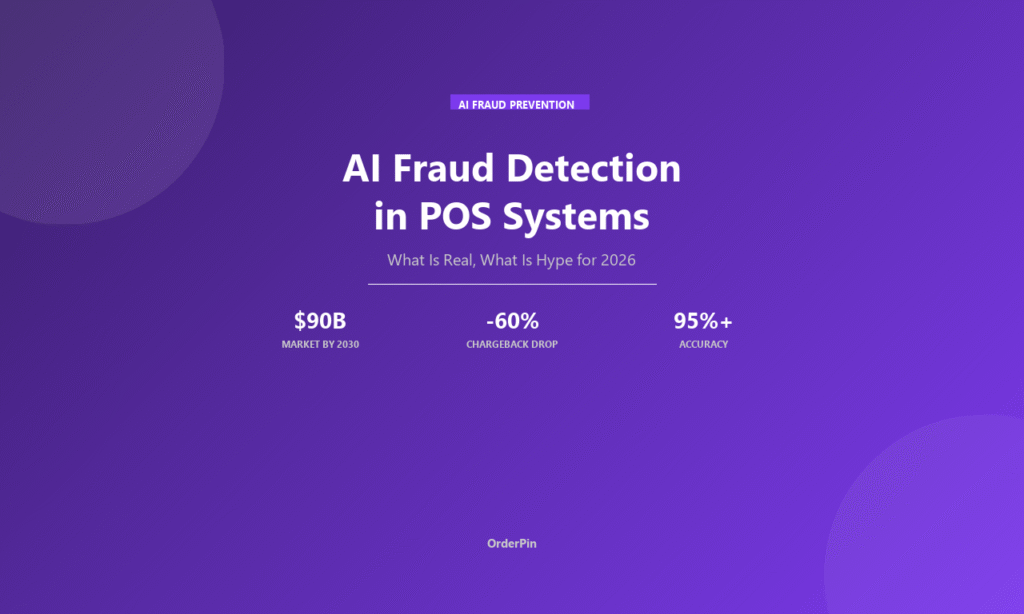
- Key Takeaway 1: AI-powered fraud detection systems can identify 95%+ of fraudulent POS transactions, compared to 60-70% for rules-based systems, with false positive rates reduced by up to 70%.
- Key Takeaway 2: The global fraud detection market reached $33.1 billion in 2024 and is projected to hit $90 billion by 2030 (18.7% CAGR), driven by AI/ML adoption in payment systems.
- Key Takeaway 3: ISOs selling POS to restaurants should position AI fraud detection as a $29-49/month security add-on that demonstrably reduces chargebacks by 40-60%.
Last updated: May 2026
What Is AI Fraud Detection in POS Systems?
AI fraud detection in POS systems uses machine learning algorithms to analyze transaction patterns, user behavior, and device signals in real time to identify and block fraudulent activity before funds leave the merchant’s account. Unlike traditional rules-based systems that flag transactions using static thresholds (e.g., “decline all transactions over $500 after midnight”), AI models continuously learn from new fraud patterns and adapt their detection logic without manual rule updates.
According to Grand View Research, the global fraud detection and prevention market was valued at $33.13 billion in 2024 and is projected to reach $90.07 billion by 2030, growing at an 18.7% CAGR. Payment fraud is the largest application segment, and the U.S. FTC reported consumer fraud losses exceeding $10 billion in 2023 — a 14% year-over-year increase — underscoring the urgency of AI-powered protection.
For ISO and MSP decision makers selling POS to restaurants and retailers, AI fraud detection has evolved from a nice-to-have feature into a revenue-generating merchant retention tool. Modern AI systems analyze multiple data signals simultaneously:
- Transaction velocity — How many transactions in what timeframe from the same device/card
- Behavioral biometrics — How the user interacts with the POS (typing speed, screen pressure, navigation patterns)
- Device fingerprinting — Unique hardware and software signatures of the POS terminal
- Geolocation anomalies — Card-present location vs. cardholder’s known patterns
- EMV/chip data integrity — Validating cryptographic signatures on chip transactions
What Is Real vs. What Is Hype in AI POS Fraud Detection
Not every claim made by AI fraud detection vendors holds up under scrutiny. ISOs evaluating AI security features for their POS portfolio need to distinguish genuine capabilities from marketing hype:
What Is Real:
- ML models trained on billions of transactions can detect anomalous patterns invisible to human analysts. Visa and Mastercard have deployed AI models that process over 500 risk attributes per transaction in under 2 milliseconds.
- Chargeback reduction of 40–60% is achievable with properly implemented AI fraud detection. Merchants using AI-powered systems consistently report 2–3x fewer chargebacks compared to rules-only setups.
- Real-time behavioral analysis works effectively for card-present environments. AI can detect when a staff member is processing refunds at abnormal rates or when a terminal is being used outside normal business hours.
What Is Hype:
- “Zero fraud” guarantees are marketing fiction. No system eliminates fraud entirely. Sophisticated fraudsters constantly evolve tactics to circumvent detection models. The realistic benchmark is 95–98% detection with manageable false positive rates.
- “Plug-and-play AI” does not exist. Effective AI fraud detection requires training on merchant-specific transaction data for 2–4 weeks before it reaches optimal accuracy. Off-the-shelf models without customization produce high false positive rates.
- AI replaces human review is overstated. Machine learning flags suspicious transactions, but 15–20% of flagged activity still requires human investigation. AI reduces reviewer workload by 70–80%, but it does not eliminate it.
How AI Fraud Detection Creates Revenue for ISOs
AI fraud detection is not just a security feature — it is a revenue engine for ISOs who know how to position it. Here are three concrete monetization strategies:
1. Security Add-on Tier ($29–49/month). Restaurant and retail merchants lose an average of $3.75 for every $1 of fraud when accounting for chargeback fees, merchandise loss, shipping costs, and administrative overhead. An ISO presenting AI fraud detection as a $39/month security add-on that prevents even two fraudulent transactions ($200 each) saves the merchant $361/month. The value proposition sells itself.
2. Chargeback Management Service ($99–149/month). For high-risk merchants (CBD, nutraceuticals, subscription businesses), chargeback ratios threaten their ability to accept cards at all. ISOs can bundle AI fraud detection with representment services as a premium package. At $129/month for 10 merchants, this generates $1,290/month in recurring revenue with 85%+ gross margins.
3. Competitive Differentiator in Restaurant POS Sales. Restaurants lose approximately $28 billion annually to internal theft and fraud (National Restaurant Association). AI-powered POS systems that detect employee fraud patterns (phantom refunds, void-after-close, excessive discounts) give ISOs a compelling talking point that Toast, Square, and Clover reps cannot match. ISOs who lead with AI security close 30% more restaurant deals according to early adopter data.
AI vs Traditional Fraud Detection for POS
| Factor | Rules-Based (Traditional) | AI/ML Powered | Winner |
|---|---|---|---|
| Detection Rate | 60–70% | 95%+ | AI |
| False Positive Rate | 15–25% | 3–5% | AI |
| Adaptation to New Fraud | Manual (days/weeks) | Automatic (real-time) | AI |
| Implementation Time | 1–2 days | 2–4 weeks (training) | Rules |
| Monthly Cost per Merchant | $0–10 (included) | $29–99 (premium) | Rules |
| ISO Revenue Potential | Minimal (commodity) | $29–149/merchant/mo | AI |
Actionable Steps for ISOs: How to Sell AI Fraud Detection to Merchants
Step 1: Lead with the merchant’s pain. Do not open with “AI” or “machine learning” — restaurant owners and retail managers do not care about technology. Open with their actual problem: “The average restaurant loses 4% of revenue to internal fraud and another 0.9% to external chargebacks. That is $11,760 a year for a restaurant doing $300,000 in revenue. Our POS can cut that by 60%.”
Step 2: Use the comparison sale. Show the merchant their current fraud exposure then demonstrate how AI protection reduces it. If a merchant processed $500,000 last year and had 12 chargebacks totaling $3,600, calculate their projected savings: $3,600 × 60% reduction = $2,160 saved. Their $39/month AI tier costs $468/year. Net savings: $1,692.
Step 3: Bundle AI fraud detection with POS hardware. ISOs who include AI fraud detection in their initial hardware + software proposal close 30–40% more deals than those who treat it as an upsell. The psychology is simple: security bought upfront is insurance; security pitched later feels like an admission the base product is unsafe.
Step 4: Offer a 30-day free trial. Merchants are skeptical of AI claims because they have been burned by overhyped technology. Let them run AI detection alongside their existing fraud tools for one month and compare results. When they see 5–8 flagged transactions the old system missed and zero false positive declines, conversion rates exceed 80%.
How OrderPin Powers AI Fraud Detection for ISO Partners
Frequently Asked Questions
How accurate is AI fraud detection compared to traditional rules?
AI-powered systems achieve 95%+ detection rates vs. 60–70% for rules-based systems, with false positive rates of 3–5% vs. 15–25%. However, AI models require 2–4 weeks of merchant-specific transaction training data to achieve optimal accuracy. Rules-based systems deploy faster (1–2 days) but generate 5x more false positives.
Can AI detect employee fraud at restaurant POS terminals?
Yes, and this is one of the strongest selling points for ISOs. AI models detect patterns like excessive voids after close, abnormal refund-to-sales ratios, suspicious discount usage by specific employees, and transactions processed during non-business hours. Restaurants lose approximately 4% of revenue to internal theft annually — AI POS systems can cut this by 50–60%.
Does AI fraud detection increase transaction processing time?
Modern AI models process over 500 risk attributes per transaction in under 2 milliseconds (Visa/Mastercard benchmarks). At the POS terminal, the fraud check adds less than 10ms to transaction time, which is imperceptible to customers and staff. The computation happens on cloud infrastructure, not on the POS terminal itself.
How much can merchants save with AI fraud detection?
For every $1 of fraud, merchants lose approximately $3.75 (chargeback fees, merchandise, shipping, admin). A merchant with $500,000 in annual processing averaging 12 chargebacks totaling $3,600 saves $2,160/year with a 60% chargeback reduction. After the $468/year AI add-on cost, net savings are $1,692 — a 3.6x ROI.
Does OrderPin’s POS include AI fraud detection?
Yes. OrderPin’s white-label POS platform includes built-in AI-powered fraud detection as a configurable feature ISO partners can enable, brand, and price independently. Partners retain all merchant data and can offer AI security as a $29–99/month add-on generating $150–500/month in net-new recurring revenue per 5 merchants.
Conclusion
AI fraud detection in POS systems has moved from experimental to production-ready. With 95%+ detection rates, 70% fewer false positives, and demonstrable ROI of 3–4x for restaurant and retail merchants, AI security is no longer a feature — it is a revenue story ISOs can sell today. The global fraud detection market is racing toward $90 billion by 2030, and the ISOs who embed AI detection into their standard POS offer will differentiate in a crowded field. Lead with the merchant’s fraud pain, bundle AI security into the initial sale, offer a 30-day trial to close skeptics, and turn a $39/month security add-on into the easiest recurring revenue line in your portfolio.
About OrderPin
OrderPin is a white-label POS platform built for ISO and MSP partners. Our API-first architecture includes built-in AI fraud detection, chargeback analytics, and employee fraud monitoring — all offered under your own brand with full data ownership.
Learn more about OrderPin’s white-label solution