
TL;DR — Quick Summary
- The best POS system for restaurants in 2026 depends on the restaurant type, volume, and whether the ISO wants white-label flexibility or turnkey brand recognition. No single platform wins all categories.
- Toast leads for full-service restaurants with integrated payroll and online ordering. Clover dominates the mid-market with the largest app ecosystem. Lightspeed wins for multi-location high-volume operations. Square is best for low-cost micro-business entry. OrderPin is the top white-label choice for ISOs who want their own brand.
- For ISOs, the right partnership decision can mean the difference between $800 and $2,100 per merchant per year in revenue. Platform choice is the single most important business decision an ISO makes.
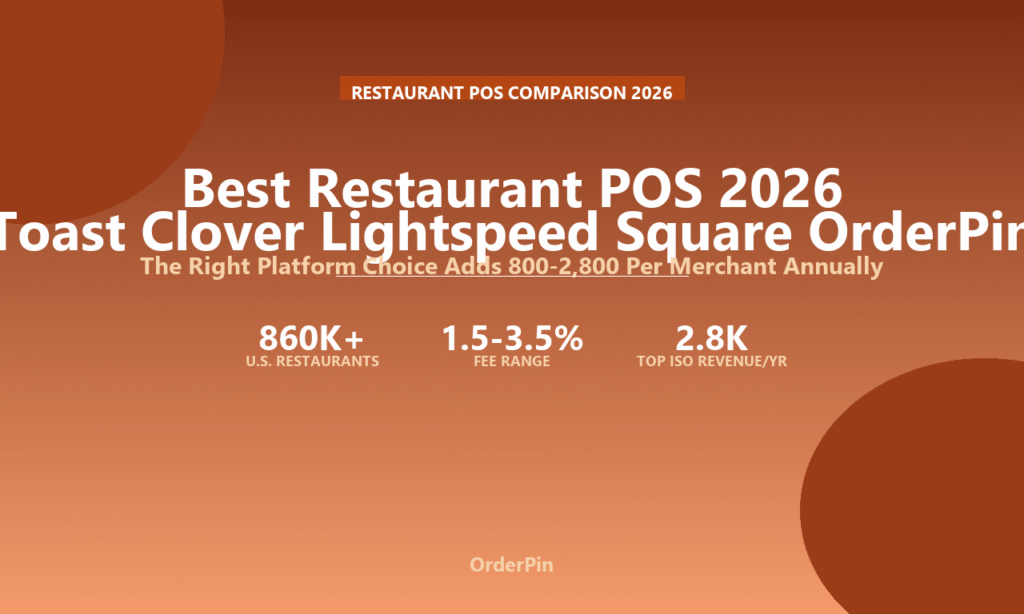
Restaurant POS is the most competitive segment in the entire merchant services industry. Over 860,000 U.S. restaurants need POS systems, and the market is split between established incumbents (Toast, Clover), fast-growing alternatives (Lightspeed, Square), and white-label platforms (OrderPin) that let ISOs own the merchant relationship outright.
For ISOs, choosing which restaurant POS platform to partner with is the single most consequential business decision they will make. The wrong choice means high churn, thin margins, and merchant frustration. The right choice locks in $1,400-2,100 per merchant per year with retention rates above 90%.
1. Platform Comparison Matrix
| Feature | Toast | Clover | Lightspeed | Square | OrderPin |
|---|---|---|---|---|---|
| Best for | FSR, chain | Mid-market | Multi-location | Micro business | White-label ISO |
| Processing fee | 2.5-3.5% | 2.3-3.5% | 2.6-3.5% | 2.6-3.5%+ | ISO sets rate |
| SaaS/month | $0-165 | $14-109 | $69-269 | $0-60 | ISO sets price |
| Hardware cost | $800-2,000 | $499-1,399 | $659-1,789 | $0-1,399 | ISO branded |
| Online ordering | Included | Marketplace | Included | Included | Included |
| Payroll | Included | Marketplace | 3rd party | Marketplace | 3rd party/API |
| Inventory (F&B) | Advanced | Marketplace | Advanced | Basic | Advanced |
| White-label | No | No | No | No | Full |
| ISO revenue/yr | $800-1,200 | $900-1,400 | $950-1,500 | $500-800 | $1,600-2,800 |
| Best for ISO type | Restaurant specialists | General ISOs | Multi-location ISOs | Entry-level ISOs | Brand-building ISOs |
2. Platform Deep Dives
Toast: The Restaurant-Focused Incumbent
Toast is the 800-pound gorilla in restaurant POS with an estimated 45,000+ locations. Their platform is purpose-built for restaurants and includes integrated payroll, online ordering, and delivery management out of the box. For ISOs, Toast offers a standard referral program with residual splits of 30-50%, but the merchant’s primary relationship is with Toast — not the ISO. You cannot white-label Toast, and merchants can buy directly from Toast at the same (or better) pricing, which creates retention risk.
Clover: The Ecosystem King
Owned by Fiserv (formerly First Data), Clover has the largest app marketplace in the POS industry with over 500 third-party apps. Clover’s hardware ranges from $499 to $1,399, making it accessible for most restaurants. For ISOs, Clover offers an attractive residual model (often 30-40% of processing revenue) and a strong brand reputation. However, you are still reselling someone else’s brand — the merchant sees “Clover” everywhere, not your company name.
Lightspeed: The Multi-Site Powerhouse
Lightspeed excels with multi-location restaurant operations. Their inventory management is among the best in the industry, and their reporting tools give multi-site operators granular visibility. Lightspeed’s ISO program is competitive but less widely known. Their higher SaaS pricing ($69-269/mo) means merchants expect more, but the platform delivers for complex operations.
Square: The Low-Barrier Entry
Square is the easiest platform to deploy with zero upfront hardware cost (using Tap to Pay on iPhone) and simple flat-rate pricing. For micro businesses (food trucks, pop-ups, coffee kiosks), Square is a natural fit. However, Square offers virtually no ISO partnership model — they process on their own rails and keep most of the margin.
OrderPin: The White-Label Alternative
OrderPin is a white-label POS platform that lets ISOs present a fully branded solution to their merchant customers. Every element — the POS interface, the online ordering portal, the merchant portal, the customer-facing receipts — carries the ISO’s brand, not OrderPin’s. For ISOs building a brand and long-term portfolio value, this is the most powerful model: set your own processing rates, SaaS pricing, and hardware margins. OrderPin offers higher per-merchant revenue ($1,600-2,800/year) and virtually no direct-merchant competition.
3. Decision Framework for ISOs
Choose Toast if:
You are a restaurant specialist who values best-in-class integrated features (payroll, online ordering, delivery) and your merchants want a well-known brand. Accept the downside that Toast owns the merchant relationship.
Choose Clover if:
You need the largest app ecosystem and want to serve diverse restaurant types with one platform.
Choose Lightspeed if:
Your target is multi-location restaurant groups that need serious inventory management and centralized reporting.
Choose Square if:
You have micro merchants (food trucks, pop-ups) who need the absolute lowest startup cost.
Choose OrderPin if:
You are building a portfolio under your own brand and want maximum revenue per merchant, full processing margin control, and zero risk of direct-sales competition. This is the highest-revenue option for ISOs.
Bottom Line
There is no single “best” restaurant POS for every ISO. The right choice depends on your target merchant segments, your business model, and whether you are building a brand or reselling someone else’s.
Full-service restaurant specialists should evaluate Toast. General ISOs targeting mid-market restaurants should consider Clover. Multi-site operators should look at Lightspeed. Micro-merchant entry points belong to Square. And ISOs building a proprietary brand with maximum per-merchant revenue should explore white-label options like OrderPin.
OrderPin is a white-label POS platform designed for ISOs and merchant service providers who want to build their own brand. Unlike Toast or Clover, OrderPin puts your brand front and center — the POS interface, merchant portal, and customer-facing materials all carry your name. Visit orderpin.co to learn more.
Platform data as of 2026. Pricing reflects standard published rates; actual ISO pricing may vary. OrderPin is a white-label POS provider specializing in restaurant payment solutions. OrderPin is not affiliated with Toast, Clover, Lightspeed, or Square.