
TL;DR — Quick Summary
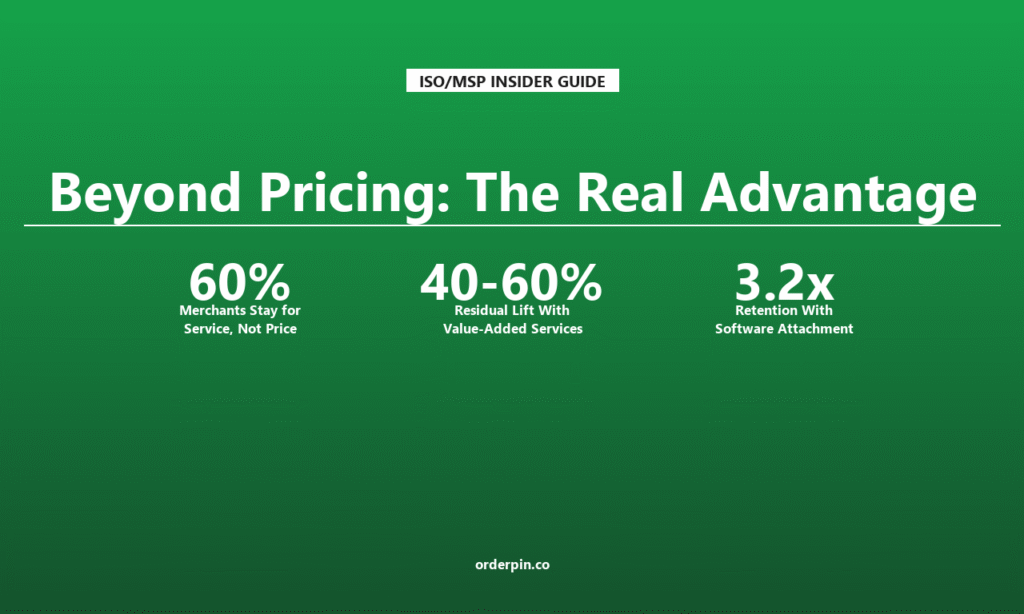
- 60% of merchants stay for service, not price: The leading reason merchants switch providers is poor service, not a better rate offer. The ISO that delivers consistent, proactive service builds a retention moat that rate competition can’t penetrate.
- Value-added services generate 40–60% higher residuals: Bundling PCI compliance, reporting, and technology platforms into a monthly service package adds recurring revenue and makes your offering far harder to compare — and replace.
- Relationship depth is the hardest moat to replicate: An ISO that knows their merchant’s business, anticipates problems, and delivers strategic advice is not easily displaced — regardless of who offers a lower rate.
Service, Not Price
Value-Added Services
Software Attachment
What Is the Real Competitive Advantage in Payments?
Walk into almost any merchant Services conversation and the first topic is rate. Basis points, interchange, and markup. The processor that can offer a lower rate wins the meeting — or so the logic goes.
The merchants who actually stay — year after year, renewal after renewal — tell a different story. They didn’t stay because the rate was competitive. They stayed because their ISO answered the phone, understood their business, flagged a problem before it became expensive, and delivered technology that made running the restaurant easier. Price is the entry point. Value is the reason they stay.
The ISOs building durable, profitable businesses in payments understand this distinction. They’re not competing on rate — they’re competing on service quality, relationship depth, and technology differentiation. And they’re generating significantly higher residuals, higher retention, and higher valuations as a result.
as Top Retention Factor
Value-Added Bundles
Software Attached
With Service Bundles
1. Why Price Competition Is a Trap
Rate competition is a race to the bottom, and every ISO who has participated in it knows it. You cut your margin to win the account. The merchant stays for 18 months — until the next ISO cuts their margin further. You lost money acquiring a merchant who was never loyal to you in the first place.
The fundamental problem with competing on rate is that rate is the most easily replicated and most easily displaced competitive variable. Any processor can lower a rate. Any competitor can undercut yours. If your entire value proposition is built on rate, you have no moat — only a price, which is inherently unstable.
The margin math doesn’t work: Cutting your rate to win an account means cutting your residual income. If you’re acquiring merchants at negative margin in hopes of making it up over time, the math requires those merchants to stay for years — which requires the kind of relationship depth that rate-only competitors can’t build.
Price-based merchants are the first to churn: A merchant acquired on price will leave on price. They’re not emotionally invested in the relationship, they don’t see the ISO as a partner, and the moment a competitor makes a slightly better offer, the account moves.
The cost of churn compounds: Every merchant who churns represents the acquisition cost — in time, marketing, and forgone margin — and the lost residual income for every future month they would have stayed. Price-based acquisition is a treadmill: you’re always acquiring, always replacing, never building equity.
2. The Four Dimensions of Real Competitive Advantage
The ISOs with the strongest competitive positions aren’t competing on one dimension. They’re building across four layers simultaneously — and each layer reinforces the others.
Service quality: The ISO who answers the phone, resolves problems quickly, and treats the merchant as a person rather than an account number builds trust that a competitor cannot easily purchase away. Speed of response and reliability of follow-through are the service moat.
Relationship depth: The ISO who understands their merchant’s business — the seasonal patterns, the staffing challenges, the expansion plans — becomes an advisor, not a vendor. That depth of relationship is not easily displaced by a rate cut.
Technology differentiation: A white-label POS platform, real-time reporting, and self-service tools make your offering functionally different from competitors. The merchant can’t just swap you out for a lower-rate processor without losing their reporting history, training, and integrations.
Value-added services: PCI compliance packages, security monitoring, and analytics retainers add recurring revenue and make your total offering opaque. A merchant can’t easily compare “ISO A’s bundle of processing plus PCI plus reporting” against “ISO B’s rate alone” — which protects your pricing power.
How OrderPin Helps ISOs Compete on Value, Not Rate
OrderPin is a restaurant POS software ISV that helps ISOs differentiate their offering with a white-label technology platform. Instead of competing on rate, ISOs who distribute OrderPin’s POS platform compete on technology, service depth, and recurring revenue — creating a value proposition that rate-only competitors cannot easily replicate.
- White-label POS platform: Deliver a branded technology product that makes switching away from you genuinely costly.
- Recurring revenue bundle: Layer monthly software and service fees on top of processing to increase per-merchant revenue and reduce price sensitivity.
- Full data ownership: Build the merchant insights that enable proactive, high-value service — your competitive moat.
- No long-term lock-in: You own the relationships; the technology enables them without trapping you.
3. Service Quality: The Moat That Compounds
Among merchants who cite service quality as their reason for staying with a provider, the most common themes are responsiveness, proactive problem-solving, and personalized attention. None of these are technology features. They’re the product of a service culture and the organizational habits that support it.
The compounding effect of service quality is significant. A merchant who has a great experience refers their colleagues. A merchant who feels genuinely served is embarrassed to leave. And an ISO with a reputation for service quality can attract better merchant prospects — because word spreads in business communities faster than any marketing campaign.
Respond before the merchant asks: Flagging a problem — a merchant whose decline rate is rising, a compliance gap that needs attention — before the merchant notices is the highest-value service act you can perform.
Set response-time standards: Define and commit to specific response times for different types of requests. Communicate those standards to merchants. Then exceed them.
Quarterly business reviews: Schedule a structured annual or quarterly check-in with your top merchants. Come prepared with data about their business — sales trends, peer benchmarks, optimization opportunities. Make the meeting worth their time.
Rate-Only ISO vs. Value-Differentiated ISO
| Dimension | Rate-Only ISO | Value-Differentiated ISO | Winner |
|---|---|---|---|
| Merchant Retention | 75–85% annual | 90%+ annual | Value-Diff |
| Revenue Per Merchant | $30–80/month | $100–200+/month | Value-Diff |
| Competitive Moat | None (rate is easily replicated) | Service, tech, relationships | Value-Diff |
| Acquirer Valuation | 1–1.5x revenue | 3–8x revenue | Value-Diff |
| Referral Rate | Low (price buyers don’t refer) | High (satisfied merchants refer) | Value-Diff |
4. Value-Added Services: The Bundle That Changes the Game
The most effective way to make your offering competitively distinct and reduce price sensitivity is bundling: combining processing with a set of services that together represent genuine value — and that a rate-only competitor cannot easily replicate with a lower rate.
A PCI compliance package alone might be worth $25–50 per month to a merchant. A real-time reporting dashboard might be worth another $50. Combined with processing in a single monthly fee, the total package is worth $150–200 — and the merchant who is evaluating your bundle against a competitor’s rate alone has no meaningful comparison point. The bundle makes your offering opaque, which protects your pricing power.
PCI compliance: Monthly security scanning, policy management, and compliance reporting — naturally paired with payments since PCI applies to card processing.
Reporting and analytics: Monthly merchant performance reports with benchmarks, trend analysis, and actionable insights — delivered as a branded document.
Priority support retainers: Guaranteed response times, a dedicated contact, and quarterly reviews — converting reactive service into a paid premium relationship.
5. Building Your Value Proposition: A Practical Framework
Shifting from a rate-based to a value-based competitive position doesn’t happen overnight — but it can start immediately, with deliberate steps that compound over time.
Audit your current value stack (month 1).
What are you currently offering beyond processing? Compliance tools, reporting, support? Write down everything you provide and its value to the merchant. If the list is short, that’s your first opportunity: identify the one service addition that would most differentiate your offering and bring the most value to your target merchants.
Price based on total value, not rate (month 1–2).
Stop leading with rate. Lead with the total value of the bundle — the technology, the compliance coverage, the support, the insights. When asked about rate, shift the conversation to what the merchant gets, not what they pay per basis point.
Build the service habits that create referrals (ongoing).
Proactive outreach is the most powerful competitive tool you have. Flag the decline rate. Suggest the pricing optimization. Recommend the second location. Every time you solve a problem before the merchant notices it, you deepen the relationship and raise the switching cost.
Double down on your best merchants. The top 20% of your book probably generates 80% of your value. Invest disproportionately in those relationships — quarterly reviews, personalized service, proactive insights — and build the retention moat in the places where it matters most.
Frequently Asked Questions
Why do merchants really switch payment providers?
Most merchant attrition is driven by poor service experience — not a competing rate offer. A merchant who feels ignored, has to wait too long for support, or discovers a problem the ISO should have caught is far more likely to switch than one who receives a competitor’s mailer with a lower rate. The ISO that delivers consistent, proactive service builds loyalty that rate competition cannot easily purchase away.
How does competing on value change an ISO’s economics?
Significantly. Value-differentiated ISOs generate 2–4x higher per-merchant revenue through service bundles and software attachments. They achieve 90%+ annual retention versus 75–85% for rate-only competitors. And they command 3–8x revenue valuation from acquirers versus 1–1.5x for processing-only books. The economics of value-based competition are superior at every level — retention, revenue, and exit valuation.
What is the fastest way to build a value-based offering?
Start with one service addition that genuinely adds value to your target merchants — a PCI compliance package, a real-time reporting tool, or a white-label POS platform. Price it as a monthly bundle with processing, and lead with the total value rather than the rate when you pitch it. Within three months, you have a differentiated offering that a rate-only competitor cannot easily replicate.
How does technology create a competitive moat?
Technology creates switching costs. A merchant who has built their operations around your POS system, who has two years of reporting history in your portal, and who has integrated your platform with their accounting software is not going to switch to a competitor offering a lower rate — because the switching cost in time, data loss, and retraining is too high. That switching cost is your competitive moat.
How do value-added services change pricing conversations?
They make the conversation opaque. A merchant comparing a bundled offering — processing plus PCI compliance plus real-time reporting — against a competitor’s rate has no clean basis for comparison. You’re not selling the same product at a different price; you’re selling a different product. That opacity protects your pricing power and reduces the leverage of rate-based competitors.
Can a small ISO compete on value against large processors?
Yes — and in many cases, better than large processors can. Large processors compete on rate and scale; they’re not built for relationship depth, personalized service, or vertical expertise. A small ISO that knows their merchants’ businesses, responds faster, and delivers a genuinely differentiated service experience has a structural advantage that no large competitor can easily replicate at their level of service.
Price competition is a race to the bottom that the ISO always loses. The merchants worth keeping — the ones generating the most residual income, referring their peers, and staying for years — are the ones who chose you because of service quality, relationship depth, and technology value. Build across all four dimensions: service, relationships, technology, and bundled services. Price your total value, not your rate. Invest disproportionately in your top merchants. OrderPin is a restaurant POS software ISV that helps ISOs compete on value, not rate — with a white-label platform that creates switching costs, recurring revenue, and a differentiated offering that rate-only competitors cannot replicate.
About OrderPin
OrderPin is a white-label POS platform built for ISO and MSP partners. We offer full data ownership, flexible pricing, and seamless API integrations to help you build a recurring revenue business under your own brand. Learn more about OrderPin’s white-label solution