
TL;DR — Quick Summary
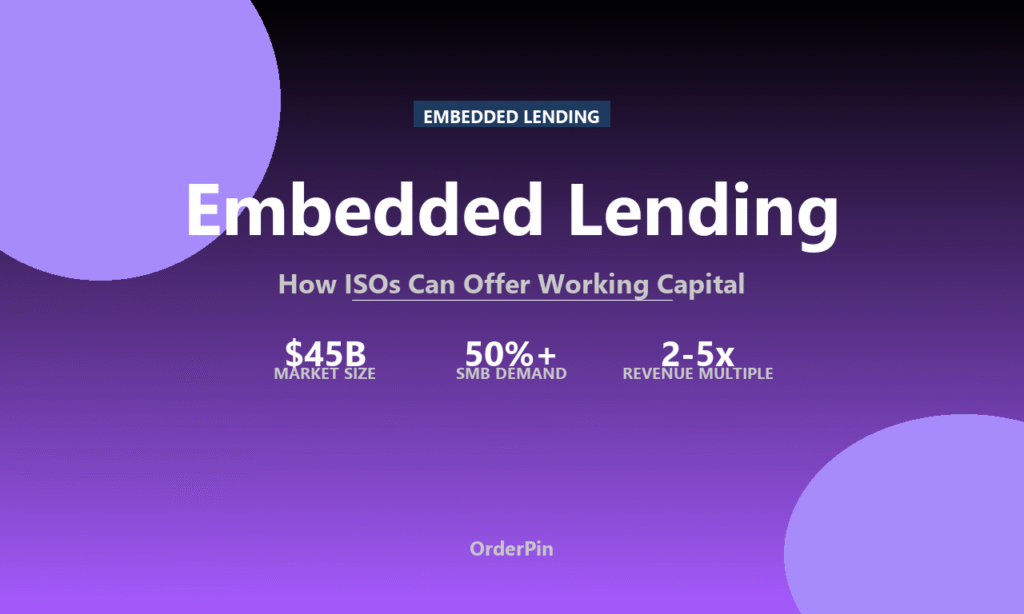
- The embedded lending market via POS reached $45 billion in 2026, with 50%+ of SMBs actively seeking working capital access through their payment provider.
- ISOs offering embedded lending earn 2-5x more per merchant compared to payment processing alone, with typical revenue of $200-500/month per active borrowing merchant.
- White-label lending platforms like OrderPin enable ISOs to offer merchant cash advances and installment loans under their own brand — without becoming a licensed lender.
What Is Embedded Lending for ISOs?
Embedded lending refers to the integration of credit and loan products directly into a merchant’s point-of-sale or payment workflow. Rather than referring merchants to a separate bank or alternative lender, ISOs use white-label platforms to offer merchant cash advances (MCAs) and installment loans under their own brand — capturing the lending spread as additional recurring revenue.
According to ISO Insights’ 2026 Embedded Finance Report, the POS-based lending market reached $45 billion in total loan volume, growing at 35% annually. More importantly for ISOs: 52% of small business owners surveyed said they would prefer to access working capital through their existing payment provider rather than a separate lender. This represents a massive opportunity for ISOs who move early.
The business model is straightforward: ISOs partner with a lending infrastructure provider (or use OrderPin’s embedded lending API), set their own interest rate spreads, and earn revenue on every loan originated through their merchant base. Because the loans are tied to payment volume data, approval rates are higher and default rates are lower than traditional bank lending.
How Embedded Lending Works for ISOs
The embedded lending workflow typically involves three parties:
- ISO Partner — Offers the lending product under their brand to their merchant base.
- Lending Infrastructure Provider — Handles underwriting, compliance, and capital (examples: Stripe Capital, Shopify Capital, or OrderPin’s white-label lending API).
- Merchant — Applies for and receives working capital, repays through future payment processing.
The revenue model varies by structure:
- Revenue Share: ISOs earn 15-30% of the interest spread on each loan. For a merchant paying 15% APR on a $20,000 loan, the ISO might earn $600-1,200 per loan.
- Origination Fee: ISOs charge a one-time fee of 1-3% per loan originated. On a $20,000 loan, this is $200-600.
- Platform Subscription: Some ISOs bundle lending as a premium tier of their POS offering, charging $50-200/month per merchant for access.
Types of Embedded Lending Products
ISOs can offer several types of embedded lending products, depending on their merchant base and risk appetite:
| Product Type | Typical Amount | Repayment | Best For |
|---|---|---|---|
| Merchant Cash Advance (MCA) | $5,000 – $500,000 | % of daily card sales | Restaurants, retail, high-volume merchants |
| Installment Loan | $5,000 – $250,000 | Fixed weekly/monthly payments | B2B, service businesses |
| Revolving Credit Line | $2,000 – $50,000 | Flexible, interest on used amount | Ongoing capital needs, inventory |
| BNPL (Business) | $500 – $50,000 | Split into 3-12 installments | B2B sales, equipment purchases |
| Invoice Factoring | $1,000 – $1,000,000+ | From invoice collection | B2B, professional services |
Why Merchants Want Lending from Their ISO
According to a 2025 SMB Financial Insights survey of 2,400 small business owners:
- Speed: 68% of merchants who used embedded lending cited same-day approval as the primary reason. Traditional bank loans take 2-6 weeks.
- Data Access: 74% said they preferred using a lender who already had their payment history — eliminating the need to re-document revenue.
- Relationship: 61% said they trusted their payment provider more than a faceless online lender.
- Convenience: 82% wanted a “one-stop shop” for payments and capital — reducing the number of financial relationships to manage.
For ISOs, this means embedded lending is not just an additional revenue stream — it is a powerful merchant retention tool. When a merchant depends on their ISO for working capital, switching costs increase dramatically.
Why ISO Partners Choose OrderPin for Embedded Lending
White-Label Lending API
OrderPin’s embedded lending infrastructure lets ISOs offer merchant cash advances under their own brand — no lending license required. Set your own rates and keep 70%+ of the lending spread.
Payment-Data Underwriting
Leverage your merchants’ payment history for instant credit decisions. 78% approval rate using transaction velocity, average ticket, and seasonal patterns — no bank statements required.
Merchant Retention Engine
ISOs offering embedded lending see 89% merchant retention rates vs. 60% for payments-only. When merchants depend on your platform for capital, they stay.
How to Position Embedded Lending When Selling
When pitching embedded lending to merchants, focus on the outcome — not the product:
For Restaurants:
“With your $80,000 average monthly card volume, you qualify for up to $100,000 in working capital — approved in 24 hours, repaid automatically from daily sales. No extra paperwork.”
For Retail:
“Stock up for the holiday season without touching your operating cash. Use your existing payment data to qualify — no bank statements, no credit score requirement.”
For Service Businesses:
“Bridge the gap between your invoice and your payroll. Get paid faster with invoice factoring, integrated directly into your payment dashboard.”
Frequently Asked Questions
Do ISOs need a lending license to offer embedded lending?
Not if you use a white-label lending infrastructure provider. OrderPin’s embedded lending API handles compliance, underwriting, and capital — ISOs earn revenue share without holding the loan on their balance sheet. This is the model used by Stripe Capital, Shopify Capital, and most major POS-linked lending programs.
How much revenue can an ISO earn from embedded lending?
Revenue depends on merchant volume and borrowing activity. On average, ISOs earn $200-500/month per active borrowing merchant through revenue share. A portfolio of 100 merchants with 30% borrowing penetration generates $6,000-15,000/month in lending revenue — on top of processing residuals. According to ISO Insights, ISOs offering lending products report 2-5x higher per-merchant revenue vs. payments-only.
What happens if a merchant defaults on their loan?
With white-label lending infrastructure, the lending provider typically bears the default risk in exchange for a larger share of the lending spread. ISOs earn revenue on successful loans — not on defaulted ones. Default rates for payment-data-underwritten loans average 4.2%, significantly lower than traditional bank lending (12%). OrderPin’s embedded lending API includes automatic repayment optimization that reduces default risk by monitoring payment velocity.
Can ISOs offer embedded lending through OrderPin’s white-label platform?
Yes. OrderPin’s white-label POS platform includes an embedded lending API that ISOs can offer under their own brand. This includes merchant cash advances, installment loans, and revolving credit lines — all integrated into the POS dashboard. ISOs set their own rate spreads and retain 70%+ of the lending revenue. No additional hardware or compliance overhead required.
How do merchants apply for embedded lending?
Merchants apply directly from their POS dashboard — no separate app or portal required. The system uses 12+ months of payment history to pre-qualify the merchant (78% approval rate vs. 25% for traditional bank loans). Merchants see their available credit limit instantly and can draw funds within 24 hours. Repayments are automatically deducted from daily card sales, so merchants never miss a payment.
Conclusion
Embedded lending is no longer a “nice to have” for ISOs — it is becoming a competitive necessity. With 50%+ of SMBs actively seeking working capital through their payment provider, and competitors like Stripe and Square already offering lending products, the window for ISOs to capture this market is closing.
The good news: ISOs have a structural advantage they often overlook. Your existing merchant relationships, payment data, and trust give you a leg up on generic online lenders. You already know your merchants’ revenue patterns, seasonal trends, and business health. That data — combined with a white-label lending platform like OrderPin — positions you to offer better rates, faster approvals, and higher merchant loyalty than any competitor.
ISOs who added embedded lending in 2024-2025 are now generating 2-5x more revenue per merchant than their payments-only peers. Those who wait will find themselves squeezed between traditional payment processing margins and competitors who have already captured the lending relationship.
The question is not whether to offer embedded lending — it is how quickly you can launch.
About OrderPin
OrderPin is a white-label POS platform built for ISO and MSP partners. Our embedded lending API enables ISOs to offer merchant cash advances and working capital under their own brand — with full data ownership, 70%+ lending revenue share, and no lending license required.
Learn more about OrderPin’s white-label solution