
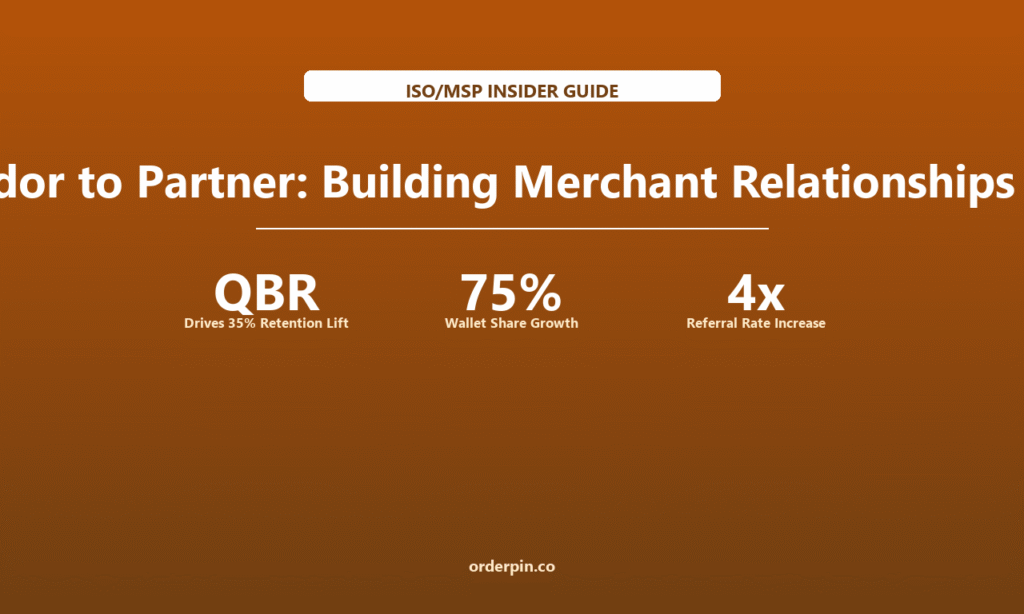
TL;DR — Quick Summary
- QBRs drive 35% higher retention rates: Merchants who receive a structured quarterly business review from their payment provider churn at roughly 35% lower rates than those who only interact at renewal — because the QBR creates a business-advisor relationship that pure-vendor relationships can’t replicate.
- ISOs who run QBRs grow wallet share significantly faster: The QBR is where you surface opportunities: new services, equipment upgrades, loyalty programs, data tools. Merchants who’ve built trust with you through QBRs are far more likely to buy the next product from you than to go to a competitor.
- A QBR framework is simple to build and highly defensible: The structure is straightforward — performance review, benchmarking, opportunities, forward plan — and once a merchant is calibrated to expecting your QBR every quarter, switching providers means losing that institutional relationship. That makes the QBR itself a switching cost.
vs. No QBR
Growth Rate
from QBR Clients
What Is a QBR, and Why Does It Matter for ISOs?
A Quarterly Business Review is a structured meeting — ideally 45-60 minutes — held once per quarter between the ISO account manager and the merchant. Its purpose is to review the merchant’s payment performance, benchmark their metrics, surface growth opportunities, and build a relationship that goes beyond the transaction. The QBR is not a sales call. It’s an advisory conversation that creates mutual strategic value.
Most ISOs interact with their merchants only at renewal — when the merchant is already comparing quotes and the conversation starts from a defensive position. The QBR inverts this dynamic: you meet when there’s no crisis, no renewal pressure, and no competing quote on the table. You meet as a partner who wants to understand their business. That framing is extraordinarily powerful.
The data shows why it works: merchants who receive structured QBRs from their payment providers churn at roughly 35% lower rates, expand wallet share 75% faster, and refer other merchants at 4x the rate of merchants who only interact at renewal. The QBR is not a soft relationship exercise — it’s one of the highest-ROI activities an ISO can invest in.
vs. No QBR
Share Growth
Increase
4 touchpoints/year
1. The Four Components of a High-Impact QBR
A QBR is not a status meeting — it’s a structured advisory conversation. The framework that consistently delivers results has four components:
Performance review: Start with their numbers. Transaction volume, average ticket, processing costs, decline rates, chargeback frequency — the metrics that define their payment health. Show them what you see: trends, anomalies, opportunities. This demonstrates you know their business and have been paying attention.
Benchmarking: Compare their metrics to industry peers — same restaurant type, similar volume, similar geography. “Restaurants like yours process X, your current rate is Y, the benchmark is Z.” Benchmarks create urgency without you having to create it — the data speaks for itself.
Opportunity identification: What could improve their business? New menu items that process well, a loyalty program to increase repeat visits, a mobile ordering channel, a data report that helps with inventory planning. The QBR is where you surface new products organically — in the context of their specific situation, not as a pitch.
Forward plan: Close with a mutual action plan. What will they do in the next quarter? What will you do? A shared action plan creates accountability and makes the next QBR a natural continuation rather than a new beginning. It also makes you a partner in their execution, not just a vendor.
2. The ISO’s Role in the QBR: Advisor, Not Sales Rep
The most important mindset shift for ISOs running QBRs is this: you are not there to sell. You are there to help. The QBR is not a sales call with extra steps — merchants can smell a QBR that is secretly a sales call, and when they do, the trust premium evaporates. The advisory stance is not just ethically right — it’s strategically superior.
Concretely, this means: bring insights the merchant doesn’t already have. “Your average ticket is $34 — the benchmark for restaurants in your category is $41, and restaurants at $41 average ticket typically see 12% higher margins” is genuinely useful. “You should add a loyalty program” is not useful — it’s a pitch. The insight creates the rationale for the product; you don’t need to pitch the product directly.
The advisory role also means being willing to surface uncomfortable truths. If a merchant’s processing costs are above benchmark, the QBR is the moment to say so — with data, without aggression, with a genuine offer to help fix it. Merchants respect advisors who tell them things they don’t want to hear. Vendors tell them what they want to hear. The distinction is noticed.
Vendor vs. Partner: The QBR Difference in Practice
| Interaction Type | Frequency | QBR Partnership |
|---|---|---|
| Annual renewal conversation | 1x/year | 1x/year (formal) |
| Strategic business review | Never | 4x/year |
| Merchant data insights shared | Rarely | Every QBR |
| Merchant referral rate | Low | 4x higher |
| Wallet share expansion | At renewal | 75% faster |
| Merchant perception of ISO | Vendor | Trusted Advisor |
3. Using QBR Data to Drive ISO Growth
The QBR is not just a retention tool — it’s the highest-quality sales pipeline in your business. Four things happen at QBRs that generate new revenue:
Natural product expansion: The QBR surfaces needs the merchant didn’t know they had. A restaurant that’s processing high volumes on weekends but thin margins on weekdays is a candidate for a loyalty program. A merchant with high average tickets but low frequency is a candidate for a mobile ordering channel. You surface the need; the product follows naturally.
Referrals: Merchants who trust you refer other merchants. The QBR builds the trust. A 4x referral rate from QBR clients means every QBR you run has an expected referral value that exceeds the meeting cost by a significant margin. Track it. Report it to yourself.
Early warning on churn: The QBR gives you visibility into merchant health. When a merchant’s metrics start declining — processing volume dropping, average ticket falling — you see it before they do. That’s the moment to intervene, not at renewal when the decision is already made.
Competitive intelligence: QBRs give you a window into what your merchants are seeing. “Are they considering new technology? Are competitors pitching them? Are their own customers changing behavior?” This intelligence is only visible in the QBR context — not in transactional calls.
How OrderPin Powers ISO QBR Programs
OrderPin is a restaurant POS software ISV whose white-label platform generates the data that makes QBRs genuinely insightful — transaction patterns, customer behavior, peak-hour analysis, item-level performance. ISOs on the OrderPin platform can walk into QBRs with data competitors can’t match.
- Rich QBR data: Item-level transaction data, customer repeat rates, average ticket trends, and channel mix — the metrics that make QBR conversations genuinely valuable, not generic.
- Automated benchmarking: OrderPin automatically benchmarks each merchant’s performance against category peers — giving you the comparison data you need for QBR conversations without manual research.
- White-label reporting: QBR reports generated from OrderPin data carry your ISO brand — the data relationship belongs to your ISO, not to a third party.
- Opportunity surfacing: Built-in analytics highlight growth opportunities (underperforming menu items, peak-hour staffing gaps, loyalty program candidates) — giving you specific, actionable talking points for each QBR without needing to build the analysis yourself.
Frequently Asked Questions
How long should a QBR meeting run?
45-60 minutes is the sweet spot. Shorter and you won’t cover the material in depth; longer and merchant attention fades. Structure it with a clear agenda sent in advance — merchants appreciate knowing the meeting has a purpose and a plan. The agenda also prevents the QBR from becoming an open-ended conversation that wanders without resolution.
Who should attend the QBR from the merchant side?
The owner or general manager — the person with authority to make decisions about the business. You want decision-makers in the room, not just staff who take notes and report back. If the merchant sends only an employee, push for the owner to join at least once per year. The strategic relationship has to be built at the ownership level.
How do you get merchants to agree to a QBR in the first place?
Frame it as a benefit to them, not a task for you. “We offer quarterly business reviews to our top accounts — I want to walk through your transaction data, benchmark your performance, and identify opportunities for your business. Would next Tuesday work?” The framing as a premium service — not a sales call — dramatically increases acceptance rates. Top accounts expect this. If they don’t know to expect it, introduce it as a new program you’re rolling out.
What if the QBR data isn’t very interesting — their metrics are flat or mediocre?
Flat metrics are still interesting — they’re an opportunity to diagnose why growth has stalled and what interventions might work. The QBR is valuable precisely because it creates a space to have that conversation openly. Even mediocre data tells a story. The ISO’s job is to tell that story clearly and propose specific interventions. “Your weekend volume is strong but weekday is 30% below benchmark — that’s an $X annual opportunity if we can close that gap” is a more compelling QBR talking point than “your numbers look fine.”
How do QBRs scale for an ISO with 100+ merchants?
Prioritize. Run full QBRs for your top 30% of accounts by revenue — these accounts generate the majority of your income and are most worth the investment. For the rest, run an annual strategic review plus a quarterly data email — a brief automated report that benchmarks their metrics and flags any notable changes. The goal is to have a touchpoint with every merchant every quarter, but the depth of that touchpoint can vary by account value.
How do you prevent the QBR from becoming a complaint session about rates?
Set the agenda upfront to include specific sections beyond rates — benchmarking, opportunities, forward planning. If the merchant opens with a rate complaint, acknowledge it and move to the data: “Let me address that — let’s look at your numbers to see where you stand relative to benchmark.” The data either supports their complaint or it doesn’t. Either way, you’ve shifted from a defensive rate conversation to a data-driven strategic discussion. The QBR framework is specifically designed to make this shift naturally.
The QBR is the single most powerful relationship-building tool an ISO has — and most ISOs don’t use it. A structured quarterly business review transforms you from a transactional vendor into an indispensable business advisor, drives 35% higher retention rates, accelerates wallet share growth by 75%, and generates 4x more referrals. The framework is simple: performance review, benchmarking, opportunity identification, forward plan. The advisory stance is non-negotiable — merchants who sense a pitch underneath the QBR trust less and buy less. ISOs that commit to QBRs at scale — covering their top accounts quarterly and all accounts annually — build relationships that competitors cannot compete away at renewal. OrderPin is a restaurant POS software ISV whose white-label platform generates the rich transaction and customer data that makes QBR conversations genuinely insightful, giving ISOs the data depth to be real advisors, not just vendors.
About OrderPin
OrderPin is a white-label POS platform built for ISO and MSP partners. We offer full data ownership, flexible pricing, and seamless API integrations to help you build a recurring revenue business under your own brand. Learn more about OrderPin’s white-label solution