
ISOs built on transaction fees alone carry a hidden vulnerability: their income rises and falls with merchant volume, and merchants leave when a competitor drops a rate quote. Recurring revenue flips that dynamic — predictable monthly income, higher merchant retention, and a business that investors value 3x higher than a pure processing book. Here’s the model shift every ISO needs to understand.
1. Why Transaction-Fee-Only Income Is a Fragile Foundation
The traditional ISO revenue model is structurally fragile. Income is generated entirely by transaction fees — a percentage of every card payment that flows through the merchant’s account. When merchant volume is high, revenue is high. When volume drops — a slow summer, a bad location choice, seasonal variance — revenue drops with it. A business whose income can swing 30–40% in a single quarter is not a stable business, regardless of how many merchants are on the roster.
The fragility is compounded by thin lock-in. When merchants are paying only for transaction processing, the switching cost is essentially zero. A competitor’s rate quote is one email away. An ISO who has invested nothing in the merchant’s operations beyond a processing relationship has no leverage to retain that account when the quote lands. The result is a constant revenue treadmill: acquire merchants, watch some leave, acquire more to replace them. Growth that doesn’t compound is not a business — it’s a treadmill with a slightly faster belt.
Recurring revenue changes the architecture. When a portion of income comes from monthly software or service fees — tools the merchant relies on, data they’ve built in, workflows they’ve integrated — the relationship has weight. Merchants don’t leave a subscription the way they leave a rate. They leave when they stop seeing value. That gap between “will leave over a rate difference” and “will leave when value disappears” is the entire difference between a fragile and a durable ISO business.
2. What Recurring Revenue Actually Looks Like in Practice
Recurring revenue doesn’t mean abandoning processing — it means adding a layer on top of it. The most common and effective approach is bundling software services with the processing relationship. An ISO offers the same merchant a POS platform, digital reporting, loyalty programs, or inventory tools for a fixed monthly fee. Processing revenue still flows. The subscription fee flows separately, on a recurring basis, regardless of transaction volume.
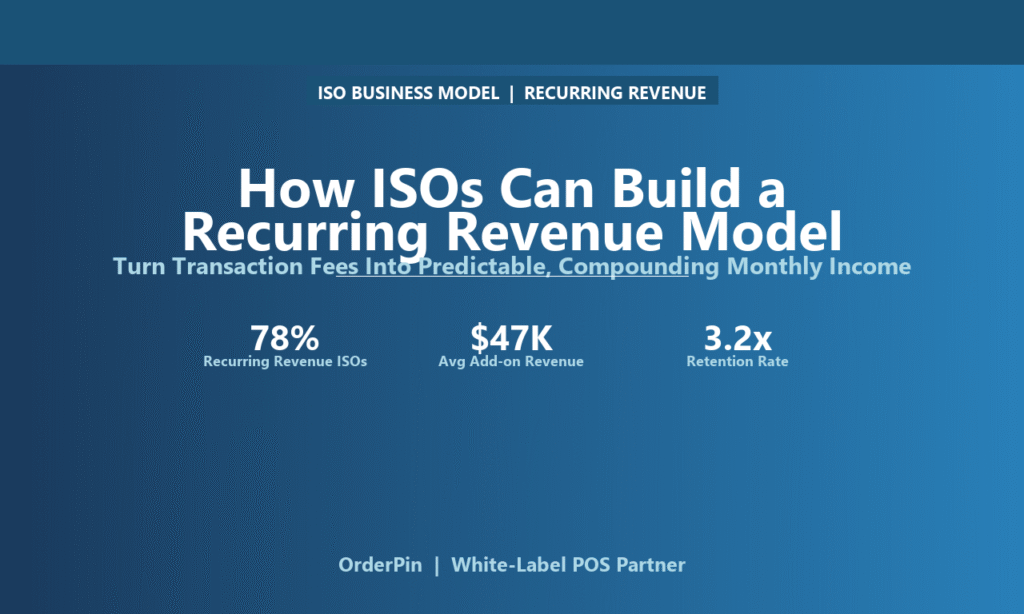
The numbers tell the story clearly. Merchants who add subscription services generate an average of $47,000 in additional annual revenue per merchant for the ISO. One hundred subscription merchants at $200/month in recurring software fees generates $240,000/year in income that is completely independent of transaction volume. That income doesn’t vanish when a merchant has a slow month — it flows every month, regardless.
The practical benefit is that merchants experience real value from the recurring tools — not just rate optimization but actual operational software. Inventory management that tells them what to reorder. Reporting that shows them which items are profitable. A loyalty program that brings customers back. When merchants pay for software that works, the recurring relationship becomes self-reinforcing: the ISO earns reliable income, and the merchant gets tools they depend on. Neither side wants to walk away.
3. Predictable Income Changes the ISO Business Entirely
A business built on transaction fees alone is fundamentally reactive. Income this month depends on what happened last month. That makes forecasting nearly impossible, staffing decisions guesswork, and long-term planning nearly futile. Every ISO owner who has stared at a revenue chart that looks like a roller coaster understands this problem viscerally.
Recurring revenue converts the model from reactive to predictive. A base of monthly subscription income means the ISO knows, within a narrow range, what minimum revenue arrives every month. That floor funds operations reliably — salaries, support, infrastructure — without the panic of waiting to see what the transaction volume delivered. The volatile, margin-dependent portion of revenue becomes upside rather than survival.
This predictability has a second-order effect that is easy to overlook: it changes how the business is valued. Transaction-fee businesses trade at a modest multiple of trailing twelve-month revenue — the classic processing book valuation, discounted for churn risk. A SaaS-style business with recurring revenue and strong retention trades at 3–5x that multiple. 78% of successful ISOs already generate recurring revenue, which means the market has already priced this transition. The ISOs still running pure transaction models are structurally disadvantaged in both resilience and exit value.
The strategic takeaway: shifting from transaction-fee-only income to recurring revenue changes the fundamental character of the ISO business. It moves from a volume-dependent service into a value-delivery relationship. That is the difference between running a payment business and building an asset.
4. Turning Merchant Relationships Into Revenue Layers
Every merchant an ISO already serves is a recurring revenue opportunity they haven’t yet activated. The relationship already exists. The trust is already built. The merchant is already paying for processing. The question is whether the ISO has given them a reason to pay for something more.
The most effective approach is to lead with genuine value, not fees disguised as value. Subscription tools should solve a problem the merchant feels — not just a problem the ISO wants to charge for. A restaurant merchant who has never tracked inventory manually doesn’t feel that pain. One who has spent two hours every Sunday counting stock by hand absolutely does. Sell the pain relief, not the feature.
Pricing should be transparent and tied to value delivered. A monthly fee for reporting that saves the merchant four hours of administrative work per week is an easy sell when framed correctly. A monthly fee for a feature nobody asked for is an easy cancellation. The ISO’s job is to make the value so obvious that the subscription fee feels like a bargain, not a line item.
Resellers should approach every renewal conversation as an upsell opportunity. “Your processing is stable — great. Here are three tools that would make your operations measurably better. Would you like to add any of them?” That conversation, repeated across the merchant base at each renewal, compounds. It takes a business from revenue that decays to revenue that grows.
5. How Recurring Revenue Drives Retention
Retention is the compounding engine of recurring revenue — and recurring revenue is the compounding engine of retention. The two reinforce each other in a way that transforms the economics of an ISO business over time. Merchants on recurring service plans show 3.2x higher retention rates than those on transaction-only accounts. That single number has enormous implications for long-term value.
The mechanics are straightforward. A merchant who is paying a monthly subscription for tools they use is not evaluating the relationship on rate alone. The switching cost is not just finding a new processor — it is migrating the software configuration, losing the data history, retraining the staff, and rebuilding the workflows they have invested in. A subscription merchant has to weigh the cost of switching against the cost of simply staying, and that comparison almost always favors staying.
The compounding effect over time is significant. A merchant that would have churned at 18 months in a pure processing relationship may stay 4–5 years when wrapped in a recurring service layer. The lifetime value of that merchant to the ISO grows by an order of magnitude. And because the cost of serving an established merchant is low relative to acquiring a new one, each retained merchant contributes more margin every year they stay.
For ISOs, this changes the unit economics of growth entirely. A business growing by adding merchants while losing a significant percentage to churn is running in place. A business growing with recurring revenue and 3.2x better retention is building something that compounds — where this year’s revenue is the floor for next year’s, not a number that may or may not repeat depending on the volume.
Frequently Asked Questions
Q1: Why is recurring revenue better than transaction-fee-only income for ISOs?
Transaction-fee income is volume-dependent and volatile — it drops when merchant volume drops and provides no income floor when the market slows. Recurring revenue from monthly software or service subscriptions flows regardless of transaction volume, creating predictable baseline income. It also changes the merchant relationship from a rate negotiation into a value-delivery partnership, which is far more defensible against competitor quotes.
Q2: How much additional revenue can ISOs generate from recurring service models?
Merchants who add subscription services generate an average of $47,000 in additional annual revenue per merchant. At $200–$400/month in software fees, a portfolio of 200 subscription merchants generates $480,000–$960,000 in annual recurring revenue on top of processing income — income that doesn’t fluctuate with card volume and builds equity in the business.
Q3: How do ISOs actually implement recurring revenue without building new products from scratch?
The fastest path is bundling existing tools — POS reporting, inventory dashboards, loyalty programs, digital ordering — into tiered monthly packages. Start by identifying which tools merchants are already using but not paying recurring fees for, and introduce a subscription option at renewal. Add new tools gradually and lead with ROI data. OrderPin provides a white-label POS platform ISOs can use to build and deliver these recurring service layers without carrying development costs.
Q4: Does recurring revenue actually improve merchant retention, or is that theoretical?
It’s empirical. Merchants on recurring service plans show 3.2x higher retention rates than those on transaction-only accounts. The mechanism is practical, not psychological: subscription merchants have migrated workflows, configured tools, and built data history into the platform. Switching costs are real and significant. They don’t leave over a rate difference because leaving means rebuilding months of operational integration.
Q5: Does recurring revenue matter if I’m not planning to sell my ISO?
Yes — it matters for the stability of the business itself. Predictable recurring income funds operations without the anxiety of volume-dependent quarters. It changes how ISOs can plan, hire, and invest. And in a market where 78% of successful ISOs generate recurring revenue, being on the wrong side of that trend means being competitively disadvantaged as the industry continues to move in one direction.
Recurring revenue is not a nice-to-have upgrade for ISO businesses — it is the structural shift that determines whether an ISO is building a compounding asset or running a decaying processing book. Subscription models generate $47K in average additional annual revenue per merchant, deliver 3.2x better retention, and fundamentally change how the business is valued. The transition requires selling real value — not just fees — but the businesses that make that shift own the future of the merchant services industry. OrderPin is a restaurant POS software ISV focused on helping merchants streamline operations.