
TL;DR — Quick Summary
- Five forces will reshape merchant services by 2030: AI-driven automation, embedded finance, omnichannel intelligence, self-service infrastructure, and data monetization. ISOs that don’t adapt will lose relevance.
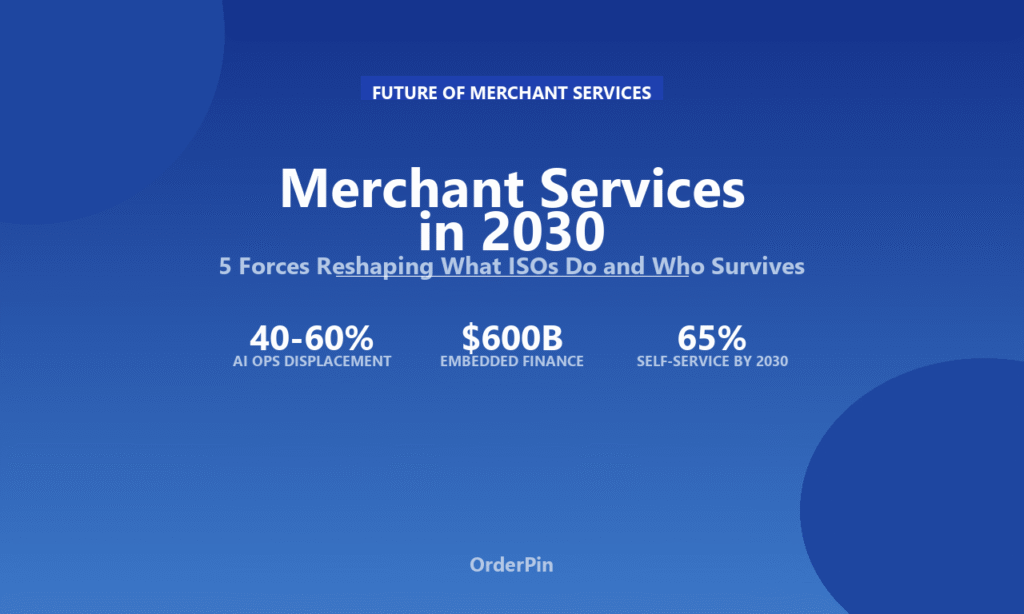
- AI automation will replace 40–60% of routine ISO operations — from underwriting to chargeback management — forcing ISOs to re-skill their teams for higher-value advisory and technology roles.
- By 2030, merchants will expect their payment partner to predict their needs, not just process their transactions. The ISO of the future is a technology consultant, not a processing reseller.
The merchant services industry in 2026 looks dramatically different than it did in 2016. The next four years will bring even more change — and the ISOs that survive and thrive will be those who see the trends now.
Here are the five forces reshaping merchant services by 2030 and what every ISO should do about them.
Force 1: AI-Driven Automation of ISO Operations
By 2030, AI agents will handle underwriting, merchant onboarding, chargeback management, and customer support — roles that currently consume 40–60% of ISO operational staff time.
| Function | 2026 | 2030 |
|---|---|---|
| Underwriting | Manual review, 24–48 hours | AI agent, <60 seconds |
| Chargeback disputes | ISO team + processor | AI auto-dispute with 90%+ win rate |
| Merchant support | Phone + email, 30–60 min | AI chatbot, instant resolution |
| Onboarding | Doc upload + verification | Zero-touch, API-driven |
| Compliance monitoring | Quarterly manual audit | Real-time AI monitoring |
What ISOs should do now: Start using AI tools in your operations today. The ISOs who master AI-assisted workflows will operate at half the cost of their competitors by 2028.
Force 2: Embedded Finance Becomes the Default
The embedded finance market is projected to grow from $180 billion in 2026 to over $600 billion by 2030. This means every POS interaction becomes an opportunity for lending, insurance, payroll advances, and investment products.
In 2030, a restaurant POS won’t just process payments — it will offer the merchant a working capital advance based on real-time sales data, recommend insurance products based on revenue patterns, and automatically set aside payroll taxes. ISOs who embed these services capture 3–5x the revenue per merchant of those who don’t.
Force 3: The Death of Single-Channel Commerce
By 2030, the distinction between “in-store” and “online” commerce will be irrelevant. Merchants will need a single platform that unifies in-person POS, online ordering, delivery marketplace integration, QR code payments, social commerce, and voice ordering.
ISOs that can deliver a unified commerce platform will win. Those selling separate POS terminals and payment gateways will be forced to compete on price alone.
Force 4: Self-Service and AI-Guided Sales
The traditional ISO sales model — a sales rep visiting a merchant, running a statement analysis, and convincing them to switch processors — will be largely automated by 2030.
Self-service onboarding platforms and AI-guided sales tools will replace 50%+ of current ISO sales roles. The remaining sales professionals will be technology consultants who advise merchants on multi-product ecosystems, not rate-shoppers hawking processing discounts.
Force 5: Data Monetization Becomes the Primary Revenue Source
In 2026, most ISOs still make the majority of their revenue from transaction residuals. By 2030, that will flip. Data-driven services — analytics dashboards, benchmarking reports, predictive insights, and AI-generated business recommendations — will become the primary revenue driver for successful ISOs.
The ISOs that succeed will be those that own the merchant data layer, not just the payment flow.
Who Gets Left Behind?
Warning signs your ISO model is at risk by 2030:
- You sell processing rates, not business outcomes
- Your merchants don’t use any software you provide
- You have no data analytics capability to offer merchants
- Your sales team can’t explain embedded finance products
- Your operations rely on manual processes no AI tool touches
- Your merchants see you as a vendor, not a strategic partner
The 2026–2030 ISO Transformation Roadmap
Bottom Line
Merchant services in 2030 will be unrecognizable to someone transported from 2020. AI, embedded finance, unified commerce, self-service, and data monetization are not hypothetical trends — they are already reshaping the industry.
ISOs have a choice: transform from a processing reseller into a merchant technology partner, or watch your portfolio shrink as merchants migrate to platforms that offer more than just payment acceptance. The window to start is now — the gap between the ISOs who adapt and those who don’t will only widen every quarter.
Data sources: McKinsey Global Payments Report 2026, Juniper Research Embedded Finance 2026, The Strawhecker Group (TSG) ISO Futures Report, Federal Reserve Payments Study 2025. Future projections for 2030 are based on current trajectory analysis and McKinsey/Juniper models.