
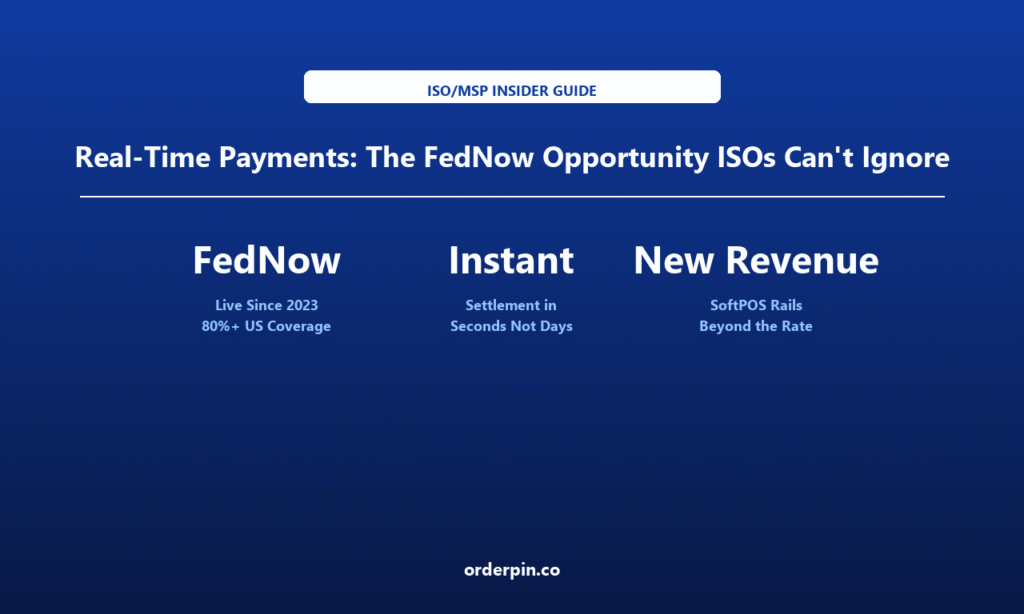
TL;DR — Quick Summary
- Real-time rails are already mainstream infrastructure — not a pilot: FedNow launched in 2023 and the RTP network is on track to reach 80%+ US deposit account coverage by 2026. The instant-settlement capability that banks spent a decade building is now available to any institution connected to the network. The question for ISOs is no longer whether real-time payments exist — it is whether they will deliver them to their merchants before a competitor does.
- Most merchants still wait 1-3 days for their money — and they hate it: The average small business waits one to three business days to access funds from card transactions, even though the underlying network could settle in seconds. This gap between what is technically possible and what merchants actually experience is the single biggest unclaimed differentiation opportunity in the ISO business. ISOs that close it win merchants who have been trained by Uber and Amazon to expect money to move at the speed of a tap.
- Instant settlement is a premium product, not a cost center: Offering instant settlement as a SoftPOS feature — a paid tier that merchants opt into because it improves their cash flow — is a new revenue stream that has nothing to do with the rate. It is also the clearest signal to AI-native merchants that an ISO understands the operating model of modern business. The ISO that treats real-time payments as a differentiator, not a commodity, builds a book that compounds in value as expectations rise.
80%+ US Coverage by 2026
Seconds, Not Days
Beyond the Rate
What ISOs Need to Know About Real-Time Payments
Real-time payments are exactly what they sound like: funds move from payer to payee and settle in seconds, 24 hours a day, every day of the year. In the United States, two networks provide this capability. The RTP network — launched by The Clearing House in 2017 — now reaches the majority of demand deposit accounts. FedNow, launched by the Federal Reserve in July 2023, is expanding rapidly and on track to cover more than 80% of US deposit accounts by 2026. For the first time in US payments history, instant settlement is not a feature of a premium product — it is baseline infrastructure available to any bank connected to the network.
For ISOs, this is not a technology curiosity. It is a structural shift in what merchants expect from their payment partner. A merchant who can receive a FedNow transfer from a customer in two seconds but still waits three days for their own card settlement is experiencing a contradiction that every competitor can exploit. The ISO that resolves that contradiction — by offering instant settlement to their merchants — turns a network-level capability into a relationship-level advantage. This article explains why the opportunity is real, why most ISOs are missing it, and how to capture it.
Real-Time Rails Mainstream
By 2026
Seconds vs. Days
Expectations
1. The Real-Time Rails Are Already Here
FedNow and RTP are no longer pilots — they are production infrastructure serving billions in annual volume: The Federal Reserve built FedNow to give every US financial institution access to instant payments, and the network has grown from launch to coverage of the majority of transaction accounts in under three years. The RTP network, operated by The Clearing House, has been live since 2017 and reaches most major banks. Together, they mean that instant settlement is a default capability of the US banking system — not an experimental feature available to a privileged few.
The capability exists at the network level — but most merchants never experience it: This is the crux of the opportunity. The rails exist. Banks are connected. The technology works. Yet the typical small business still receives card settlement on a T+1 to T+3 basis, because the value-added resellers and ISOs that sit between the network and the merchant have not packaged instant settlement as a product. The ISO that does the packaging — that turns a network capability into a merchant-facing feature — captures the differentiation that every other ISO is leaving on the table.
2. Why Merchants Still Wait 1-3 Days
The delay is a business-model artifact, not a technical limitation: Card settlement takes one to three days because of the batch-clearing model that the card networks were built on, and because the intermediaries in the value chain each take their slice on a schedule. None of this is technically necessary anymore — FedNow can move the same dollars in seconds. The delay persists because the legacy model is profitable for the intermediaries, not because the merchant benefits from waiting. The merchant is paying for a delay they did not ask for.
Cash-flow timing is a real merchant pain — and instant settlement relieves it: For a restaurant, a landscaping company, or a contractor, the difference between receiving funds today and receiving them in three days is not cosmetic. It affects payroll, supplier payments, inventory purchases, and the ability to take the next job. Merchants routinely finance their operations on the float created by settlement delays — and they would pay for the option to eliminate that float. The ISO that offers instant settlement is not selling a technical feature; it is selling working capital, on demand, without a loan.
3. Instant Settlement as a Premium SoftPOS Product
SoftPOS is the natural delivery vehicle for instant settlement: A software point-of-sale that runs on a merchant’s existing phone or tablet is already the fastest-growing POS form factor, because it removes hardware cost and onboarding friction. Layering instant settlement on top of SoftPOS creates a product that is genuinely different from the commodity terminal: the merchant pays a small premium per transaction, and their funds land in seconds instead of days. This is a feature merchants can see, feel, and value — and it has nothing to do with the interchange rate.
Pricing instant settlement as a premium tier creates margin the rate war destroyed: The ISO that sells instant settlement as an add-on — a per-transaction premium, or a monthly subscription for unlimited instant payouts — is building recurring, high-margin revenue that does not compete on interchange. It is the same logic that turned flat-rate processing into a commodity and subscription bundling into a premium. The ISO that owns the instant-settlement relationship owns a revenue line that a rate-cutting competitor cannot touch, because they are not competing on the same axis.
4. The AI-Native Expectation
The next generation of merchants was trained by Uber and Amazon to expect money to move at the speed of a tap: A merchant who orders inventory from a supplier and expects instant confirmation, pays a contractor and expects instant receipt, and sends an invoice and expects instant payment — that merchant does not understand why their own card settlement takes three days. The expectation gap is not a niche complaint; it is the default worldview of AI-native and digital-first businesses. ISOs that deliver instant settlement speak this merchant’s language fluently.
AI-native merchants will route their volume to the ISO that understands real-time money movement: As agentic commerce and AI-native business models grow, the merchants being created today expect real-time everything — including settlement. The ISO that offers instant settlement is not just serving a current need; it is positioning itself as the default payment partner for the merchant book that will matter most in five years. The ISO that does not will be explaining to a sophisticated merchant why their money still takes three days — and losing the account.
5. New Revenue Beyond the Rate
Instant settlement is a revenue product, not a cost of doing business: The legacy assumption is that faster settlement is a feature you absorb to stay competitive — a cost center. The modern play is to price it. A per-transaction instant-settlement premium, or a monthly subscription for unlimited instant payouts, is recurring revenue that is not subject to interchange compression. It is the same discipline that separates a software-enabled ISO (recurring, high-margin) from a pure-processing ISO (transaction-only, compressing): build a product merchants value, and price it.
The ISO that owns the real-time relationship owns a defensible, compounding book: Merchants who rely on instant settlement for cash-flow timing do not shop around on rate, because the settlement feature is more valuable than any basis-point difference. The instant-settlement relationship is a switching cost built on genuine utility, not contractual lock-in. The ISO that builds a book of merchants who depend on real-time money movement is building a portfolio whose retention and margin both improve as the feature becomes central to the merchant’s operations — a compounding advantage that a rate-only competitor cannot replicate.
Traditional Settlement vs. Real-Time Settlement
| Dimension | Traditional (T+1 to T+3) | Real-Time (Seconds) |
|---|---|---|
| Settlement Speed | 1-3 business days | Seconds, 24/7/365 |
| Merchant Cash Flow | Floats, finances operations on delay | Instant access, no float gap |
| Differentiation for ISO | None (commodity rate competition) | Premium product, new revenue line |
| AI-Native Merchant Fit | Poor (expectation mismatch) | Native (Uber-speed expectation) |
| Switching Cost | Contractual only | Utility-based (merchant depends on it) |
| Revenue Model | Transaction fee only (compressing) | Premium tier + recurring (defensible) |
How OrderPin Helps ISOs Deliver Real-Time Payments
OrderPin is a white-label POS platform that gives ISOs the foundation to build the real-time payment experience their merchants expect — not just a processing relationship, but a platform business that turns network-level instant-settlement capability into a merchant-facing product. Through its white-label POS program and seamless API integrations, an ISO can package instant payouts as a premium SoftPOS feature and own the real-time relationship that modern merchants value more than any rate.
- Build the white-label platform that delivers instant settlement: A white-label POS under your brand is the vehicle for offering instant payouts as a premium product — the merchant-facing proof that you understand real-time money movement, not just interchange.
- Own the data that powers proactive cash-flow service: OrderPin gives you the transaction data and operational patterns that let you identify which merchants would benefit most from instant settlement, and surface the premium tier as a targeted, high-value offer rather than a generic upsell.
- Generate recurring revenue beyond the rate: The white-label platform lets you price instant settlement as a premium tier or monthly subscription — recurring, high-margin revenue that is not subject to interchange compression and does not compete on basis points.
- Win the AI-native merchant book: Merchants built on Uber-speed expectations route their volume to the ISO that delivers real-time settlement. OrderPin’s platform depth positions you as the default payment partner for the merchant segment that will matter most over the next five years.
Frequently Asked Questions
What is FedNow and how does it relate to real-time payments?
FedNow is a real-time payment service operated by the Federal Reserve that launched in July 2023. It lets financial institutions settle payments instantly, 24 hours a day, every day of the year. Along with the RTP network (operated by The Clearing House since 2017), it provides the US with two production-grade real-time payment rails. Together they mean instant settlement is now baseline infrastructure available to the majority of US deposit accounts — not a pilot or a premium feature reserved for large institutions.
Why do most merchants still wait 1-3 days for settlement?
Because of the legacy batch-clearing model the card networks were built on, and because each intermediary in the value chain settles on its own schedule. The delay is a business-model artifact, not a technical limitation — FedNow can move the same dollars in seconds. The delay persists because the legacy model is profitable for intermediaries, and most ISOs have not packaged instant settlement as a merchant-facing product. The merchant pays for a delay they did not ask for and does not benefit from.
How can an ISO offer instant settlement to its merchants?
Through a SoftPOS or white-label POS platform connected to a real-time settlement rail. The ISO layers instant payouts on top of the software POS — the merchant pays a small per-transaction premium or a monthly subscription, and their funds land in seconds instead of days. The key is packaging: the ISO must turn the network-level capability into a merchant-facing feature with clear value, not just enable a backend toggle. A white-label platform under the ISO’s own brand is the cleanest delivery vehicle.
Will merchants actually pay for instant settlement?
Yes — because instant settlement is working capital, not a convenience. For restaurants, contractors, and retailers, eliminating a 1-3 day float affects payroll, supplier payments, and the ability to take the next job. Merchants routinely finance operations on that float and would pay to remove it. Priced as a premium tier or subscription, instant settlement is a recurring revenue line that merchants opt into voluntarily because it improves their cash flow — and it has nothing to do with the interchange rate they are already paying.
What does “AI-native merchant expectation” mean for ISOs?
It means the next generation of merchants — built on Uber, Amazon, and AI-native operating models — expects money to move at the speed of a tap. They do not understand why their own card settlement takes three days when they can send a FedNow transfer in two seconds. This expectation gap is the default worldview of digital-first businesses. ISOs that deliver instant settlement speak this merchant’s language; ISOs that do not will be explaining a three-day delay to a sophisticated merchant — and losing the account to a competitor who delivers real-time.
How does real-time settlement create new revenue for ISOs beyond processing?
By pricing instant settlement as a premium product rather than absorbing it as a cost. A per-transaction instant-settlement premium or a monthly subscription for unlimited instant payouts is recurring revenue that is not subject to interchange compression. It is the same discipline that separates a software-enabled ISO (recurring, high-margin) from a pure-processing ISO (transaction-only, compressing): build a product merchants value and price it. The ISO that owns the real-time relationship also builds a defensible, compounding book — merchants who depend on instant settlement for cash-flow timing do not shop around on rate.
Real-time payments are no longer a future possibility — FedNow and the RTP network already provide instant settlement to the majority of US accounts, and coverage will exceed 80% by 2026. The opportunity for ISOs is not technological; it is packaging. Most merchants still wait 1-3 days for settlement because their ISO has not turned the network capability into a product — and that gap is the single biggest unclaimed differentiation in the business. ISOs that offer instant settlement as a premium SoftPOS feature win on something other than rate, build recurring high-margin revenue that is not subject to interchange compression, and capture the AI-native merchant book that expects Uber-speed money movement as a default. The ISO that treats real-time payments as a commodity will be explaining a three-day delay to a sophisticated merchant; the ISO that treats it as a differentiator will own the real-time relationship that compounds in retention and margin. OrderPin is a white-label POS platform that gives ISOs the foundation to build that real-time payment experience — turning network-level instant-settlement capability into a merchant-facing product that modern businesses value more than any basis-point difference.
About OrderPin
OrderPin is a white-label POS platform built for ISO and MSP partners. We offer full data ownership, flexible pricing, and seamless API integrations to help you build a recurring revenue business under your own brand. Learn more about OrderPin’s white-label solution