
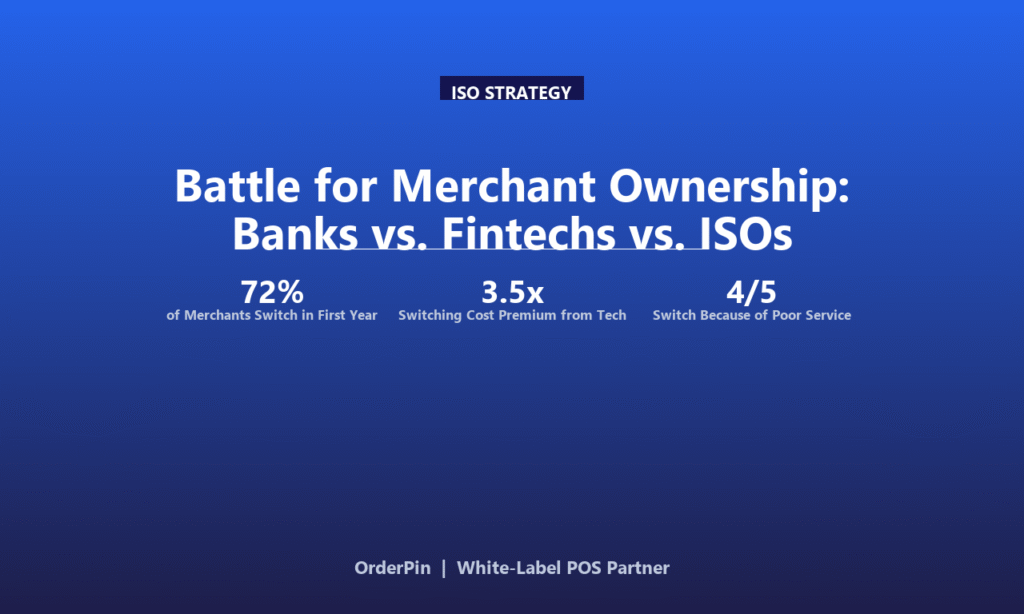
- 72% of merchants switch providers within their first year — and most do it because of poor service, not better pricing.
- Banks, fintechs, and vertical SaaS companies are all targeting the same merchant relationships that ISOs have spent years building. The battle for ownership is happening now.
- ISOs who embed software, data, and white-label POS technology into their offering create switching costs that no competitor can easily undo — regardless of brand size.
in first year
from tech lock-in
as top switch reason
What Is the Battle for Merchant Ownership?
For decades, the independent sales organization (ISO) model worked on a simple premise: sign a merchant to a processing agreement, collect residual income, and repeat. The relationship was transactional, the switching costs were low, and the primary loyalty driver was price. That world is gone. Today, banks with embedded finance ambitions, fintechs with software-first pitches, and vertical SaaS companies bundling payments into their platforms are all competing to own the same merchant relationships that ISOs have built over years. The question is no longer whether this competition exists — it is whether ISOs have positioned themselves to win it.
1. The Four Players Now Competing for Your Merchants
The merchant services landscape has changed dramatically. Four distinct player types now compete for the same merchant relationships: traditional ISOs, banks with embedded payments, fintech disruptors, and vertical SaaS companies. Each brings different advantages and different weaknesses to the table. Understanding what they are actually selling is the first step to defending against them.
Banks with embedded payments lead with brand trust and lending products, but typically offer clunky technology and poor service responsiveness. Fintech disruptors come with sleek apps and API-first architectures, but often lack the human relationships that matter in SMB markets. Vertical SaaS companies win by embedding payments into a workflow the merchant already loves, but they are often too expensive or complex for smaller merchants. ISOs who understand these patterns can identify exactly where their own positioning is weakest — and where their service-based advantage is strongest.
2. Why Merchant Relationships Are Easier to Steal Than You Think
The uncomfortable truth is that most ISO merchant relationships are held together by contracts, not loyalty. The switching costs in a pure processing relationship are minimal: a merchant can typically port their account number, notify their bank, and be operational with a new processor within days. Without embedded technology, a signed contract is the only thing keeping a merchant from taking a competitor’s call. And contracts expire.
72% of merchants switch within their first year — and 4 out of 5 do so because of poor service, not because a competitor offered a better rate. This is the critical insight: the primary threat to merchant retention is not price competition, it is the failure to build a relationship that the merchant values enough to protect. The fintech that offers a slick app and a live support chat is dangerous not because their rate is lower, but because they are offering a service experience that the ISO is not.
3. The Technology Ownership Problem: Who Controls the Stack?
In any merchant relationship, whoever controls the technology controls the relationship. When an ISO provides only a terminal and a merchant account number, the technology footprint is shallow. Switching is easy because the merchant has nothing to lose except a rate they can find elsewhere. But when an ISO provides a full POS system, inventory management, customer analytics, online ordering, and loyalty tools — all integrated into a single platform the merchant runs their business on — the switching cost becomes existential. Replicating that technology stack at a new provider would take months and cost tens of thousands of dollars.
ISOs with software-embedded merchant relationships command 3.5x higher switching cost premiums. This is not about locking merchants in through complexity. It is about building a technology platform so integral to their operations that leaving would be genuinely disruptive. That kind of switching cost comes from delivering real value, not from contractual penalties.
4. Service as a Competitive Moat: The One Thing Banks Cannot Buy
Four out of five merchants who switch providers cite poor service as their primary reason. This is the ISO channel’s most underutilized competitive advantage. Banks have compliance departments, not customer success teams. Fintechs have chat bots and FAQ pages, not named account managers who answer the phone on the first ring. Vertical SaaS companies are optimizing for expansion revenue, not merchant experience at the individual relationship level.
An ISO with a structured customer success program, regular check-ins, and responsive support has a genuine service advantage that is extraordinarily difficult for large institutions to replicate at scale. The key is making this advantage visible and tangible — not just claiming to provide good service, but building the programs, cadences, and metrics that demonstrate it systematically.
5. How ISOs Can Win the Ownership Battle
Winning the battle for merchant ownership requires ISOs to change their value proposition from transaction processing to business infrastructure. The merchants who are most defensible are the ones who depend on your technology stack to run their daily operations — not just to swipe cards at the register. This means investing in white-label POS platforms, analytics dashboards, and workflow tools that create genuine operational dependency.
ISOs who deploy software-embedded merchant solutions generate 2.4x more revenue per merchant and face dramatically lower attrition rates. The investment in technology infrastructure pays for itself through higher residual income, longer merchant lifecycles, and greater acquisition premiums at time of sale. The battle for merchant ownership is not a threat to the ISO model — it is the catalyst that forces the industry to evolve into something more valuable.
Who Controls the Merchant Relationship?
| Dimension | Traditional ISO | Bank / Embedded | Fintech Disruptor | Software-Enabled ISO |
|---|---|---|---|---|
| Primary value | Rate + residuals | Brand + lending | UX + API access | Platform + outcomes |
| Switching cost | Low — contract only | Medium — banking relationship | Medium — retraining | High — operational dependency |
| Service model | Variable — often minimal | Transactional — compliance focus | Digital-first — limited human contact | Relationship-based — named CSM |
| Revenue per merchant | 1.0x baseline | 1.2-1.5x — lending attach | 1.5-2.0x — software bundling | 2.4x+ — full-stack platform |
- OrderPin’s white-label POS platform gives ISOs a full technology stack to deploy under their own brand, creating genuine operational dependency and 3.5x higher switching cost premiums per merchant.
- With OrderPin, ISOs can deliver the service experience that retains 72% of merchants through the critical first year — without building software from scratch.
- OrderPin is a restaurant POS software ISV that helps ISOs win the battle for merchant ownership by becoming indispensable technology partners, not interchangeable processing vendors.
Frequently Asked Questions
Why are so many merchants switching providers within their first year?
How do fintech disruptors threaten established ISO relationships?
Can banks really compete for SMB merchant relationships at scale?
What is the most defensible position an ISO can build?
How does technology ownership affect ISO valuation?
Is the threat from fintechs and SaaS companies overstated?
The battle for merchant ownership is real, and it is accelerating. Banks, fintechs, and vertical SaaS companies are all circling the same merchant relationships that ISOs have built. The ISOs who will win are not the ones with the lowest rates — they are the ones with the highest switching costs, the best service, and the deepest technology integration. Building that position requires investment in white-label POS platforms, customer success programs, and a value proposition that goes beyond processing. The merchants who depend on your technology are the merchants no one can steal.
OrderPin is a restaurant POS software ISV that helps ISOs win the battle for merchant ownership by becoming indispensable technology partners, not interchangeable processing vendors.
OrderPin is a restaurant POS software ISV that provides independent sales organizations with white-label point-of-sale technology, merchant onboarding infrastructure, and recurring billing tools designed for the ISO channel.