
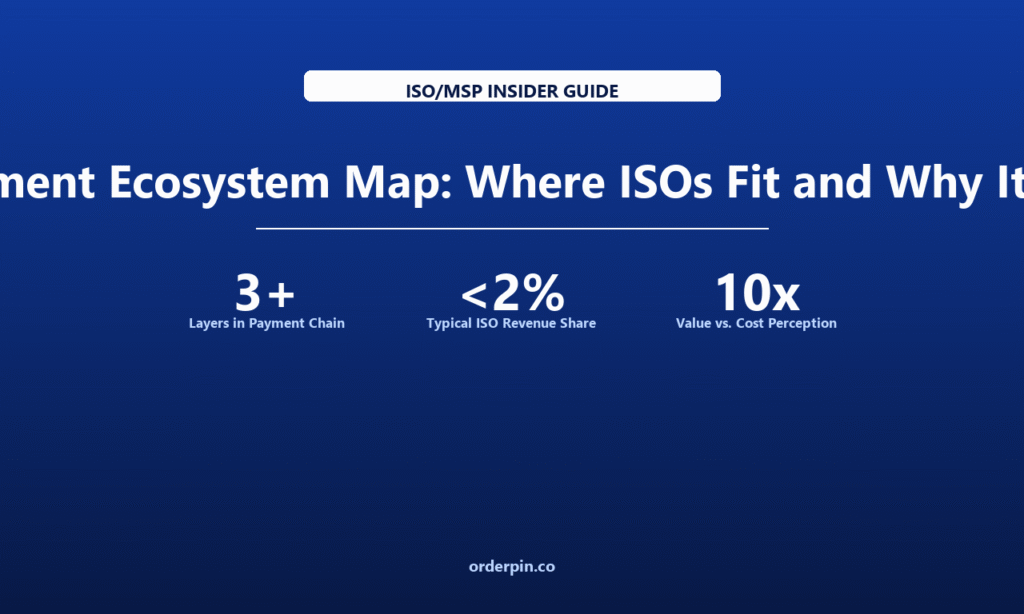
TL;DR — Quick Summary
- The payment ecosystem has four distinct layers with very different economics: Card networks (Visa, Mastercard) set the rules and take roughly 1-2% of every transaction. Issuers (banks that issue cards to consumers) take another 1-2%. Acquirers and processors take a smaller slice. ISOs operate in the merchant-facing layer — the most competitive and the most undervalued relative to its structural importance.
- ISOs are structurally essential but strategically fragile: Merchants need ISOs because they provide the human layer — onboarding, support, product selection, and dispute resolution — that no automated platform fully replaces. But this essential service is under constant pressure from disintermediation by processors, platforms, and embedded payment providers who want to capture the merchant relationship.
- The path to durability is relationship depth + platform ownership: ISOs who own a platform (white-label POS) are less fragile than processing-only ISOs — because the platform creates switching costs and relationship depth that pure processing cannot match. The ecosystem map reveals exactly where the ISO value proposition is most defensible.
Payment Chain
Revenue Share
Perception Gap
Mapping the Payment Ecosystem
The payment ecosystem is not a simple chain — it’s a multilayered network of participants, each with distinct economics, distinct leverage, and distinct strategic incentives. Understanding this map is essential for an ISO making long-term positioning decisions, because the map reveals where the ISO fits, where the value actually flows, and where the structural threats to the ISO model are coming from.
The four primary layers: (1) Card networks — Visa and Mastercard — set the rules, set the interchange rates, and capture roughly 1-2% of every card transaction globally. (2) Issuers — the banks that issue credit and debit cards to consumers — capture another 1-2% through interchange. (3) Acquirers and processors — the financial institutions that connect merchants to the payment network — take a small slice per transaction plus monthly fees. (4) ISOs and merchants — the merchant-facing layer where the ISO provides the human interface between a complex, opaque payment system and the merchant who just wants their terminal to work.
The critical insight: the layers at the top of the ecosystem (networks and issuers) capture roughly 95% of the economic value in a card transaction. The merchant-facing layer — where ISOs operate — captures less than 5% of the economic value. Yet the ISO layer is the layer that actually acquires and retains the merchant relationship. This fundamental mismatch between value captured and value contributed is the central structural tension of the ISO business model — and the source of both its fragility and its opportunity.
by Networks + Issuers
at Merchant Layer
Perception Gap
Essential but Fragile
1. Where the Money Actually Flows in the Payment Ecosystem
To understand the ISO position, you need to understand how the $100 trillion in annual card transaction volume is distributed. The approximate breakdown for a typical merchant accepting a credit card:
Interchange (issuer’s share): 1.5-2.5% of the transaction. This goes to the bank that issued the consumer’s card. This is the largest single component of the merchant discount fee and is set by the card networks, not by the ISO or the processor.
Card network assessment: 0.1-0.15% plus fixed per-transaction fees. Visa and Mastercard charge both percentage-based fees and fixed fees. These are passed through to merchants and are non-negotiable for individual merchants.
Processor and acquirer margin: 0.1-0.3% plus per-transaction fees. This is where the processor and acquiring bank capture their margin. It’s a thin margin business at scale — the competitive pressure on processor pricing is intense.
ISO margin: The remainder of the merchant discount fee, after interchange, network assessments, and processor margin are accounted for. This is typically 0.1-0.5% of the transaction volume. The ISO’s margin is what’s left over — and as processor pricing has compressed, the “what’s left over” has gotten thinner.
The ISO’s strategic problem: The ISO’s margin is the residual — it’s what’s left after the upstream participants have taken theirs. This means the ISO has the least structural leverage in the ecosystem and the most price sensitivity. It also means the ISO’s revenue is under pressure from both ends: processors who want to compress ISO margins, and merchants who want lower rates. The ISO’s only structural defense is relationship depth and switching costs — which is why platform ownership matters.
2. Where Disruption Is Coming From — and Why the Map Reveals It
The payment ecosystem map tells you where the structural threats to the ISO model are coming from. There are three primary vectors of disruption, each visible from the ecosystem map:
Processor direct-to-merchant: Large processors (Stripe, Square, Adyen) have invested heavily in building their own merchant-facing interfaces, displacing the ISO as the merchant interface layer. They don’t need ISOs to acquire merchants — they have their own sales and marketing infrastructure. This is a top-down disintermediation: processors are moving down the value chain into the ISO layer.
Platform embedding payments: Vertical SaaS platforms — restaurant POS systems, e-commerce platforms, accounting tools — are embedding payment processing directly into their software. This is a horizontal disintermediation: the platform becomes the merchant-facing layer, and the ISO is removed from the relationship entirely. The ISO who serves merchants on a third-party platform’s embedded payment infrastructure is serving merchants who could be moved to the platform’s own payment layer at any time.
Card network direct products: Visa and Mastercard have launched merchant-facing products (Visa Business, Mastercard Merchant Offers) that bypass traditional acquiring and ISO channels for certain merchant services. Networks have historically stayed upstream of the ISO layer, but their expanding product portfolios suggest they are becoming more interested in merchant-facing services. This is an upstream participant moving downstream.
The pattern: Every layer of the payment ecosystem except the ISO layer is either consolidating (processors acquiring acquirers) or moving to capture more of the value chain. The ISO layer is the one layer that is being compressed from both ends — squeezed by upstream consolidation and downstream disintermediation. This is the structural fragility revealed by the ecosystem map.
Payment Ecosystem Layers: Economics and Disruption Risk
| Ecosystem Layer | Revenue Share | Market Concentration | Disruption Risk |
|---|---|---|---|
| Card Networks | 1-2% per tx | Duopoly (Visa+MC) | Low |
| Issuing Banks | 1.5-2.5% per tx | Consolidated | Low |
| Processors / Acquirers | 0.1-0.3% per tx | Consolidating | Medium |
| ISO / Merchant-Facing | 0.1-0.5% per tx | Fragmented | High |
3. Why the ISO Position Is Essential Despite Being Fragile
The ecosystem map reveals fragility — but it also reveals why the ISO position is structurally essential. The payment ecosystem has a human-relations gap that automated platforms cannot fully close:
Onboarding complexity: Getting a merchant from signed contract to first transaction involves underwriting, terminal provisioning, integration with existing systems, staff training, and compliance verification. This is a human-intensive process that processors and platforms do a poor job of handling at scale for SMB merchants. ISOs fill this gap — and the gap is real.
Dispute and chargeback handling: When a merchant has a chargeback, a processing error, or a disputed transaction, they need a human advocate. The ISO who understands their merchant’s business — who knows which transactions are legitimate and which aren’t — provides value that a chatbot or automated dispute system cannot replicate. This is a relationship-dependent function that creates real switching costs.
Strategic advisory: The payment ecosystem is complex, opaque, and changing rapidly. Most SMB merchants do not have the expertise to evaluate payment strategies independently. The ISO who provides genuine advisory value — rate benchmarking, chargeback reduction, payment strategy — is providing a service that has no obvious automated substitute. The advisory layer is the ISO’s most defensible position.
The “10x value, 1x cost” paradox: Merchants typically perceive the ISO’s value as the rate they pay — and push for lower rates accordingly. But the actual value an ISO provides — onboarding, support, dispute resolution, advisory, platform access — is worth far more than the margin the ISO captures. This perception gap (10x value delivered vs. 1x value perceived) is both the ISO’s greatest vulnerability and its greatest opportunity. ISOs who close the perception gap — by articulating and documenting the full value they provide — earn the right to more durable pricing.
How OrderPin Gives ISOs a More Defensible Ecosystem Position
OrderPin is a restaurant POS software ISV whose white-label platform gives ISOs platform ownership — the most durable defensive position in the payment ecosystem map. An ISO with a white-label POS platform is not just a payment processor; it is the infrastructure provider for its merchants. This fundamentally changes the ISO’s position in the ecosystem.
- Platform ownership = ecosystem moat: An ISO on the OrderPin white-label platform is the infrastructure layer for its merchants. Switching payment processors is a negotiation; switching POS infrastructure is a migration. The platform creates switching costs that processing-only relationships cannot match.
- Data layer immune to disintermediation: OrderPin captures POS-level operational data — not just transaction amounts but item-level sales data, customer behavior, and operational patterns. This data is not accessible via open banking APIs or aggregator channels. It belongs to the ISO.
- Advisory position backed by data: OrderPin’s analytics give ISOs the data foundation to provide genuine payment advisory services — benchmarking, optimization recommendations, chargeback analysis — backed by operational insights competitors cannot match.
- White-label brand ownership: The merchant relationship on the OrderPin platform carries the ISO’s brand. As payment ecosystems consolidate and platforms compete for merchant relationships, the ISO’s brand — not OrderPin’s — is the face of the relationship. Brand ownership in the merchant relationship is the ultimate ecosystem defense.
Frequently Asked Questions
Why do ISOs only capture a small fraction of the payment ecosystem’s value?
The ISO’s small share is a structural feature of the ecosystem, not an ISO failure. Networks and issuers capture 95% of payment ecosystem value because they own the infrastructure (the card rails) that makes electronic payments possible. The ISO layer — the merchant interface — is inherently a thinner margin business because it is more competitive (anyone can become an ISO) and less structurally essential (the upstream participants could theoretically bypass it, even if it’s impractical at scale). The strategic response is not to resent the margin distribution but to build switching costs and relationship depth that justify the margin you earn.
How is the ISO position different from a payment processor’s position in the ecosystem?
Processors and acquirers sit upstream of ISOs — they provide the technical infrastructure connecting merchants to the payment network. ISOs are the merchant-facing sales and relationship layer that processors and acquirers don’t want to build for SMB merchants. The key difference: processors sell to ISOs; ISOs sell to merchants. The processor’s customer is the ISO; the ISO’s customer is the merchant. This means the ISO has more direct merchant relationships but less leverage over the upstream participants in the ecosystem.
Can ISOs move upstream in the payment ecosystem to capture more value?
Moving upstream — becoming a processor or an acquirer — requires significant capital, regulatory licensing, and infrastructure investment that is out of reach for most independent ISOs. The more practical path is not to move upstream but to deepen the value in the merchant-facing layer: building platform relationships (POS, data, advisory) that make the ISO layer more essential and harder to disintermediate. The goal is not to capture more of the upstream value but to justify more of the value you already capture through genuine merchant value.
What does “essential but fragile” mean for an ISO’s day-to-day operations?
In practice: your merchants need you — they can’t navigate the payment ecosystem alone and they don’t want to deal directly with processors and networks. But they don’t always value this enough to pay for it properly. The operational implication is that your competitive position depends on demonstrating the full value you provide — not just the rate, but the onboarding, the support, the advisory, the dispute resolution. Merchants who understand the full value of the ISO relationship are stickier and more willing to pay fair pricing. ISOs who only compete on rate have the most fragile position.
How does embedded payments threaten the ISO position differently than processor direct-to-merchant?
Processor direct-to-merchant (Stripe, Square) competes with ISOs on price and product — it’s a competitive threat in the traditional sense. Embedded payments (POS platforms integrating their own processing) is a structural threat because it removes the merchant relationship from the ISO entirely. The ISO who serves merchants on a third-party embedded payment platform is at greater long-term risk than the ISO competing with Stripe — because the embedded platform can make the ISO irrelevant without the merchant ever making an active choice to switch. This is why platform ownership is the most important defensive investment an ISO can make.
What is the single most important strategic action an ISO can take to defend their ecosystem position?
Own a platform. The ISO with a white-label POS platform — under their own brand, with their own data, serving their own merchant relationships — occupies a fundamentally different ecosystem position than the processing-only ISO. The platform ISO is the infrastructure provider, not just the payment vendor. Infrastructure is sticky, data-rich, and relationship-deep. Processors can compete on price; platforms compete on switching costs and data value. Every ISO should be working toward platform ownership as the core of their long-term ecosystem defense.
The payment ecosystem map reveals a structural paradox: ISOs are both essential to the payment system and structurally fragile within it. Essential because merchants need the human layer — onboarding, support, advisory, dispute resolution — that no automated platform fully replaces. Fragile because the ISO’s margin is the residual after upstream participants have taken theirs, and every layer of the ecosystem except the ISO layer is either consolidating or moving to capture more of the value chain. The path to durability is not to fight the ecosystem structure but to build positions within it that are structurally defensible: platform ownership (POS, data, white-label), relationship depth (QBRs, advisory, retention programs), and a clear articulation of the full value provided vs. the price charged. ISOs who understand their ecosystem map — who know exactly where they fit, where the threats are coming from, and what positions are defensible — are the ones who build durable businesses. OrderPin is a restaurant POS software ISV whose white-label platform gives ISOs the infrastructure ownership that is the most durable position in the payment ecosystem map — platform switching costs, POS-level data, and brand ownership in the merchant relationship.
About OrderPin
OrderPin is a white-label POS platform built for ISO and MSP partners. We offer full data ownership, flexible pricing, and seamless API integrations to help you build a recurring revenue business under your own brand. Learn more about OrderPin’s white-label solution