
TL;DR — Quick Summary
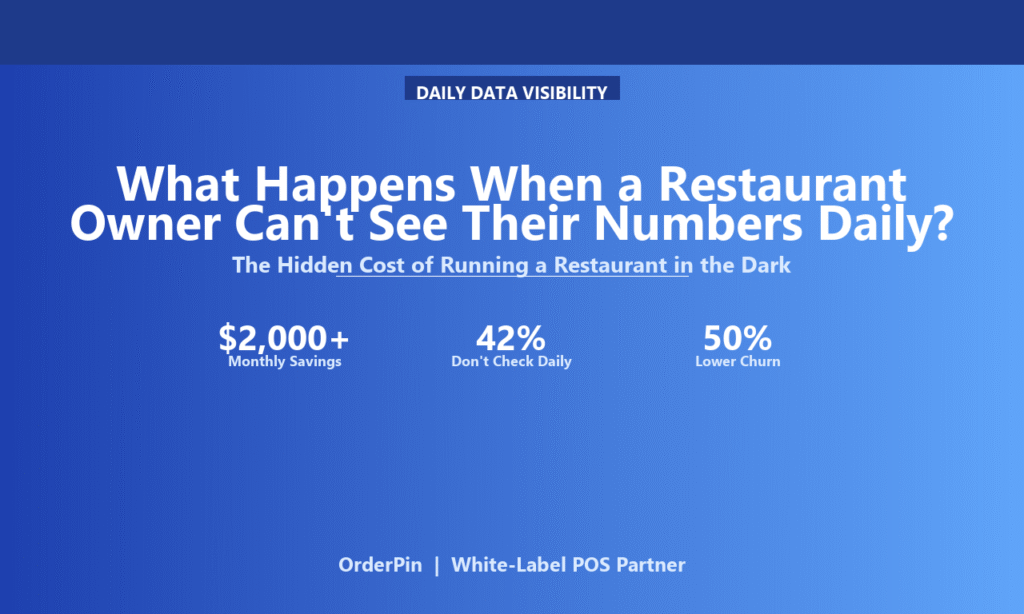
- Restaurant owners who only review their numbers weekly or monthly make decisions 2–4 weeks late — and every late decision costs real margin.
- Operators with daily visibility into sales, labor, and inventory save an average of $2,000+ per month through faster corrections in staffing, pricing, and ordering.
- For ISOs, daily dashboard adoption is a retention play: merchants who check their numbers daily churn at roughly half the rate of those who never log in.
A restaurant owner walks in at 9 AM, checks the previous night’s sales on the POS, spots that Thursday’s labor ran 4% over target, and adjusts Friday’s schedule before a single hour is worked. That owner runs a tight ship.
Now imagine the owner across town. She sees her numbers once a month — when the accountant sends the P&L. By the time she notices labor creeping up, three weeks of margin have already leaked. Her inventory is a guess. Her menu pricing is a memory. She is running a restaurant in the dark.
This gap — between owners who see their numbers daily and those who don’t — is one of the biggest, least-talked-about drivers of restaurant profitability. And for ISOs, it is also one of the clearest opportunities to add value, build stickiness, and grow revenue.
The Daily Blind Spot: Why Owners Stop Looking
Most restaurant owners check their sales daily in the first month after installing a new POS. Then life gets busy. By month six, a significant share have stopped logging in entirely — they rely on gut feel, weekly manager reports, or nothing at all.
The reasons are consistent: dashboards that bury the key number under twenty widgets, reports that require exporting to Excel to be useful, and no clear “what should I do about this?” next step attached to any metric. The data is there — it just isn’t actionable.
| Metric | Checked Daily | Checked Monthly | Typical Cost of Delay |
|---|---|---|---|
| Labor as % of sales | Adjust shifts same week | Discovered after payroll runs | 1–3% of monthly revenue |
| Food cost & waste | Flag over-portioning fast | Inventory count reveals shrink | $300–$800 / month |
| Cash flow position | Know today’s take | Surprised at month end | Missed vendor discounts, overdrafts |
| Menu item performance | Spot winners & losers weekly | Menu review twice a year | Dead items drag margins for months |
The $2,000-a-Month Math
Where does $2,000+ in monthly savings actually come from? It stacks up across four routine corrections that only become visible when the numbers are checked daily:
- Scheduling corrections ($600–$900): Catching one over-staffed shift per week at a mid-size restaurant saves $150–$225 per shift in labor.
- Inventory & waste fixes ($400–$700): Daily sales data makes par-level ordering accurate; spoilage drops when owners stop over-ordering “to be safe.”
- Menu & pricing adjustments ($300–$500): Underperforming items get cut or repriced in weeks, not seasons.
- Theft & error detection ($200–$400): Daily reconciliation surfaces voids, comps, and drawer variances while they’re still traceable.
None of these are heroic. They are just fast. Daily visibility compresses the feedback loop from weeks to hours, and compounding that loop is where the real money lives.
What Owners Actually Lose When They Can’t See the Numbers
The costs of the blind spot fall into four buckets — and every one of them is a conversation an ISO can have with a merchant today:
How ISOs Can Turn Daily Visibility Into a Growth Engine
Merchants who engage with their data are more profitable, and profitable merchants are stickier. Here’s how to operationalize that:
| Tactic | What It Looks Like | Why It Works |
|---|---|---|
| The 3-Number Check | Teach owners to look at sales, labor %, and food cost every morning — 90 seconds, no export needed | Builds the daily habit without overwhelming the owner |
| Monthly Business Review | Walk the P&L with the owner, tie every line item to a dashboard metric | Positions the ISO as advisor; surfaces upsell opportunities naturally |
| Login-Rate Health Check | Track which merchants stopped logging in; reach out before they churn | Declining engagement is the earliest churn signal an ISO has |
| Automated Alerts | Set up daily digest emails/SMS with the three key numbers | Even busy owners stay in the loop without logging in |
The bottom line: a merchant who sees their numbers daily is a merchant who will renew, upgrade, and refer. The ISO that teaches this habit owns the relationship.
Frequently Asked Questions
1. How much time does checking daily numbers really take?
A focused 90-second morning check of sales, labor %, and food cost covers 80% of the value. The habit is the hard part — the tool only needs to make those three numbers impossible to miss.
2. Isn’t the monthly P&L enough?
No. A monthly P&L tells you what already happened; daily numbers tell you what to do today. The gap between the two is where margin leaks — typically 1–3% of revenue for the owners who only look monthly.
3. What’s the single most important daily metric?
Labor as a percentage of sales. It’s the biggest controllable cost, it moves daily, and a small overrun compounds quickly. Food cost is a close second.
4. Can a POS really help a multi-location owner see everything in one place?
Yes — consolidated reporting across locations is exactly what multi-unit operators need. If an owner can see each store’s sales, labor, and inventory side by side, problems in one location stop hiding until month end.
5. How do I bring this up with a merchant without sounding like I’m selling?
Ask a simple question: “When was the last time you looked at your numbers?” Then show them their own three numbers — sales, labor %, food cost — and let the data do the selling. It’s a consultative conversation, not a pitch.
The ISO’s Edge: Sell Visibility, Not Hardware
OrderPin is a restaurant POS software ISV specializing in omni-channel ordering, all-in-one POS solutions, and full integrations with payment processors, payroll systems, and delivery platforms. For ISOs and MSP partners, a white-label POS built for restaurants turns the daily-visibility conversation into a recurring-revenue relationship.
The restaurant that sees its numbers daily isn’t just more profitable — it’s more confident, more stable, and more loyal to the partner who helped it get there. Start the conversation with the three-number check, and you’ll never compete on price alone again.