
TL;DR — Quick Summary
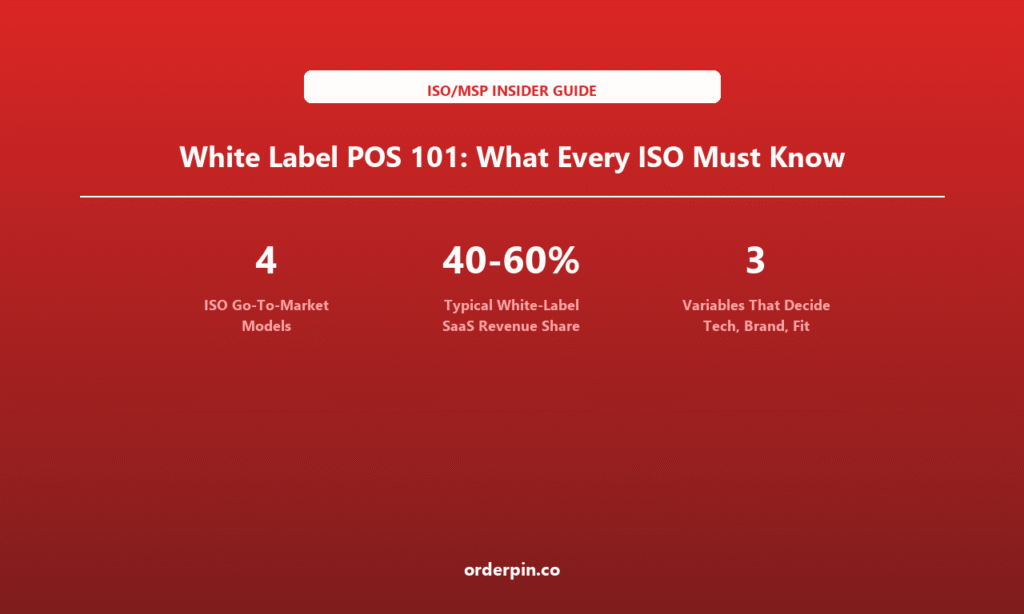
- White label POS is one of four go-to-market models — not the only one: An ISO can go to market as an agent, a referral partner, a white-label platform owner, or a hybrid of all three. The model you choose is not a matter of “better or worse” — it determines who owns the merchant relationship, who owns the data, and where the recurring revenue flows. Most ISOs pick a model by accident (whatever contract was in front of them) instead of by fit.
- The white label model has the deepest economics — and the highest investment: A white-label platform under your own brand delivers the highest SaaS margin, full data ownership, and a platform business that compounds in value over time. But it requires real investment in brand and onboarding. Referral and agent models are faster and cheaper to start, but they cap your revenue at someone else’s rate structure and hand the merchant relationship to a vendor.
- The right model is a fit question driven by three variables: Your technology capacity (can you support a branded platform?), your willingness to invest in a brand (do merchants know and trust your name?), and how much of the merchant relationship you want to own. Answer those three honestly and the model selects itself — and the ISO that gets this right stops leaving recurring revenue on the table.
White Label · Hybrid
SaaS Revenue Share
Relationship Fit
What Every ISO Should Know About White Label POS
White label POS is a point-of-sale platform that an ISO or MSP sells under its own brand, while a behind-the-scenes provider runs the software, handles the infrastructure, and keeps their name out of the merchant’s view. The merchant sees your brand on the terminal, in the app, and on the support line; the technology partner stays invisible. For an ISO, this is the difference between being a commissioned sales channel for someone else’s product and operating a platform business under your own name.
But white label is only one of four ways an ISO can bring payments and POS to market. Before committing to a white label program — with its brand investment, contract terms, and onboarding effort — it is worth understanding all four models and exactly how each one generates revenue, who owns the merchant data, and what it takes to run. This guide is the 101 every ISO should read before signing anything.
Earn a residual share
Lightest investment
Deepest economics
white-label strategic accounts
1. The Four Ways an ISO Can Go to Market
Agent model — you sell someone else’s brand: As an appointed agent, you represent a processor or POS vendor, sell under their name, and earn a share of the residuals or a commission. It is the lowest-investment entry point: no brand to build, no platform to support. The trade-off is that you never own the product, the merchant sees the vendor’s name, and your revenue is capped by the vendor’s rate structure.
Referral model — you hand off the merchant: You pass qualified leads to a processing partner and earn a referral fee or a thin recurring share. It is the lightest possible investment, but the moment you refer the merchant, the relationship becomes someone else’s asset. You get speed and cash; you give up the account.
White label model — you own the platform: You license a POS platform, rebrand it as your own, and own the merchant relationship end to end. Highest investment in brand and onboarding, but you own the SaaS margin, the data, and the account. This is the only model where the ISO operates a platform business rather than a sales channel.
Hybrid model — you run all three: Most mature ISOs run a hybrid: referral or agent relationships for high-volume commodity accounts, plus a white-label platform for strategic merchants where ownership and margin justify the investment. The referral volume funds the brand investment that makes the white-label accounts stick.
2. How Each Model Generates Revenue
Agent: a recurring residual share, capped by the vendor: You earn a portion of the processing margin on every merchant you board. It is predictable and recurring — but it is capped by the vendor’s rate structure, and you never own the product or the pricing. Your upside is someone else’s decision.
Referral: fast cash, zero compounding: A one-time or thin recurring fee per referred merchant. The money lands quickly, but the merchant becomes someone else’s asset the instant you refer them. There is no portfolio to compound, no renewal to defend, no exit value to build.
White label: where recurring, high-margin revenue lives: SaaS subscription plus transaction revenue share plus add-on modules (loyalty, analytics, online ordering). This is the revenue model with the highest margin and the highest exit multiple — software-enabled ISOs sell for 5-15x EBITDA versus 1-3x for pure processing. The platform compounds in value as merchants and modules accumulate.
Hybrid: the best of both cash flows: Referral and agent relationships throw off fast, low-overhead cash that funds the brand and support investment behind your white-label platform. The white-label accounts compound in value. The ISO uses the speed of one to build the permanence of the other.
3. The Three Variables That Determine Fit
Technology capacity — can you support a branded platform? White label does not mean “no tech work.” You still own onboarding, training, and Tier-1 troubleshooting under your brand. If your ops team can handle that, white label is your highest-leverage move. If not, a referral or agent model keeps you out of support you cannot staff.
Brand investment — do merchants know and trust your name? White label only pays if merchants recognize and trust your brand on the terminal. ISOs with an established local reputation convert white label faster than anonymous resellers. If you have no brand equity, building one is part of the white-label cost — and part of its return.
Relationship ownership — how much do you want to own? If you are content to be a payment utility, referral is fine. If you want to be the merchant’s operating partner — the one they call for growth, not just for a terminal — white label is the only model that gets you there. Ownership is a choice, and it drives every other decision.
4. A Simple Decision Framework
No brand and no tech capacity → start as referral or agent: Learn the book, build merchant trust, and earn while you learn the operational side of payments. This is the lowest-risk way to discover which merchants you can serve and which you cannot.
Strong merchant relationships, limited tech capacity → agent with a strong vendor: You bring the relationships; the vendor brings the platform and the support. You keep a recurring residual without building the infrastructure yourself.
An established brand and willingness to invest → white label for strategic accounts: Your reputation carries the platform; your investment in onboarding and support makes the merchant relationship stick. This is where the compounding economics begin.
Scale across all three → run hybrid: Referral or agent relationships for high-volume commodity accounts; white label for the strategic merchants where ownership and margin justify the investment. Hybrid captures both the speed of referral cash and the permanence of platform value.
5. Common Mistakes ISOs Make When Choosing
Signing a white label contract before understanding exit terms and data portability: The headline SaaS split looks attractive; the fine print decides whether you can leave with your merchants and your data. Review exit fees, data export format, and the non-compete scope before signing — not after.
Assuming white label means “no tech work”: Onboarding and Tier-1 support are still yours under your brand. ISOs that underestimate this strain their ops and churn merchants in the first 90 days — the exact window that determines retention.
Treating referral and white label as either/or: Hybrid captures both. ISOs that force themselves into one model leave either fast cash or compounding value on the table. The mature ISO runs all three and allocates by merchant fit.
Picking a model on upfront commissions instead of lifetime value: A big upfront referral check feels good; a compounding white-label book is worth more over five years. Model selection should follow the merchant’s lifetime value, not the size of the first check.
Agent vs. Referral vs. White Label vs. Hybrid
| Dimension | Agent | Referral | White Label | Hybrid |
|---|---|---|---|---|
| Brand Ownership | Vendor’s | Vendor’s | Yours | Mixed |
| Revenue Model | Residual share | One-time / thin | SaaS + share + add-ons | Both combined |
| Data Ownership | Vendor’s | None | Yours | Mixed |
| Tech Investment | Low | Lowest | Highest | Mixed |
| Best For | New ISOs learning the book | Fast cash, low ops | Branded platform businesses | Scaled ISOs, all fits |
How OrderPin Helps ISOs Choose and Run the Right Model
OrderPin is a white-label POS platform built for ISO and MSP partners. For an ISO evaluating the four go-to-market models, a white-label program is the path that turns a sales channel into a platform business — and OrderPin’s program is designed to make that path practical, not theoretical. Through full data ownership, flexible pricing, and seamless API integrations, an ISO can build a recurring revenue business under its own brand without building software from scratch.
- Own the platform, not just the relationship: A white-label POS under your brand is the vehicle for the deepest economics in the 101 — SaaS margin, data ownership, and a portfolio that compounds in value instead of capping at a vendor’s rate.
- Keep the technology invisible to the merchant: OrderPin runs the software and infrastructure behind the scenes; the merchant sees your brand on the terminal, in the app, and on the support line. You operate a platform business without operating a software company.
- Build recurring revenue beyond the rate: Modular add-ons — loyalty, analytics, online ordering — let you price for merchant value, not just interchange, creating the high-margin recurring revenue that separates a software-enabled ISO from a pure-processing one.
- Start where your fit is: Whether you are a new ISO learning the book or a scaled ISO running hybrid, OrderPin’s white-label program gives you the foundation to own strategic accounts while you grow into full platform ownership.
Frequently Asked Questions
What exactly is a white label POS?
A white label POS is a point-of-sale platform that an ISO or MSP sells under its own brand while a behind-the-scenes provider runs the software and infrastructure. The merchant sees your brand on the terminal, in the app, and on the support line; the technology partner stays out of view. It lets an ISO operate a platform business under its own name instead of acting as a sales channel for someone else’s product.
How is white label different from being an agent or referral partner?
As an agent, you sell a vendor’s brand and earn a residual share; as a referral partner, you pass leads and earn a fee. In both, the vendor owns the brand, the data, and the relationship. White label is different: you own the brand, the data, and the relationship, and you earn the deeper SaaS plus transaction economics. White label requires more investment but captures far more of the merchant’s lifetime value.
How much does it cost to launch a white label POS?
The largest costs are brand investment (merchants must know and trust your name) and operational investment (onboarding, training, Tier-1 support under your brand) — not software development, because the platform is licensed, not built. Contract terms vary by vendor: watch for minimum commitments, integration fees, and exit costs. The 101 rule is to model the total cost of ownership, including the cost of leaving, before signing.
Do I need to build software to white label a POS?
No. White label means you license an existing platform and rebrand it — the provider handles development, infrastructure, security, and updates. Your job is the merchant-facing business: brand, onboarding, support, and relationship. This is the key advantage over “build your own” — you get platform ownership without a software engineering team, and you avoid the maintenance burden that sinks many self-built projects.
Who owns the merchant data in a white label relationship?
In a true white label relationship, you do — the merchant is your account, and the transaction and operational data sit under your brand. This is the central difference from agent and referral models, where the vendor owns the data. Data ownership is also what makes the white-label book defensible and valuable at exit, so confirm the data processing terms and export format in the contract before signing.
How do I choose between white label and a referral model?
Answer the three fit variables: your technology capacity (can you support a branded platform?), your brand investment (do merchants know your name?), and your relationship ownership goal (do you want to be the merchant’s operating partner or a payment utility?). If all three point to ownership, white label captures the compounding economics. If not, referral or agent is the lower-risk start — and hybrid lets you run both as you scale.
White label POS is one of four go-to-market models an ISO can use — agent, referral, white label, and hybrid — and the model you choose determines who owns the merchant relationship, who owns the data, and where the recurring revenue flows. The white label model delivers the deepest economics: the highest SaaS margin, full data ownership, and a platform business that compounds in value, at the cost of the highest brand and operational investment. The right model is not “better or worse” — it is a fit question driven by three variables: your technology capacity, your willingness to invest in a brand, and how much of the merchant relationship you want to own. Answer those honestly and the model selects itself. Most ISOs leave recurring revenue on the table by picking a model by accident instead of by fit; the ISO that gets this right builds a portfolio that compounds instead of capping at someone else’s rate. OrderPin is a white-label POS platform built for ISO and MSP partners — giving you the foundation to own the platform, keep the technology invisible to the merchant, and build recurring revenue under your own brand without building software from scratch.
About OrderPin
OrderPin is a white-label POS platform built for ISO and MSP partners. We offer full data ownership, flexible pricing, and seamless API integrations to help you build a recurring revenue business under your own brand. Learn more about OrderPin’s white-label solution