
TL;DR — Quick Summary
- The ISO delivery model decision is the most consequential strategic choice after platform selection: reselling a white label POS platform is lower capex ($10K to $50K to launch), faster to revenue (30 to 60 days), and shares compliance risk with the vendor. Becoming a PayFac is higher capex ($150K to $500K+), slower to revenue (6 to 12 months for sponsor bank and PCI certification), but delivers higher per-transaction margin and full control of the merchant relationship, data, and economics.
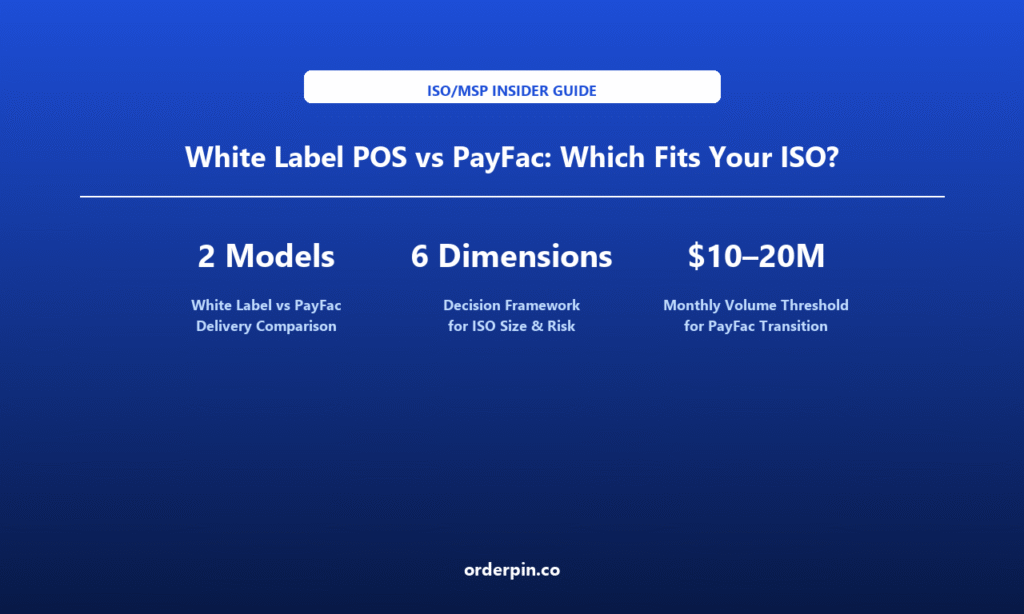
- The two models are not mutually exclusive — but they require different organizational capabilities: a white label ISO needs sales, support, and brand-building capabilities. A PayFac needs underwriting, risk management, compliance, and sponsor bank relationship capabilities. Most ISOs should start as white label and evaluate PayFac transition only when portfolio volume exceeds $10 to $20 million per month — the point at which the margin differential justifies the compliance investment.
- The decision framework in this article evaluates six dimensions: capex, time to revenue, compliance burden, margin per transaction, merchant ownership depth, and exit flexibility. Use the framework to determine which model fits your ISO today — and at what portfolio size the PayFac transition becomes economically rational.
Delivery Comparison
for ISO Size & Risk
for PayFac Transition
The Two Paths to Market
Every ISO that delivers POS software to merchants faces the same strategic question: do I resell someone else’s platform under my brand (white label), or do I own the full payments stack myself (PayFac)? The answer determines the ISO’s capital requirements, compliance burden, margin structure, speed to market, and ultimately the type of business they become. A white label ISO is a sales and support business with a technology layer. A PayFac is a financial services business with a technology platform. They are fundamentally different businesses that happen to serve the same end merchant.
The confusion arises because both models let the ISO put their brand on the merchant experience. The difference is not in what the merchant sees — it is in who owns the risk, the data, the compliance, and the margin. A white label ISO’s vendor handles underwriting, KYC, AML, and PCI compliance behind the scenes. A PayFac handles all of that itself — and is legally responsible for it. The brand layer is the same; the business layer underneath is completely different.
vs $150–500K+ PayFac
vs 6–12 months PayFac
vs Full (PayFac)
vs 40–80 bps PayFac
Dimension 1 — Capital Expenditure
White Label ($10K to $50K to launch): The capex is minimal — vendor onboarding fee (often waived), initial hardware inventory (if you provision terminals, $100 to $300 per merchant), white-label configuration costs (domain, SSL, developer accounts, $200 to $500 total), and working capital for the first 60 days of operations before processing revenue stabilizes. Most ISOs can launch a white label POS business with less than $25,000 in total capex — making it accessible to ISOs at almost any size.
PayFac ($150K to $500K+ to launch): The capex is substantial — sponsor bank setup and legal fees ($25K to $75K), PCI DSS Level 1 certification ($50K to $100K for initial assessment and remediation), underwriting and risk management infrastructure ($30K to $80K for software, systems, and initial staffing), KYC/AML compliance platform ($15K to $40K per year), reserve capitalization ($50K to $250K held by the sponsor bank), and working capital for the 6 to 12 months before revenue begins. The total capex range is $150,000 to $500,000+ for a PayFac launch — a 10x to 20x increase over white label.
Dimension 2 — Time to Revenue
White Label (30 to 60 days): The ISO can sign merchants as soon as the vendor onboarding is complete and the white-label configuration is live. The vendor’s existing PCI compliance, sponsor bank relationship, and underwriting infrastructure cover the merchant — the ISO’s role is sales, configuration, and support. First processing revenue arrives within 30 to 60 days of signing with the vendor.
PayFac (6 to 12 months): The ISO cannot board merchants until the sponsor bank agreement is signed, the PCI DSS certification is complete, the underwriting and KYC/AML infrastructure is operational, and the risk management team is in place. The timeline: sponsor bank negotiation (2 to 4 months), PCI assessment (2 to 4 months), compliance infrastructure setup (1 to 3 months), and initial testing and certification (1 to 2 months). Revenue begins only after this 6 to 12 month buildout is complete — during which the ISO is spending, not earning.
Dimension 3 — Compliance Burden
White Label (Shared): The vendor handles PCI DSS compliance, sponsor bank relationship, merchant underwriting, KYC/AML screening, chargeback management, and regulatory reporting. The ISO’s compliance burden is limited to their own business operations — business licensing, sales compliance (where applicable), and data handling under their vendor agreement. The ISO does not need a dedicated compliance officer or risk management team. This is the most significant operational advantage of the white label model.
PayFac (Full): The PayFac is the legally responsible party for all compliance: PCI DSS Level 1 (annual audit, quarterly scans, $50K+ annual cost), KYC/AML (per-merchant identity verification, ongoing transaction monitoring, SAR filing), sponsor bank reporting (daily settlement, monthly portfolio reporting, risk metric dashboards), state money transmitter licensing (if applicable, $10K to $50K per state), and chargeback management (representation, arbitration, loss recovery). The PayFac needs a dedicated compliance officer, a risk management team, and ongoing legal counsel — adding $150K to $300K in annual overhead that the white label ISO does not carry.
Dimension 4 — Margin Per Transaction
White Label (15 to 30 bps net margin): The ISO earns the spread between the merchant rate and the vendor’s wholesale rate, minus the vendor’s per-transaction fee. For a merchant processing $20K/month at a 2.8 percent effective rate, the ISO’s gross margin is typically 20 to 40 bps ($40 to $80 per merchant per month), minus the vendor’s 5 to 15 bps surcharge, leaving 15 to 30 bps net ($30 to $60 per merchant per month). The vendor captures the rest — the interchange optimization, scheme fees, and processing margin that the PayFac would keep directly.
PayFac (40 to 80 bps net margin): The PayFac earns the full spread between the merchant rate and interchange plus scheme fees, minus their own processing cost. For the same $20K/month merchant at 2.8 percent, the PayFac’s gross margin is 80 to 120 bps ($160 to $240 per merchant per month), minus processing cost of 10 to 20 bps, leaving 40 to 80 bps net ($80 to $160 per merchant per month). The margin differential is 2x to 3x in favor of PayFac — but only after the compliance and overhead costs are covered.
Dimension 5 — Merchant Ownership Depth
White Label (Brand ownership, shared relationship): The ISO owns the merchant relationship at the brand level — the merchant sees the ISO’s brand, calls the ISO’s support, and renews with the ISO. But the vendor owns the underlying merchant account, the processing data, and the compliance relationship. If the ISO leaves the vendor, the merchant accounts do not transfer automatically — the ISO must re-onboard every merchant on a new platform. This is the “portability risk” that limits the ISO’s exit flexibility (see AD8 on vendor fine print and exit fees).
PayFac (Full ownership): The PayFac owns the merchant account, the processing data, the compliance relationship, and the brand. If the PayFac changes sponsor banks or platforms, the merchant accounts move with them (subject to sponsor bank approval). This is the deepest form of merchant ownership — and it is the reason PayFac businesses command higher exit multiples than white label ISOs (see AC12 on the ISO exit multiplier).
Dimension 6 — Exit Flexibility
White Label (Constrained by vendor agreement): The ISO’s exit value depends on whether the merchant portfolio is portable. If the vendor agreement includes data portability (see AD7 due diligence and AD12 contract negotiation), the ISO can migrate merchants to a new platform and sell the portfolio as a portable asset. If not, the portfolio is vendor-locked — and the exit value is whatever the vendor offers to acquire the book, typically 2x to 4x annual EBITDA versus 3x to 5x for a portable portfolio.
PayFac (Unconstrained, higher multiple): The PayFac’s merchant portfolio is fully portable — it is their own merchant accounts, not a vendor’s. Exit value is driven by portfolio quality (volume, churn, margin) and the PayFac’s compliance infrastructure, not by a vendor relationship. PayFac businesses typically trade at 4x to 7x annual EBITDA, versus 2x to 5x for white label ISOs, reflecting the deeper merchant ownership and the portability of the asset.
Decision Framework: Which Model Fits Your ISO?
| ISO Profile | Recommended Model | Rationale | Transition Trigger |
|---|---|---|---|
| <$2M/mo volume, <50 merchants | White Label | Capex constraints, speed to revenue, no compliance team | N/A — focus on growth |
| $2–10M/mo, 50–200 merchants | White Label + Hybrid revenue | Scale supports Hybrid model (AD10), compliance not yet justified | Begin PayFac evaluation at $8M/mo |
| $10–20M/mo, 200–500 merchants | Evaluate PayFac transition | Margin differential ($50–100K/mo) begins to justify compliance overhead | If 12-mo margin gain > 12-mo compliance cost, transition |
| >$20M/mo, >500 merchants | PayFac (if risk-capable) | Margin gain clearly exceeds compliance overhead; portfolio supports underwriting | Execute transition over 12–18 months |
The $10 to $20 million monthly volume threshold is not a hard line — it is the range where the margin differential (the 25 to 50 bps the PayFac keeps that the white label ISO gives to the vendor) exceeds the incremental compliance overhead ($150K to $300K annually). Below this range, the compliance cost consumes the margin gain. Above it, the margin gain compounds. Each ISO should run the calculation with their own portfolio metrics, using the TCO model from AD15 and the revenue models from AD10.
Where OrderPin Fits in the Delivery Model Decision
OrderPin is a white-label POS platform built for ISO and MSP partners — which means it serves the white label side of this decision. For ISOs below the $10 to $20 million monthly volume threshold, OrderPin provides the platform, white-label configuration, and partner support infrastructure that makes the white label model economically viable without the compliance burden of a PayFac. For ISOs approaching the transition threshold, OrderPin’s data portability and merchant data ownership terms preserve exit flexibility — so the ISO can evaluate a PayFac transition without losing the portfolio they built on the platform. Use the decision framework above to determine where your ISO is today, and use the same framework to plan the path to where you want to be in three to five years.
Frequently Asked Questions
Can I be both a white label ISO and a PayFac?
Yes — and many large ISOs eventually do both. The typical path is to start as a white label ISO, build the portfolio and the sales/support infrastructure, and then transition to PayFac when volume justifies it. During the transition, the ISO may run both models in parallel: new merchants boarded on the PayFac infrastructure, existing merchants migrated over time. The transition takes 12 to 18 months and requires careful coordination with the white label vendor (for data portability and merchant migration support) and the sponsor bank (for merchant account migration).
What is the biggest risk of becoming a PayFac?
Underwriting and credit risk. As a white label ISO, the vendor assumes the risk of merchant default and chargeback liability. As a PayFac, the ISO assumes that risk directly — and a single high-risk merchant that generates $50,000 in chargebacks before being detected can wipe out months of margin. The PayFac needs robust underwriting (credit checks, business verification, processing history review), ongoing monitoring (velocity alerts, chargeback ratio monitoring, behavioral anomaly detection), and a risk reserve adequate to absorb losses. ISOs that underestimate the risk management capability required are the most common PayFac failures.
How does the PayFac model affect my merchant pricing?
The PayFac model gives the ISO more pricing flexibility — because the ISO controls the full margin stack and can offer custom pricing without vendor approval. A PayFac can offer aggressive rates to win a competitive deal (absorbing lower margin to acquire a strategic merchant), bundled pricing (software + processing + services in one price), or volume-based tiered pricing — all without negotiating with a vendor over wholesale rates. The tradeoff is that the PayFac also absorbs the risk of underpricing — if the merchant’s actual processing cost (interchange plus scheme fees plus processing cost) exceeds the priced rate, the PayFac loses money on every transaction.
What happens to my merchants if I switch from white label to PayFac?
Merchant migration from a white label platform to a PayFac infrastructure requires re-underwriting each merchant under the PayFac’s sponsor bank — which means new KYC, new merchant agreement, and in some cases a new merchant ID. The ISO should plan the migration in waves (by merchant tier or risk profile) and negotiate data portability support with the white label vendor as part of the original contract (see AD12 contract negotiation, L4 data portability lever). The migration timeline is typically 6 to 12 months for a full portfolio of 200 to 500 merchants.
Is the PayFac model worth it for a small ISO?
Almost never — below $10 million in monthly volume, the compliance overhead ($150K to $300K annually) exceeds the margin gain from owning the full stack. A small ISO processing $2 million per month gains approximately $5,000 to $10,000 per month in incremental margin by becoming a PayFac — against $12,500 to $25,000 per month in incremental compliance overhead. The math does not work. The small ISO should focus on scaling the portfolio through the white label model, optimizing the revenue model toward Hybrid (see AD10 and AD15), and evaluating PayFac only when the portfolio approaches the transition threshold.
How does this article relate to AD4 and AD15?
AD4 covers per-merchant unit economics (CAC, LTV, margin per merchant). AD15 covers the ISO’s business-level TCO (total cost of ownership across seven categories). This article (AD16) covers the delivery model decision (white label vs PayFac) that determines the margin structure and compliance cost the ISO operates within. Together, AD4 + AD15 + AD16 give the ISO a complete economic picture: per-merchant economics, business-level cost structure, and the strategic delivery model that shapes both. Use all three together when evaluating whether your ISO’s current model is the right one for your portfolio size and growth trajectory.
The white label vs PayFac decision is the most consequential strategic choice an ISO makes after platform selection — and the answer depends on portfolio volume, risk appetite, and organizational capability. For most ISOs below $10 to $20 million in monthly volume, the white label model is the right choice: lower capex, faster to revenue, shared compliance, and the ability to build portfolio value before taking on PayFac-level obligations. For ISOs above the threshold with the risk management and compliance capability to support it, the PayFac model delivers 2x to 3x margin per transaction and deeper merchant ownership. Use the six-dimension framework to evaluate your position, and use OrderPin, a white-label POS platform built for ISO and MSP partners, as the white label foundation that preserves your transition optionality — with data portability, merchant data ownership, and the flexibility to evaluate a PayFac transition when the economics justify it.
About OrderPin
OrderPin is a white-label POS platform built for ISO and MSP partners. We offer full data ownership, flexible pricing, and seamless API integrations to help you build a recurring revenue business under your own brand. Learn more about OrderPin’s white-label solution