
TL;DR — Quick Summary
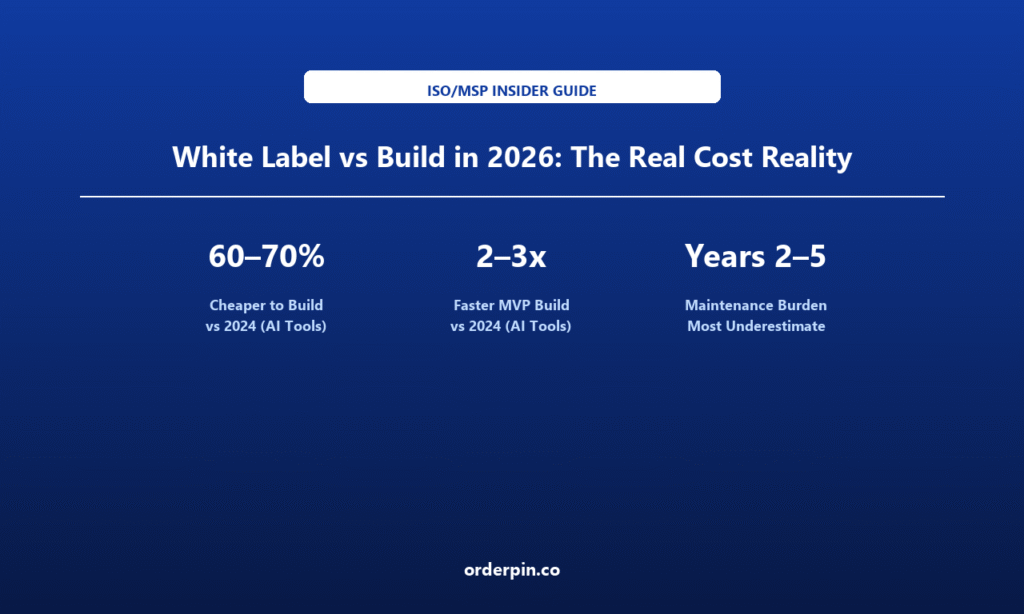
- AI code generation tools have materially changed the build calculus — but they have not eliminated the structural reasons to choose white label: Cursor, Copilot, and Claude can reduce MVP development time by 2–3x and cost by 60–70% versus 2024. But an MVP is not a production POS platform. The gap between a working prototype and a merchant-grade system that handles peak restaurant traffic, integrates with 40 payment processors, and passes PCI-DSS audit is still measured in years and millions of dollars. The AI tools have lowered the floor; the ceiling has not moved.
- The real cost of building is not the MVP — it is years 2–5 of maintenance, compliance, and support: every ISO that has built and then abandoned a POS system cites the same reason: the maintenance burden was invisible in the build decision and became unsustainable after year one. Payment processor API changes, PCI-DSS requirement updates, new terminal hardware certifications, and merchant support tickets do not stop because you are busy building the next feature. The ISO that builds still has to run the business while paying the ongoing maintenance bill.
- White label does not mean giving up the merchant relationship — it means owning the relationship without owning the infrastructure: the strategic case for white label is that you own the merchant contract, the billing relationship, the support touchpoint, and the upsell opportunity. The platform provider owns the compliance burden, the hardware certification, and the API maintenance. This is a better division of labor for most ISOs than building, running, and maintaining a software platform while also trying to sell and service merchant accounts.
vs 2024 (AI Tools)
vs 2024 (AI Tools)
Most ISOs Underestimate
What Changed — and What Did Not — in the Build vs White Label Decision
In April 2026, the original “Build vs Buy” analysis for POS concluded that building your own POS software was almost never the right call for an ISO — the capital requirements, the engineering talent, the compliance burden, and the time horizon made white label the default choice for any ISO without a specific strategic reason to build. That analysis was correct in April 2026. The question now, 18 months later, is whether AI code generation tools have changed the conclusion.
The answer is nuanced: the economics of building an MVP have improved materially, the economics of building a production-grade, merchant-ready POS system have improved only marginally, and the ongoing maintenance burden — which is where most build decisions actually fail — has not changed at all. This article re-runs the analysis with current tooling costs, realistic timelines, and honest estimates of where AI has helped and where it has not.
reduce MVP cost 60–70%
Grade: 18–36 mo
hardware certs
build and white label
1. What AI Tools Have Actually Changed in 2026
AI tools have reduced the cost of an MVP by 60–70% and the time by 2–3x: a POS MVP that would have cost $150,000–$250,000 in 2024 can now be built for $50,000–$100,000 with a competent team using Cursor, Copilot, and Claude as coding partners. The productivity gains are real: AI-assisted code generation accelerates boilerplate, accelerates testing, and accelerates documentation. An ISO that budgets $75,000 and 4–6 months for an AI-assisted MVP is in the right range for 2026.
What AI tools cannot do is compress the compliance and certification timeline: PCI-DSS compliance for a POS system takes 6–12 months minimum and requires penetration testing, annual audits, and ongoing compliance monitoring. Payment processor certifications (for each processor you want to integrate) take 3–6 months each. Terminal hardware certifications add 2–4 months per hardware model. These timelines do not compress with AI coding tools — they are human approval processes and third-party testing processes that AI cannot accelerate.
The gap between MVP and production-grade is still 18–36 months: an MVP that demonstrates core POS functionality (order entry, payments, basic reporting) is a proof of concept. A production-grade system that handles peak restaurant Friday-night volume, 40 simultaneous terminals, 12 payment processors, 8 hardware integrations, loyalty, online ordering, and PCI-DSS audit-ready architecture is an order of magnitude more complex. Most ISOs underestimate this gap by 3–4x when they use AI tools to build the MVP — the AI helps build faster but does not reduce the complexity of what “production grade” actually means.
2. The Hidden Maintenance Burden: Why Most Build Decisions Fail in Years 2–5
The maintenance burden is invisible in the build decision — and that is by design: when an ISO evaluates building versus white label, the comparison is usually framed as a one-time capital cost question. Build costs $75,000–$150,000 (with AI tools). White label costs $X per month per merchant. The problem is that the build cost is a Year 1 number, and the maintenance burden is a Year 2, 3, 4, and 5 cost that does not appear in the initial comparison. This asymmetry leads to systematic underestimation of the true cost of building.
The annual maintenance cost of a self-built POS for 50+ merchant locations is typically $150,000–$300,000 per year: this includes at least one full-time senior engineer ($120,000–$180,000/year), ongoing PCI-DSS compliance costs ($20,000–$50,000/year), payment processor re-certification costs ($10,000–$30,000/year for major API changes), and hardware certification costs ($10,000–$20,000/year per new terminal model). These costs do not scale with merchant volume — they are flat costs that you pay regardless of whether you have 50 or 500 merchants on the platform.
Every major payment processor changes its API at least once per year: Stripe updates its API with breaking changes 2–3 times per year; Adyen and Braintree do the same. Each change requires engineering time to update the integration, test it in staging, and deploy to production. If you support five processors and each has two breaking changes per year, that is 10 engineering sprints dedicated to keeping the integrations alive — sprints that are not building new features, not improving the product, and not improving the merchant experience. This cost is invisible until you are paying it.
3. The Strategic Cost of Not Owning the Merchant Relationship
White label does not mean giving up the merchant relationship — this is the most common misconception: in a white label arrangement, the ISO owns the merchant contract, the billing relationship, the support touchpoint, and the upsell opportunity. The white label platform provider owns the compliance burden, the software maintenance, and the hardware certification. The ISO is the face of the product to the merchant; the platform provider is the infrastructure underneath. This is an important distinction because it means the strategic case for white label — owning the merchant relationship — is preserved while the operational burden is delegated.
The ISO that builds its own platform and then uses it to serve its own merchants faces a conflict of interest when evaluating future options: having built the platform, the ISO is now institutionally committed to it. The platform becomes a sunk cost that influences every future strategic decision — a white label alternative that is better or cheaper cannot be adopted without acknowledging the capital already spent. This is not a theoretical risk; it is the most common reason ISOs stay on an aging, expensive-to-maintain self-built platform long past the point where it is the right choice.
4. The 2026 Updated Decision Framework
Choose white label if you are primarily a payments business: if your core competency is merchant acquisition, relationship management, and payment processing — and software is a means to those ends — then white label is almost always the right answer. The platform provider handles the compliance and maintenance burden; you focus on growing the merchant base. This describes the majority of ISOs and MSPs.
Consider building if you have a specific, defensible technical differentiation that cannot be obtained from a white label provider: this is a narrow case. The differentiation must be real (not aspirational), proprietary (not replicable by a white label provider in 12 months), and large enough to justify the capital and maintenance cost. An example might be a vertical-specific POS system with proprietary hardware integration that no white label provider offers and that commands a premium in a specific vertical where you have dominant market share. Even in this case, start with white label and build the differentiated component as a layer on top.
Run the full cost model before deciding — not just the Year 1 build cost: the full cost model for building includes: Year 1 build cost ($75,000–$150,000 with AI tools), Years 1–5 annual maintenance ($150,000–$300,000/year), Year 3–5 feature development ($50,000–$100,000/year to stay competitive), and opportunity cost (the engineering team you could have used to grow the merchant base instead of maintaining a platform). Compare this to the 5-year white label cost: per-merchant platform fees on a growing merchant base, plus the engineering headcount freed up to focus on merchant acquisition and relationship management.
5. What to Do If You Are Already Built
Run the migration cost/benefit analysis before assuming your platform is too expensive to replace: most ISOs with self-built platforms overestimate the cost of migrating to white label and underestimate the ongoing cost of staying. Calculate the annual maintenance cost of your current platform (engineering headcount + compliance + certifications), multiply by your remaining platform horizon (years until a rebuild would be required anyway), and compare that to the 5-year white label cost. The answer is often that white label is cheaper on a 5-year horizon even after accounting for migration costs and platform fees.
The “sunk cost” test: if you were starting fresh today with no existing platform, no existing codebase, and no existing engineering team — would you choose to build or white label? If the answer is white label, then the sunk cost of your existing platform is the only thing keeping you from making the right decision. Sunk costs are not a reason to continue; they are a reason to make a clean decision now about whether the future value of the platform justifies the future maintenance cost.
OrderPin’s Approach to the Build vs White Label Decision
OrderPin is a white-label POS platform built for ISO and MSP partners. We built OrderPin on the premise that most ISOs should own the merchant relationship, not the infrastructure — and that a white label platform should handle the compliance, maintenance, and certification burden so the ISO can focus on what they do best: acquiring and retaining merchants. OrderPin’s platform supports per-location SaaS revenue models, flexible pricing, and modular add-ons that let an ISO build white label unit economics from the first merchant signed. If you are evaluating the build vs white label decision, we recommend running the full 5-year cost model — and we are happy to share what our ISO partners have found when they have done exactly that.
Frequently Asked Questions
How much has AI actually reduced the cost of building a POS MVP in 2026?
AI code generation tools (Cursor, Copilot, Claude) have reduced POS MVP development costs by approximately 60–70% versus 2024 — from $150,000–$250,000 to $50,000–$100,000 for a competent team using AI-assisted development. The timeline has compressed from 9–12 months to 4–6 months. These gains are real for the MVP stage. However, the gap between an MVP and a production-grade, merchant-ready, PCI-DSS-audited POS system is still 18–36 months of additional work that AI tools cannot eliminate. The maintenance burden (years 2–5) has not changed at all.
What is the hidden maintenance cost of a self-built POS that most ISOs underestimate?
The annual maintenance cost for a self-built POS serving 50+ merchant locations is typically $150,000–$300,000 per year, including at least one senior full-time engineer ($120,000–$180,000/year), PCI-DSS compliance costs ($20,000–$50,000/year), payment processor re-certification costs ($10,000–$30,000/year for breaking API changes), and hardware certification costs ($10,000–$20,000/year per new terminal model). These are flat costs that do not scale with merchant volume — they exist regardless of whether you have 50 or 500 merchants, making them an increasingly large burden as a percentage of margin as the merchant base shrinks.
Does choosing white label mean giving up the merchant relationship?
No. In a white label arrangement, the ISO owns the merchant contract, the billing relationship, the support touchpoint, and the upsell opportunity. The platform provider owns the compliance burden, the software maintenance, and the hardware certification. The ISO is the face of the product to the merchant; the platform provider is the infrastructure underneath. This is the key distinction: white label lets the ISO own the relationship without owning the infrastructure — which is the correct division of labor for an ISO whose core competency is payments, not software engineering.
How long does PCI-DSS compliance take for a new POS platform?
PCI-DSS compliance for a POS system takes a minimum of 6–12 months from the beginning of the compliance process to achieving validated status, including a gap assessment, remediation, penetration testing, and the QSA (Qualified Security Assessor) audit. This timeline cannot be compressed with AI coding tools — it is a human approval and testing process. Additionally, PCI-DSS compliance is not a one-time achievement; it requires annual re-certification, ongoing vulnerability scanning, and periodic penetration testing. This is a recurring annual cost that white label platform providers amortize across their entire merchant base, while a self-built platform pays the full cost alone.
When might it actually make sense to build instead of choosing white label?
Consider building if you have a specific, defensible, proprietary technical differentiation that no white label provider offers and that commands a premium in a specific vertical where you have dominant market share — and that differentiation is not replicable by a white label provider within 12 months. Even in this case, the recommendation is to start with white label and build the differentiated component as a layer on top, rather than building the entire platform from scratch. The burden of proof for building should be high: the differentiation must be real, proprietary, and large enough to justify the capital and ongoing maintenance cost over a 5-year horizon.
What should an ISO with an existing self-built platform do in 2026?
Run the migration cost/benefit analysis before assuming your platform is too expensive to replace. Calculate the annual maintenance cost of your current platform, multiply by your remaining platform horizon (years until a rebuild would be required anyway), and compare that to the 5-year white label cost including migration. If the answer is that white label is cheaper on a 5-year horizon — which it often is — then the sunk cost of your existing platform is the only thing keeping you from making the right decision. Apply the “fresh start test”: if you were starting today with no existing platform, no codebase, and no engineering team, would you build or white label? If the answer is white label, then make a clean decision now.
AI code generation tools have improved the economics of building a POS MVP by 60–70% in 2026 — but they have not changed the structural reasons to choose white label for most ISOs. The gap between an MVP and a production-grade, merchant-ready, PCI-DSS-audited POS system is still measured in years and millions of dollars, and the annual maintenance burden of a self-built platform ($150,000–$300,000/year) does not shrink with AI tools. White label lets you own the merchant relationship without owning the infrastructure — which is the correct division of labor for an ISO whose core competency is payments, not software engineering. The right question is not “can we build it?” but “should we own the maintenance burden for the next 10 years?” For most ISOs, the answer is no. OrderPin is a white-label POS platform built for ISO and MSP partners — designed so you own the merchant relationship while we handle the infrastructure, compliance, and maintenance burden.
About OrderPin
OrderPin is a white-label POS platform built for ISO and MSP partners. We offer full data ownership, flexible pricing, and seamless API integrations to help you build a recurring revenue business under your own brand. Learn more about OrderPin’s white-label solution