
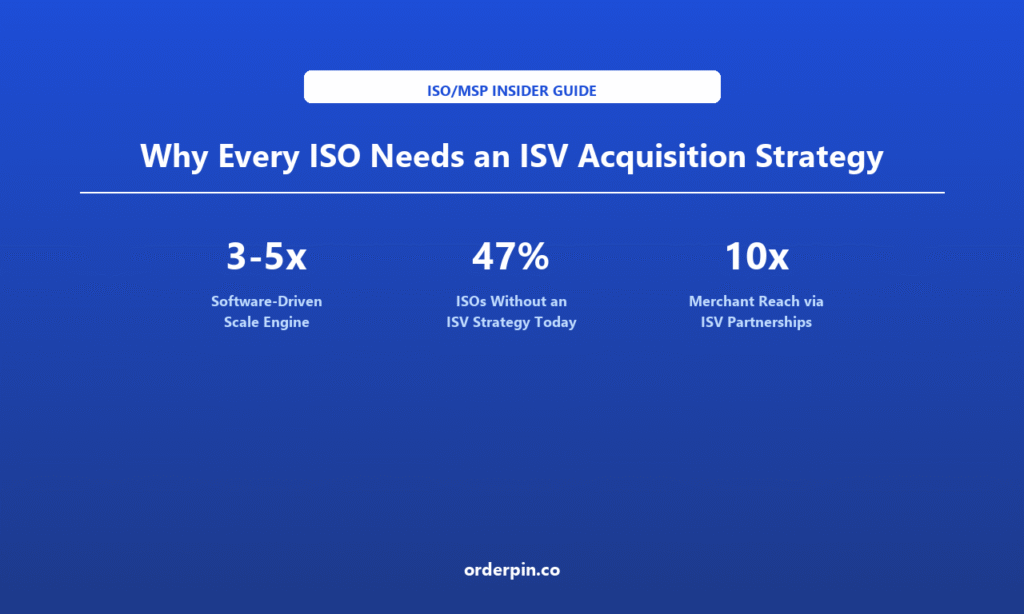
TL;DR — Quick Summary
- ISVs are now the single most efficient merchant acquisition channel in payments: Independent software vendors — the companies that build the operational software merchants actually use every day — sit between ISOs and the merchants they want. An ISV that embeds payments into its software acquires merchants at a fraction of the cost of a human sales team, and those merchants stay because switching software is expensive. ISOs that ignore this channel are competing with one hand tied behind their back.
- A structured ISV strategy scales beyond headcount — a human sales team does not: Every additional sales rep adds linear cost and linear revenue, and hits a ceiling at the size of your recruiting and training capacity. An ISV partnership adds merchant volume every time the software vendor adds a customer — growth that compounds with zero incremental sales headcount. The ISO that builds a portfolio of ISV relationships has a growth engine that does not cap out at its payroll.
- Acquisition and partnership are two different tools — most ISOs need both: Partnership (referral, reseller, embedded) is fast and capital-light but yields thinner margins and weaker control. Acquisition (tuck-in, roll-up) is slower and capital-heavy but yields full ownership, full data, and permanent portfolio value. The ISOs that win structure a layered strategy: partner broadly to build the pipeline, acquire selectively to capture the highest-value software and the deepest merchant relationships.
Scale Engine
Formal ISV Strategy
ISV Partnerships
What Is an ISV Partnership — and Why It Changed Merchant Acquisition
An ISV — independent software vendor — is a company that builds the operational software that merchants run their businesses on: point-of-sale systems, restaurant management platforms, scheduling software, inventory tools, accounting systems, appointment booking, field service management. These are not payment companies. They are the software layer that sits between the merchant and every transaction the merchant processes. And that position — embedded in the merchant’s daily operations — is exactly what makes ISVs the most powerful merchant acquisition channel in payments today.
The mechanics are simple. A restaurant adopts a POS platform. That platform has a payments module. The merchant activates payments inside the software they already use — with one click, often without ever speaking to a salesperson. The ISV has acquired the merchant on behalf of the payment provider, at near-zero customer acquisition cost, and the merchant is now locked in: switching payment providers means ripping out the software they run their business on. This is the structural advantage that human sales teams cannot match. The ISO sales rep knocks on the door; the ISV is already inside the building.
The scale of this shift is now measurable. Industry analysts estimate that ISV-embedded payment channels now account for the majority of new small-business merchant accounts in several verticals — restaurants, salons, professional services, and field service — and that the share is growing year over year as more software vendors add payments. For an ISO, the question is no longer whether to work with ISVs. It is whether to treat ISV partnership as a side activity or as a core, structured, capitalized growth strategy. The ISOs that treat it as core are building merchant books that grow without proportional headcount. The ones that treat it as an afterthought are watching their best prospects get acquired by software vendors before a sales rep ever makes the call.
This article lays out the two paths — partnership and acquisition — and how to combine them. It is written for ISO owners who are deciding where to invest next: more sales reps, or a software-driven acquisition engine. The math, as we will see, increasingly favors the latter.
M&A Volume
Headcount Model
via ISV Channel
Retention Rate
1. Partnership Models: Four Ways to Work With ISVs
Referral partnership: The lightest form of ISV relationship. The software vendor refers its merchants to the ISO for payments, typically in exchange for a one-time or recurring referral fee. Low friction, no integration required, but thin margins and no embedded control — the merchant still chooses the ISO, and can switch. Best for ISOs testing an ISV channel before committing engineering resources.
Reseller / ISO-of-record: The ISV sells the ISO’s payment product under its own brand, with the ISO as the back-end processor and program manager. Deeper integration, better economics, and the ISO owns the merchant relationship contractually. Requires API work and a revenue-share agreement, but yields stickier merchants than pure referral.
Embedded / embedded-finance: Payments are built directly into the ISV’s software via API, so the merchant activates payments inside the product without ever seeing a separate provider. This is the gold standard — lowest acquisition cost, highest retention, deepest data. Requires real technical integration (or a white-label platform that provides it), but delivers the structural lock-in that defines the modern ISO.
Equity / strategic stake: The ISO takes an ownership position in the ISV — either an investment or a full acquisition — converting a channel partner into a captive distribution asset. Highest control, highest cost, and permanent portfolio value. This is the acquisition path covered in the next section.
2. Acquisition Frameworks: How to Buy Software the Right Way
Tuck-in acquisition: Buy a single ISV whose software serves a vertical you want to dominate (restaurants, salons, field service). You gain its merchant base, its software, and its distribution — instantly. Most common first acquisition for an ISO; lower risk than a platform buy because the scope is contained.
Roll-up: Acquire multiple small ISVs in the same or adjacent verticals and merge them onto one platform. The combined merchant base and engineering talent create a business worth more than the sum of parts — and a portfolio multiple that attracts further capital. This is how the largest ISOs compound.
Platform acquisition: Buy or build a payments-capable platform and layer your ISO’s processing on top, then use it as the foundation for embedding into many downstream ISVs. This is the strategic apex — you become the platform other ISVs embed into, not just a reseller of someone else’s software.
Earnout-structured deals: Pay partial upfront, tie the remainder to retained merchant volume and software performance. This aligns the ISV founder with the ISO’s long-term portfolio value and protects against overpaying for churned merchants. Essential discipline for any ISO doing its first acquisition.
3. Structuring ISV Deals for Maximum Long-Term Portfolio Value
Own the data, not just the processing: The real long-term value of an ISV relationship is the merchant’s operational data — transaction patterns, inventory, scheduling, customer behavior. Structure deals so the ISO owns or has perpetual access to that data, because data is what makes the merchant book defensible against competitors and valuable at exit.
Negotiate exclusivity where it matters: For embedded deals, exclusivity in the vertical protects your merchant base from a competing ISO sneaking in through the same software. Non-compete and exclusivity clauses are worth more than a lower upfront price in most ISV transactions.
Match deal structure to merchant quality: Pay a premium multiple only for ISVs with high-retention, high-volume merchants and clean software. Pay earnout-based, low-upfront structures for early-stage ISVs whose merchant base is unproven. Overpaying for churn risk is the most common mistake in ISV M&A.
Plan the integration before you close: The value is realized in integration — migrating merchants to your stack, unifying reporting, and cross-selling. Deals that close without an integration plan stall, and stalled integrations are where portfolio value leaks. Build the 90-day integration roadmap as part of the term sheet, not after.
ISO Without an ISV Strategy vs. ISO With an ISV Strategy
| Dimension | ISO With ISV Strategy | ISO Without ISV Strategy |
|---|---|---|
| Primary Acquisition Channel | Software-embedded + sales team | Human sales team only |
| Customer Acquisition Cost | Low (software-driven) | High (headcount-driven) |
| Scalability Ceiling | Compounds with software adoption | Caps at payroll size |
| Merchant Retention | 90%+ (software-locked) | 15-25% annual churn |
| Data Ownership | Full operational data | Transaction data only |
| Exit Valuation Multiple | 8-15x (software-enabled) | 3-5x (processing-only) |
How OrderPin’s White-Label Platform Turns ISOs Into ISV Channel Players
OrderPin is a white-label POS platform built so ISOs can become the software layer — not just a reseller of someone else’s stack. For an ISO executing an ISV strategy, the platform is the asset that makes embedded partnerships possible without building software from scratch.
- Embedded partnership without the engineering cost: OrderPin’s API-first architecture lets an ISO offer embedded payments inside an ISV’s software — the gold-standard acquisition model — without hiring a development team. The ISO presents the platform as its own brand; the ISV embeds it; merchants activate inside the software they already use.
- Captive distribution through white-label ownership: Because the platform carries the ISO’s brand, every merchant acquired through an ISV partner is the ISO’s merchant — not the software vendor’s. The ISO owns the relationship, the data, and the recurring revenue. This is the structural difference between a referral fee and a permanent portfolio asset.
- Data ownership for portfolio value: OrderPin gives the ISO full operational data on every merchant — transaction patterns, multi-location performance, and usage depth. That data is what makes the ISO’s book defensible and what drives a premium exit multiple when the time comes to sell.
- Roll-up ready: As the ISO acquires or partners with multiple ISVs, OrderPin provides a single platform to consolidate them on — exactly the integration discipline that protects portfolio value during a roll-up. One stack, many channels, one unified merchant book.
Frequently Asked Questions
Do I need to write code to build an ISV partnership?
For referral and reseller models, no. For embedded partnerships, some integration is required — but a white-label platform with an API-first design (like OrderPin) provides the integration layer, so the ISO does not need to build software internally. The engineering burden falls on the platform, not the ISO. This is what makes embedded ISV deals accessible to ISOs that are not technology companies.
What is the difference between an ISV partnership and an ISV acquisition?
A partnership is a commercial relationship — the ISV refers or embeds your payments in exchange for a fee or revenue share. You do not own the software or the company. An acquisition means you buy the ISV (or a stake in it), gaining ownership of the software, the merchant base, and the distribution. Partnership is fast and capital-light; acquisition is slower and capital-heavy but yields full control and permanent portfolio value. Most ISOs need both.
How much should an ISO pay to acquire an ISV?
It depends on merchant quality, not headline revenue. Pay a premium only for ISVs with high-retention, high-volume merchants and clean software; structure early-stage or unproven ISVs as earnout deals with low upfront and payments tied to retained merchant volume. The most common mistake is overpaying for churn risk — an ISV whose merchants leave after acquisition is worth a fraction of its sticker price. Earnouts protect against this.
Which ISVs should an ISO target first?
Start with ISVs whose software serves a vertical you already understand and have merchants in — restaurants, salons, field service, professional services. The closer the ISV’s vertical aligns with your existing book, the faster you can cross-sell and the lower the integration risk. A tuck-in acquisition of one well-matched ISV is a better first move than a broad, unfocused partnership spree.
Does an ISV strategy replace the sales team?
No — it changes the sales team’s role. Human reps remain essential for complex, high-value merchant relationships and for managing ISV partners themselves. But the ISV channel handles high-volume, lower-touch merchant acquisition that a human team cannot do economically. The ISO that combines both — a sales team for enterprise relationships and an ISV engine for volume — has a growth model that neither approach achieves alone.
How does an ISV strategy affect exit valuation?
Strongly. Acquirers and private equity pay software-enabled ISOs 8-15x EBITDA versus 3-5x for processing-only businesses. The premium reflects the stickier merchant base, the owned data, and the recurring software-driven revenue. An ISV strategy is not just an acquisition channel — it is the single biggest lever on an ISO’s exit multiple. ISOs that start building it now will command that premium; those that do not will sell at a processing-only discount.
ISVs have become the most efficient merchant acquisition channel in payments — they acquire merchants at near-zero cost and keep them because switching software is painful. For an ISO, an ISV strategy is no longer optional; it is the difference between a growth engine that compounds beyond headcount and a sales team that caps out at payroll size. Partnership and acquisition are complementary tools: partner broadly to build the pipeline, acquire selectively to capture the highest-value software and the deepest merchant relationships. The ISOs winning this shift own the data, negotiate exclusivity, match deal structure to merchant quality, and plan integration before they close. The cost of waiting is structural — every quarter without an ISV strategy is a quarter of merchants acquired by software vendors before a sales rep calls. OrderPin is a white-label POS platform with an API-first architecture that lets ISOs execute embedded ISV partnerships and consolidate acquired channels onto one owned stack — turning the ISO from a reseller into the software layer that owns the merchant relationship.
About OrderPin
OrderPin is a white-label POS platform built for ISO and MSP partners. We offer full data ownership, flexible pricing, and seamless API integrations to help you build a recurring revenue business under your own brand. Learn more about OrderPin’s white-label solution