
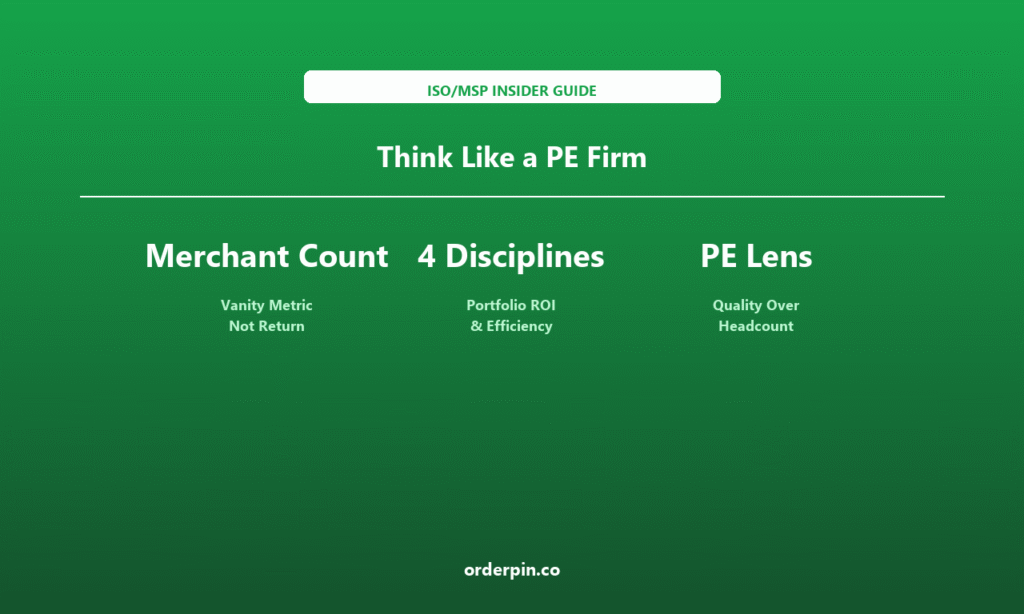
TL;DR — Quick Summary
- ISOs optimize for count and volume; PE firms optimize for return: The ISO’s scoreboard is logos and processing dollars, which rewards growth without asking whether each merchant earns its keep. A private equity firm scores the same book on portfolio quality, unit economics, and long-term value — and that single shift in what you measure changes what you build.
- Four PE disciplines translate directly to an ISO: Portfolio optimization (prune and concentrate on quality), per-merchant ROI (treat every account as an investment), operational efficiency (margin is a discipline, not a by-product), and long-term value creation (build durable enterprise value, not just residuals to sell).
- This is the operating lens, not the exit lens: AC12 covered why software-enabled ISOs sell for higher multiples. AC55 is about how to run the book day-to-day with PE discipline so that, whether or not you ever sell, you compound value instead of just accumulating merchants.
Is a Vanity Metric
Optimize & Build
Enterprise Value
What ISOs Can Learn From Private Equity
Private equity firms do not buy businesses to collect them — they buy to improve them and compound value. Every portfolio company is measured on return on invested capital, unit economics, and trajectory, and capital flows to the holdings that earn it. ISOs, by contrast, have historically measured success in merchant count and processing volume: more logos, more dollars, full stop. That scoreboard rewards growth without ever asking whether each merchant earns its keep.
The shift this article proposes is simple but powerful: run the ISO like a PE firm runs a portfolio. Optimize for portfolio quality, per-merchant ROI, operational efficiency, and long-term value creation. This is distinct from the exit-multiple conversation in AC12 — there we discussed why software-enabled ISOs command higher sale prices; here we focus on the operating discipline that makes any ISO more valuable whether or not it is ever sold. The lens you adopt determines the book you build.
on Quality
as an Investment
Discipline
Enterprise Value
1. The ISO Scoreboard Rewards Growth, Not Return
Count hides the quality problem: When the dashboard is logos and volume, every merchant looks like a win — even the deeply discounted, support-heavy, churn-prone account that erodes value. The book grows in size while its quality quietly declines, because nothing on the scoreboard is measuring return.
PE firms measure what ISOs ignore: A PE portfolio is scored on return on invested capital, unit economics, and trajectory. Capital is reallocated away from laggards and toward winners. The ISO that adopts this discipline stops celebrating merchant count and starts asking whether each account is earning its place.
2. Discipline One: Portfolio Optimization
Concentrate on quality, not just size: PE firms actively prune underperformers and double down on the holdings that compound. ISOs can do the same — segment the book by risk-adjusted return, retire or re-price the accounts that destroy value, and redirect acquisition energy toward the merchant profile that actually performs.
A smaller, better book beats a bigger, worse one: The goal is not the longest merchant list; it is the portfolio that returns the most per dollar of effort. Optimization is the discipline that turns a scattered book into a deliberate one.
3. Discipline Two: Per-Merchant ROI
Treat every merchant as an investment with a return: A PE firm knows the cost and the payoff of each holding. An ISO should know the acquisition cost, support cost, and lifetime value of each merchant — and be willing to act when the math does not work. ROI is the number that turns a relationship into a decision.
Unit economics beat vanity volume: A thousand marginal merchants at negative unit economics is a liability; a hundred merchants with strong, durable returns is an asset. Per-merchant ROI is what lets the ISO tell the difference and allocate accordingly.
4. Discipline Three: Operational Efficiency
Margin is a discipline, not a by-product: PE operators obsess over cost structure because they know efficiency is where value is protected. ISOs can apply the same rigor — automate onboarding, consolidate reporting, and drive down per-merchant operating cost so that more of every dollar of revenue reaches the bottom line.
Efficiency compounds just like growth: The ISO that runs lean can out-earn a larger competitor on a smaller book. Operational efficiency is the quiet multiplier that PE discipline brings to an otherwise volume-obsessed business.
5. Discipline Four: Long-Term Value Creation
Build durable enterprise value, not just residuals to sell: PE firms create value so the asset is worth more on exit — but the operating improvements are real regardless of whether a sale happens. ISOs that build a branded platform, own the data, and embed with merchants are building enterprise value that compounds every year they hold the book.
The operating lens and the exit lens reinforce each other: Run the book with PE discipline and you not only perform better while you own it — you also become the asset AC12 describes, the one that commands a premium multiple when the time comes. Value creation is the long game that makes everything else pay off.
Volume-Driven ISO vs. PE-Disciplined ISO
| Dimension | Volume-Driven ISO | PE-Disciplined ISO |
|---|---|---|
| Scoreboard | Merchant count & volume | Return & unit economics |
| Portfolio View | Accumulate everyone | Optimize for quality |
| Cost Structure | By-product of growth | Managed discipline |
| Value Horizon | Residuals to sell | Durable enterprise value |
| Outcome | Bigger but weaker | Smaller but stronger |
How OrderPin Helps ISOs Run the Book Like PE
OrderPin is a white-label POS platform built for ISO and MSP partners. It gives the ISO the asset a PE firm would demand: a branded platform, full data ownership, and the integration layer to measure and improve every merchant as an investment. Through its white-label POS program and seamless API integrations, an ISO can apply portfolio discipline — optimizing quality, driving per-merchant ROI, and automating for efficiency — without building technology from scratch.
- Own the data to measure ROI: Because the transaction and operational data lives with the ISO, you can score every merchant on acquisition cost, support cost, and lifetime value — the unit economics a PE firm would insist on.
- Optimize the portfolio: The platform lets you segment the book by return, retire or re-price value-destroying accounts, and concentrate acquisition on the merchant profile that actually performs.
- Automate for efficiency: Self-service onboarding and consolidated reporting drive down per-merchant operating cost, so margin becomes a managed discipline rather than a by-product.
- Build durable value: A branded platform and owned data layer are exactly the enterprise-value assets AC12 shows command a premium — the operating lens and the exit lens reinforcing each other.
Frequently Asked Questions
Why should an ISO think like a private equity firm?
Because PE firms optimize for return, unit economics, and long-term value, while ISOs traditionally optimize for merchant count and volume. A volume scoreboard rewards growth without asking whether each merchant earns its keep. Adopting the PE lens changes what you measure — and therefore what book you build. It is the operating discipline that makes any ISO more valuable, sold or not.
How does this differ from the exit-multiple point in AC12?
AC12 covered why software-enabled ISOs command higher sale multiples. AC55 is about how to run the book day-to-day with PE discipline — portfolio optimization, per-merchant ROI, operational efficiency, and value creation — so you compound value regardless of whether you ever sell. The two reinforce each other: the operating improvements are exactly what makes the asset worth a premium.
What does per-merchant ROI actually mean for an ISO?
It means knowing the acquisition cost, support cost, and lifetime value of each merchant and being willing to act when the math does not work. A thousand marginal merchants at negative unit economics is a liability; a hundred with strong, durable returns is an asset. Per-merchant ROI turns a relationship into a decision and lets the ISO allocate capital like a portfolio manager.
How does an ISO optimize its portfolio without losing merchants?
Optimization is about concentration on quality, not mass churn. Segment the book by risk-adjusted return, re-price or retire the accounts that genuinely destroy value, and redirect acquisition energy toward the merchant profile that performs. The point is a deliberate book that returns more per dollar of effort — not the longest possible merchant list.
Where does operational efficiency fit in the PE lens?
Margin is a discipline, not a by-product. PE operators obsess over cost structure because efficiency is where value is protected. ISOs apply the same rigor through automated onboarding, consolidated reporting, and lower per-merchant operating cost — so more of every revenue dollar reaches the bottom line. Efficiency compounds like growth and lets a leaner ISO out-earn a larger, sloppier one.
Can a white-label platform really help an ISO act like PE?
It is precisely the asset a PE firm would demand. Because the ISO owns the merchant relationship, the data, and the branded surface, it can measure per-merchant ROI, optimize the portfolio, and automate for efficiency — the three operating disciplines that build durable enterprise value. OrderPin is built for that role: a white-label POS platform with full data ownership and open integrations.
ISOs optimize for merchant count and volume; private equity firms optimize for return, unit economics, and long-term value. The ISO scoreboard rewards growth without ever asking whether each merchant earns its keep, so the book grows in size while its quality quietly declines. Adopting the PE lens changes what you measure — and therefore what book you build. Four disciplines translate directly: optimize the portfolio by pruning and concentrating on quality, treat every merchant as an investment with a measurable ROI, run margin as a managed discipline rather than a by-product, and build durable enterprise value that compounds whether or not you ever sell. This is the operating lens, distinct from the exit-multiple angle in AC12 — but the two reinforce each other, because the improvements are exactly what make the asset command a premium. OrderPin is a white-label POS platform built for ISO and MSP partners — giving you the branded platform, full data ownership, and integration layer to measure per-merchant ROI, optimize the portfolio, and automate for efficiency, so you run the book like an investor instead of a collector.
About OrderPin
OrderPin is a white-label POS platform built for ISO and MSP partners. We offer full data ownership, flexible pricing, and seamless API integrations to help you build a recurring revenue business under your own brand. Learn more about OrderPin’s white-label solution