
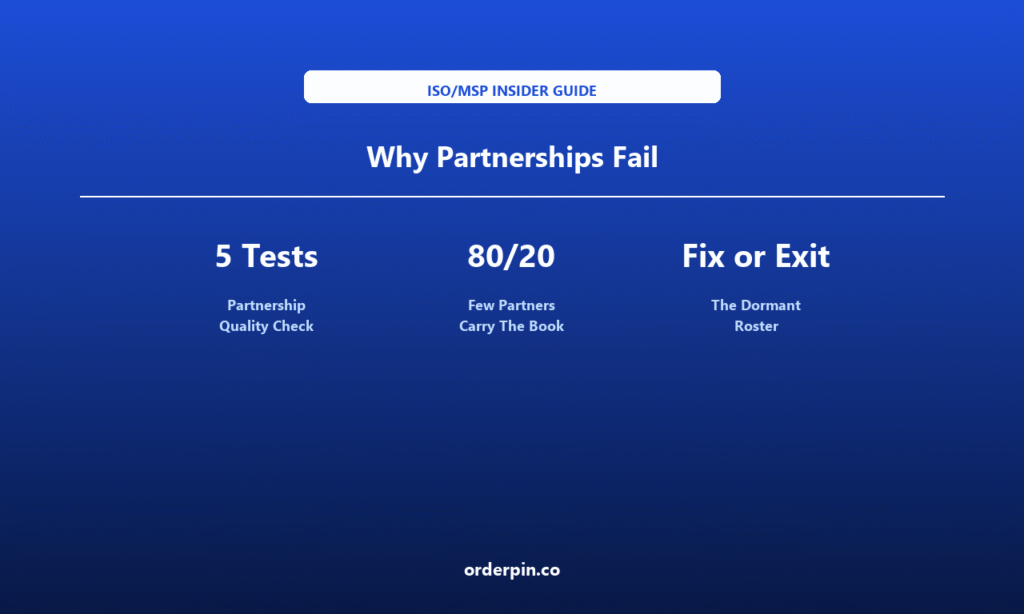
TL;DR — Quick Summary
- Partnerships fail on quality, not quantity: Most ISOs sign partners by the handful and wonder why revenue never compounds. The partnerships that generate millions share five traits — incentive alignment, real enablement, clear communication, strategic fit, and long-term commitment. The ones that die are treated as lead sources and starved the moment the agreement is signed.
- A handful of partners carry the book: In most ISO portfolios, a small minority of partnerships produces the overwhelming majority of partner-sourced revenue, while the rest sit dormant or quietly churn. The gap between an enabled partner and a starved one is not a few points of performance — it is the difference between a real channel and a logo on a slide.
- Run the diagnostic, then act: Score every existing partnership against the five tests, kill the ones that fail, and double down on the few that can compound. Relentless enablement of a small set of aligned partners beats a wide, neglected roster every quarter — and it is cheaper than chasing the next logo.
Quality Diagnostic
Partner vs. Starved
& Bank Partnerships
What Makes an ISO Partnership Generate Millions — or Nothing
Every ISO has partnerships. A handful generate millions; the rest generate a logo on a slide deck and a quarterly call nobody attends. The difference is almost never the size of the partner or the size of the market. It is quality — whether the partnership is built to generate revenue or merely to look like distribution. A referral partner, an ISA, and a bank partnership all start with the same promise. What decides which ones produce is how they are designed, fed, and kept.
The partnerships that fail almost always fail the same way: they are treated as lead sources rather than as businesses to be enabled, then starved after signing when the “new partner” energy fades. The ones that print money are the opposite — aligned so both sides win on the same events, enabled with real tools and enablement rather than a PDF, communicated with on a rhythm, chosen for strategic fit rather than convenience, and committed to past the first renewal. This article is the diagnostic: five tests that separate a million-dollar partnership from a dead one, and how to fix the broken ones before they quietly drain your team.
On The Same Events
Not A PDF
Communication
Past Renewal One
1. The Partnership Graveyard: Quantity Without Quality
Signing partners is easy; producing revenue is not: Partnership quantity is the cheapest metric in payments. A logo can be signed in an afternoon and never produce a single referral. Most ISO “partner programs” are graveyards of agreements that were never fed — signed for the announcement, forgotten by the next quarter.
The 80/20 is starker than you think: In most portfolios a small minority of partnerships carries nearly all partner-sourced revenue, while the rest sit dormant or quietly churn. The trap is treating all partners equally — spreading thin enablement across a wide, neglected roster instead of building depth with the few that can actually compound.
2. Tests One and Two: Incentive Alignment and Strategic Fit
Incentive alignment — does your partner win when you win? A partnership that generates millions pays the partner on the events that actually matter to you — activated merchants, retained volume, deployed terminals — not a one-time spiff that rewards the signature and ignores the outcome. When the partner’s payout and your revenue move on the same event, the partner keeps selling after the launch. When they don’t, the partner optimizes for their own number and your channel stalls.
Strategic fit — does the partner already sit in front of your buyer? The best partnerships are not the biggest names; they are the ones whose daily business already touches your merchant. A bank that serves the same SMBs, an ISA already selling adjacent services, a vertical software vendor with the same customer — strategic fit means the partner does not have to build a new relationship to sell you. Convenience and a big logo are not fit.
3. Tests Three and Four: Real Enablement and Clear Communication
Real enablement — do you feed the partner or starve it? A PDF and a portal login is not enablement. The partnerships that scale get a real product the partner can demo, co-branded materials, a clear path to onboard a merchant, and a named person on your side who answers within a day. Starved partnerships are the norm: signed, launched with a webinar, and never given the tools to sell a second time. Enablement is the single largest lever between a dead partner and a compounding one.
Clear communication — is there a rhythm, or just a launch? Winning partnerships run on a cadence: a scheduled review, shared pipeline, and a standing channel where problems surface before they become a dead quarter. Failing partnerships run on silence — one enthusiastic launch, then nothing until someone notices the partner stopped referring. Communication is not a nice-to-have; it is the mechanism that keeps a channel alive.
4. Test Five: Long-Term Commitment
A deal ends at the signature; a partnership starts there: The partnerships that generate millions are treated as multi-year programs, not quarterly campaigns. That means investing in the partner before the revenue shows up — training, co-selling, joint marketing, and patience through the ramp — rather than judging the partnership by its first ninety days and quietly abandoning it.
Commitment is what the partner feels: A partner can tell within a quarter whether you are building something with them or using them for a press release. The ones that stay, keep referring, and defend you in competitive deals are the ones that felt a real commitment — consistent support, a visible roadmap, and a relationship that outlives one person’s quota.
5. The Fix: Exit the Dead and Compound the Living
Score every partnership against the five tests: Give each partner a simple pass or fail on incentive alignment, enablement, communication, strategic fit, and commitment. The score is not academic — it tells you where to spend your scarce enablement hours and which relationships are quietly consuming them.
Fix the fixable; formally exit the dead: Some failing partnerships are one missing element away from working — a better incentive, a named contact, an enablement session. Fix those deliberately. The rest are dead weight: end them cleanly so the roster reflects reality and your team stops pretending a dormant logo is a channel.
Go deep on the few that compound: Take the partners that pass the tests and over-invest in them — more enablement, joint planning, first access to new offers. Depth with five aligned partners beats breadth with fifty neglected ones, and it compounds every quarter.
Make the partner’s success your product: Give the partner something real to sell and make it easy to sell — the same principle behind merchant success in AC17 and retention in AC46, applied to the channel. When the partner can win without you in the room, the partnership stops depending on your team’s attention.
Failed Partnership vs. Million-Dollar Partnership
| Dimension | Failed Partnership | Million-Dollar Partnership |
|---|---|---|
| Incentive Model | One-time spiff | Paid on shared outcomes |
| Enablement | PDF & portal login | Product, tools, named owner |
| Communication | Launch, then silence | Scheduled rhythm |
| Strategic Fit | Big logo, no overlap | Already in front of your buyer |
| Time Horizon | Judged in 90 days | Built over years |
How OrderPin Helps ISOs Build Partnerships That Compound
OrderPin is a white-label POS platform built for ISO and MSP partners. The hardest part of a partner program is giving the partner something real to sell — and making it easy to sell. A white-label POS platform lets an ISO hand partners a branded product they can demo, deploy, and support, so enablement stops being a PDF and becomes a real channel.
- Give partners a real product: A white-label platform is something the partner can put in front of their own merchants — a tangible offer that turns a referral relationship into a selling relationship.
- Align on outcomes: Because the ISO owns the platform, data, and merchant relationship, incentives can be built on activated merchants and retained volume rather than one-time introductions.
- Enable without rebuilding: Co-branded, API-integrated deployment lets ISOs enable partners quickly instead of running a bespoke integration project for every new logo.
- Compound the channel: The same owned-platform economics that make merchant monetization compound also make partner-sourced revenue compound — the partner keeps selling because the product keeps working.
Frequently Asked Questions
Why do so many ISO partnerships fail?
Because they are treated as lead sources rather than businesses to be enabled. They get signed, launched with a webinar, and starved the moment the new-partner energy fades. They fail on quality, not on the market — most lack incentive alignment, real enablement, a communication rhythm, strategic fit, or any commitment past the first renewal.
What are the five tests of partnership quality?
Incentive alignment (does your partner win when you win?), real enablement (do you feed the partner or starve it?), clear communication (a rhythm, not just a launch), strategic fit (does the partner already sit in front of your buyer?), and long-term commitment (a multi-year program, not a quarterly campaign). Pass all five and the partnership can compound; fail most and it is a logo on a slide.
How many partners should an ISO actually have?
Far fewer than most sign. A rule of thumb: 20% of partnerships drive 80% or more of partner-sourced revenue, so the productive roster is usually a handful. Depth with five aligned, enabled partners beats breadth with fifty neglected ones — the goal is compounding revenue, not the biggest partner count.
What does real partner enablement look like?
Not a PDF and a portal login. Real enablement means a product the partner can demo, co-branded materials, a clear path to onboard a merchant, and a named person on your side who answers within a day. Enablement is the single largest lever between a dead partner and one that keeps selling after the launch.
Should I drop partnerships that are not producing?
Score them first. Some failing partnerships are one missing element away from working — a better incentive, a named contact, an enablement session — and those are worth fixing deliberately. The rest are dead weight that consumes scarce enablement hours; end them cleanly so your roster reflects reality and your team stops treating a dormant logo as a channel.
How does a white-label POS platform help a partner program?
It gives partners something real to sell. A white-label platform lets an ISO hand partners a branded product they can demo and deploy, so enablement becomes a real channel instead of a document. Because the ISO owns the platform and data, incentives can be built on shared outcomes and the partner keeps selling long after the launch. OrderPin is built for that kind of partnership motion.
Partnership quantity is easy and nearly worthless; partnership quality is rare and decisive. The partnerships that generate millions share five traits — incentive alignment, real enablement, clear communication, strategic fit, and long-term commitment — while the ones that fail are treated as lead sources and starved after signing. In most portfolios a small minority of partners carries the overwhelming majority of partner-sourced revenue, so the winning move is a diagnostic, not a bigger roster: score every partnership against the five tests, fix the ones that are one element away, formally exit the dead, and over-invest in the few that compound. Depth with five aligned, enabled partners beats breadth with fifty neglected ones, every quarter. OrderPin is a white-label POS platform built for ISO and MSP partners — giving you a real product to put in your partners’ hands, owned data and economics that align incentives, and a faster, co-branded path to enablement, so your partnerships stop being logos and start compounding.
About OrderPin
OrderPin is a white-label POS platform built for ISO and MSP partners. We offer full data ownership, flexible pricing, and seamless API integrations to help you build a recurring revenue business under your own brand. Learn more about OrderPin’s white-label solution