
TL;DR — Quick Summary
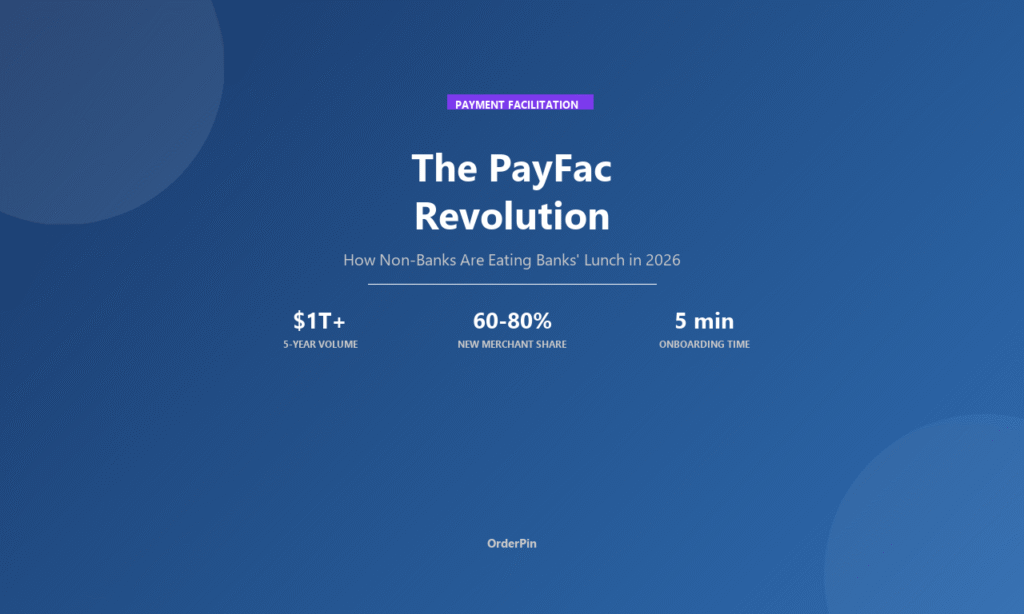
- Key Takeaway 1: Payment Facilitators (PayFacs) like Square, Stripe, and Toast now process over $1 trillion annually, capturing 60-80% of new merchant onboardings in key verticals from traditional ISOs.
- Key Takeaway 2: ISOs face commoditization risk as PayFacs offer sub-5-minute merchant onboarding, built-in POS, and embedded capital products that traditional residual models cannot match.
- Key Takeaway 3: The opportunity lies in the hybrid model: using white-label PayFac infrastructure to offer sub-minute onboarding and capital products under your own brand while preserving card residual income.
Last updated: May 2026
What Is a Payment Facilitator (PayFac)?
Payment Facilitator (PayFac) is a non-bank entity that aggregates transactions from multiple merchants under a single master merchant account, enabling rapid merchant onboarding without individual bank sponsorship relationships. In plain terms, a PayFac is a company that acts as a meta-processor: it has a direct relationship with Visa and Mastercard networks, and lets sub-merchants process payments under its umbrella.
The PayFac model fundamentally changed how ISOs and merchants interact with payment infrastructure. When Square launched in 2009 and pioneered the modern PayFac concept, a restaurant could sign up for card processing in minutes — no ISO, no merchant application, no 6-8 week underwriting process. Today, Stripe, Toast, Adyen, PayPal, and dozens of others operate on this same model.
For ISO and MSP decision makers in 2026, understanding PayFacs is not optional — it is existential. The question is no longer whether PayFacs will disrupt your ISO business. The question is whether you will adapt before the disruption becomes terminal.
The Major PayFacs in 2026: Who They Are and What They Offer
The PayFac landscape in 2026 is dominated by seven major players, each with distinct strengths and target verticals:
Square (Block, Inc.) — Pioneer of the modern PayFac model since 2009. Processes hundreds of billions in annual payment volume. Square Financial Services offers banking products. Dominant in SMB retail and food & beverage. Their hardware ecosystem (Square Terminal, Square Stand, Square Register) creates high merchant lock-in.
Stripe — The dominant PayFac for online and platform businesses. Stripe Connect powers thousands of marketplaces (Shopify, DoorDash, Lyft). Processes over $1 trillion annually. Stripe Atlas enables rapid company formation plus payment integration. Best for tech-forward ISOs targeting e-commerce merchants.
Toast — Restaurant-native PayFac combining POS hardware, payment processing, and Toast Capital (merchant cash advances) in one platform. Toast payments revenue grew 40%+ year-over-year. Now the dominant PayFac in the U.S. restaurant vertical. Toast Capital has deployed over $4 billion in merchant advances.
PayPal / Braintree — The original PayFac — PayPal operated as a payment aggregator since 1998, long before the term existed. Today, Braintree powers payments for Airbnb, Uber, and many platform businesses globally. Venmo handles P2P and growing consumer-to-business payments.
Adyen — Global PayFac displacing legacy processors for enterprise merchants (Uber, Netflix, Airbnb, Microsoft). Adyen’s unified platform offers PayFac-style sub-merchant structures at enterprise scale. Best positioned for ISOs targeting high-volume enterprise merchants.
Shopify Payments — Shopify’s embedded PayFac powers payments for 2+ million merchants on its platform. Shopify takes the interchange spread, offers Shopify Capital, and competes directly with traditional ISOs for its own merchant base.
Wells Fargo & JPMorgan PayFac Services — Traditional banks entering the PayFac space, offering sponsored merchant services under their banking umbrella. Growing rapidly in B2B payments and healthcare verticals.
Major PayFacs Compared for ISO Positioning
| PayFac | Best Vertical | Annual Volume | Capital Products | ISO Threat Level |
|---|---|---|---|---|
| Square | SMB Retail / Food | $200B+ | Square Capital | Very High |
| Stripe | E-Commerce / SaaS | $1T+ | Stripe Capital | Very High |
| Toast | Restaurants | $50B+ | Toast Capital ($4B+) | Critical |
| Adyen | Enterprise / Marketplace | $1T+ | Limited | Moderate |
| Shopify | E-Commerce SMB | $100B+ | Shopify Capital | Very High |
| Traditional ISO | All verticals | Varies | Third-party only | Defend |
Why the PayFac Revolution Is a Direct Threat to ISOs
The uncomfortable truth: when a restaurant can sign up for Toast or Square in five minutes and get a complete payment, POS, and capital solution, the value proposition of a traditional ISO (“I will set up your merchant account”) gets dramatically weaker.
The Commoditization Risk. ISOs that primarily resell processing capacity from a single processor — without differentiated software, service, or capital offerings — are increasingly vulnerable to disintermediation. PayFac platforms onboard merchants faster, offer built-in POS, and cross-sell capital products that a traditional ISO can only offer through third-party partnerships.
The Merchant Expectation Gap. The next generation of restaurant and retail owners (Millennials and Gen-Z entrepreneurs) grew up with Square and Toast. They expect to sign up, accept their first payment, and access capital from the same platform. A traditional ISO pitch (“let me send you a merchant application and call you in two weeks”) feels antiquated by comparison.
Capital Competition. PayFac capital products (Square Capital, Toast Capital, Stripe Capital) have deployed billions to merchants. These products are profitable AND sticky — a merchant who has received a capital advance from their PayFac is far less likely to switch processors. ISOs who cannot offer capital products face accelerating churn in their portfolios.
How ISOs Can Partner with or Become a PayFac
The PayFac revolution is not all doom and gloom for ISOs — it is a strategic opportunity. Here are four concrete paths:
1. Become a Sub-ISO under an existing PayFac. Stripe Atlas, Toast partner program, and Bankful allow ISOs to white-label a PayFac infrastructure. You bring the merchant relationships; they handle bank sponsorship, network registration, and compliance. You earn on the spread. Best for ISOs with strong merchant acquisition channels but limited capital for full PayFac registration.
2. Apply for your own PayFac registration. With sufficient capital, tech infrastructure, and compliance expertise, you can apply directly to Visa and Mastercard for your own Payment Facilitator designation. Requires $500K+ in capital reserves and dedicated compliance staff, but gives full control over merchant relationships and economics. Best for well-capitalized ISOs ready to make a strategic leap.
3. Partner with a sponsor bank as a Super ISO. Celtic Bank, Coastal Community Bank, and others allow ISOs to operate with more PayFac-like characteristics: faster onboarding, portfolio-level underwriting, direct API access — without full PayFac registration. Best for ISOs wanting PayFac-like capabilities with lower regulatory burden.
4. Build a white-label POS + capital stack with OrderPin. Use OrderPin’s white-label platform to offer your own branded PayFac-lite experience: sub-minute onboarding, your own capital product, analytics dashboards, and API integrations — all under your brand. OrderPin handles the technical infrastructure while you own the merchant relationship. Best for ISOs who want the PayFac economics and brand without building from scratch.
How OrderPin Helps ISOs Compete in the PayFac Era
Frequently Asked Questions
How much volume do PayFacs process compared to traditional ISOs?
The top PayFacs (Stripe, Square, Toast, Adyen) collectively process over $1 trillion annually. Stripe alone processes more than $1 trillion. Square processes $200B+. Toast processes $50B+ with 40%+ annual growth. In comparison, even the largest traditional ISOs process $1-5B annually. The scale difference is 100-1,000x.
What is the main threat PayFacs pose to traditional ISOs?
PayFacs threaten ISOs through three vectors: (1) Speed — sub-5-minute merchant onboarding vs. 6-8 week ISO onboarding; (2) Capital — embedded merchant cash advances that create portfolio stickiness; (3) POS bundling — free or subsidized hardware that locks merchants into a complete ecosystem. ISOs who cannot match on all three will lose merchants progressively.
Can a traditional ISO become a PayFac?
Yes, but it requires significant investment. Full PayFac registration with Visa and Mastercard requires $500K+ in capital reserves, dedicated compliance staff, PCI-DSS Level 1 certification, and ongoing regulatory reporting. A more accessible path is becoming a Sub-ISO or Super ISO through a sponsor bank relationship, which provides PayFac-like economics with lower capital requirements ($50-100K typically).
Which restaurant ISOs face the highest PayFac threat from Toast?
ISOs targeting QSR (quick-service restaurants) and fast-casual dining face the highest threat from Toast. Toast has over 80% market share in the tech-forward restaurant segment and offers hardware subsidies, Toast Capital advances, and online ordering integration that make switching cost-prohibitive for merchants. ISOs should prioritize full-service dining, hotel restaurants, and sports venue concessions where Toast penetration is lower.
How does OrderPin help ISOs compete with Square and Toast?
OrderPin provides white-label POS infrastructure that ISOs can brand as their own, complete with sub-minute merchant onboarding, API-first architecture, and capital product integration. Unlike becoming a PayFac from scratch (which costs $500K+), OrderPin lets ISOs offer a PayFac-like merchant experience at a fraction of the cost, with full data ownership and no direct competition from the platform provider.
Conclusion
The PayFac revolution is not coming — it is here. Square, Stripe, Toast, and Adyen have fundamentally changed merchant expectations about payment processing speed, capital access, and ecosystem integration. ISOs who do not adapt will see their portfolios erode progressively as merchants discover that PayFac platforms offer a better experience at comparable or lower cost.
The strategic response is not to compete with PayFacs on their terms (speed, subsidies, consumer-grade UX) — it is to become a better version of a PayFac. Use white-label infrastructure like OrderPin to offer your own branded instant-onboarding experience, bundle capital products, and build the merchant analytics dashboards that make switching away from you cost-prohibitive. The ISOs who make this transition in 2026 will own the next decade of merchant services. Those who do not will become irrelevant.
About OrderPin
OrderPin is a white-label POS platform built for ISO and MSP partners. We offer sub-minute merchant onboarding, API-first architecture, and capital product integration — everything you need to compete with PayFacs under your own brand with full data ownership.
Learn more about OrderPin’s white-label solution