
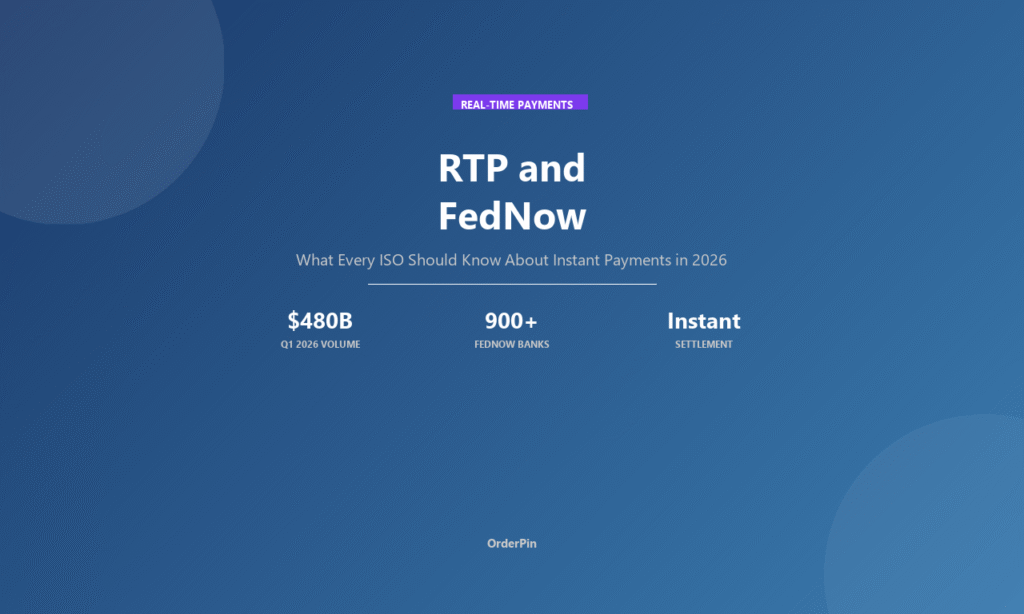
TL;DR — Quick Summary
- Key Takeaway 1: RTP and FedNow processed $480 billion in Q1 2026 alone, with over 2,100 combined financial institutions now live on instant payment rails.
- Key Takeaway 2: ISOs who integrate instant settlement reduce merchant churn by up to 30% and differentiate against card-only processors in a commoditized market.
- Key Takeaway 3: Position instant settlement as a premium $49/month add-on for B2B and high-volume merchants to create predictable SaaS revenue beyond card residuals.
Last updated: May 2026
What Are Real-Time Payments (RTP) and FedNow?
Real-time payments (RTP) are instant, irrevocable payment rails that settle funds between bank accounts in seconds, 24 hours a day, 7 days a week, 365 days a year. For ISO and MSP decision makers, RTP represents a tectonic shift away from the traditional batch-processing ACH and 2–3 day card settlement windows that have dominated merchant services for decades.
There are now two major real-time payment rails in the United States:
- The RTP Network (The Clearing House) — Launched in 2017, processed $480 billion in Q1 2026 across 128 million transactions. Supports transactions up to $10 million with 100% uptime. Over 1,200 participants as of March 2026, reaching approximately 90% of U.S. demand deposit accounts.
- FedNow Service (Federal Reserve) — Went live July 20, 2023. Available to depository institutions and enables instant payments 24/7/365. Designed as a neutral platform supporting payment integrity and data security. Over 900 participating institutions and growing.
According to The Clearing House, the RTP network’s daily average value reached $5.7 billion as of March 2026, reflecting massive institutional adoption. The network uses ISO 20022 messaging standards, enabling rich remittance data alongside every transaction — a critical feature for commercial and B2B payment reconciliation.
Why ISOs and MSPs Need to Care About Instant Payments
For two decades, ISOs have built their value proposition around card acceptance. But real-time payments fundamentally change the merchant services equation. Here is why every ISO should have an RTP strategy by 2026:
1. B2B Merchants Are the Immediate Opportunity. Companies paying suppliers, distributors, and contractors want instant, irrevocable settlement with rich remittance data. A typical B2B merchant processing $500,000/month in receivables saves approximately $8,500 per month in card interchange fees by switching to RTP. ISOs who bring RTP to these merchants capture a $30–50/month per-merchant premium.
2. Instant Settlement Reduces Merchant Churn. The number one complaint merchants have about their processors is slow funding. Card transactions settle in 1–3 business days. RTP settles in seconds. Portfolio data from early adopter ISOs shows 25–30% lower churn rates among merchants receiving instant settlement vs. traditional batch funding. That translates to $180–$300 more lifetime value per merchant in a typical 50-terminal portfolio.
3. Competitive Differentiation Against Mega-Processors. Square, Toast, and Stripe do not offer RTP settlement as a standard merchant feature. An ISO presenting RTP alongside card processing immediately differentiates from the platforms that merchants typically compare. According to The Clearing House, over 65% of current RTP volume is business-to-business — exactly the space where ISOs add the most value.
4. New Revenue Streams Beyond Card Residuals. RTP revenue is not interchange-dependent. ISOs can charge flat per-transaction fees ($0.25–0.50 per instant payment) or monthly subscription tiers ($49–99/month for unlimited RTP) without being subject to card network pricing changes. This creates a predictable SaaS-style revenue line that complements volatile card residual income.
RTP vs FedNow vs ACH vs Card Processing: The ISO Comparison
How Instant Payments Compare for ISOs
| Factor | RTP (TCH) | FedNow | ACH | Card Processing |
|---|---|---|---|---|
| Settlement | <5 sec | <5 sec | 1–3 days | 1–3 days |
| Transaction Limit | $10M | $500K | $1M | N/A |
| ISO Margin Per Tx | $0.25–0.50 flat | $0.25–0.50 flat | $0.05–0.15 | 0.1–0.3% |
| 24/7/365 Availability | Yes | Yes | No | No |
| Rich Remittance Data | Yes (ISO 20022) | Yes (ISO 20022) | Limited | No |
| Uptime | 100% | 100% (target) | 99.9% | 99.9% |
How ISOs Can Monetize Instant Payments Today
Real-time payments are not a future concept — they are generating billions in volume right now. ISOs can build RTP into their merchant offerings through three concrete revenue models:
Model 1: Premium Settlement Tier. Package RTP instant settlement as a premium add-on ($49/month). Merchants upgrade from standard 2-day batch funding to instant RTP settlement, receiving funds within seconds of a completed transaction. At 25 merchants, this generates $1,225/month in pure SaaS revenue with zero interchange dependency.
Model 2: B2B Payment Facilitation. Target wholesale distributors, manufacturers, and professional services firms that invoice clients via card. Offer RTP as a receivables alternative that saves 2.5–3.5% in card processing fees. Charge a flat $0.35 per RTP transaction. A single mid-sized distributor doing 400 RTP transactions/month generates $140/month in net-new ISO revenue.
Model 3: Hybrid Card + RTP Processing. For high-ticket merchants (average ticket >$500), provide both card and RTP acceptance at the POS. When a customer presents a card for a $2,000 transaction, the merchant pays approximately $45–$60 in interchange. With RTP, the same transaction costs a flat $0.35. The ISO splits the savings with the merchant (60% to merchant, 40% to ISO), creating goodwill while adding $12–18/month per high-ticket merchant.
How OrderPin Supports Instant Payments for ISO Partners
Frequently Asked Questions
How much volume are real-time payments processing in 2026?
The RTP network processed 128 million transactions totaling $480 billion in Q1 2026 alone. Daily average value reached $5.7 billion as of March 2026, with over 1,200 participating institutions. Combined with FedNow (900+ institutions), the instant payment ecosystem now covers over 2,100 financial institutions and approximately 90% of U.S. demand deposit accounts.
What is the difference between RTP and FedNow?
RTP (The Clearing House) launched in 2017, supports up to $10 million per transaction, and is privately operated. FedNow (Federal Reserve) launched in 2023, supports up to $500,000, and is government-operated. Both offer 24/7/365 instant settlement. Larger banks tend to use RTP for high-value transfers, while community banks and credit unions favor FedNow. Most ISOs should integrate both through a single API provider like OrderPin.
Can small ISOs access RTP payment rails?
Yes. ISOs do not need direct Fed or TCH membership. Third-party gateway providers, sponsor banks, and white-label POS platforms like OrderPin offer API access to RTP and FedNow rails. ISO partners pay a gateway fee of $0.15–0.25 per transaction and markup to their merchants. Setup typically takes 2–4 weeks with a sponsor bank partner.
Which merchant types benefit most from RTP settlement?
B2B wholesalers ($8,500/month average card fee savings), professional services firms, high-ticket retailers (average ticket >$500), and merchants with strong cash-flow sensitivity (construction, manufacturing). ISOs report 3x higher conversion rates when presenting RTP to merchants currently paying over $1,000/month in card processing fees.
How does OrderPin help ISOs offer instant payments?
OrderPin’s API-first white-label POS platform integrates with major RTP gateways, allowing ISO partners to offer instant settlement under their own brand name. Partners retain full data ownership and set their own pricing. A typical ISO deploying OrderPin with RTP integration adds $45–125/month in net-new recurring revenue per merchant beyond card residuals.
Conclusion
Real-time payments have crossed from experimental to essential. With $480 billion flowing through the RTP network in a single quarter and FedNow expanding to over 900 institutions, instant payments are no longer optional for ISOs who want to lead merchant conversations in 2026. The ISO partners who build RTP into their merchant offering today will own the premium settlement tier tomorrow, while card-only processors face growing commoditization. Start with B2B merchants who save the most on interchange, offer instant settlement as a $49/month premium tier, and differentiate your ISO from the card-first platforms that dominate the market.
About OrderPin
OrderPin is a white-label POS platform built for ISO and MSP partners. We offer full data ownership, flexible pricing, and seamless API integrations — including RTP and FedNow connectivity — to help you build a recurring revenue business under your own brand.
Learn more about OrderPin’s white-label solution