
TL;DR — Quick Summary
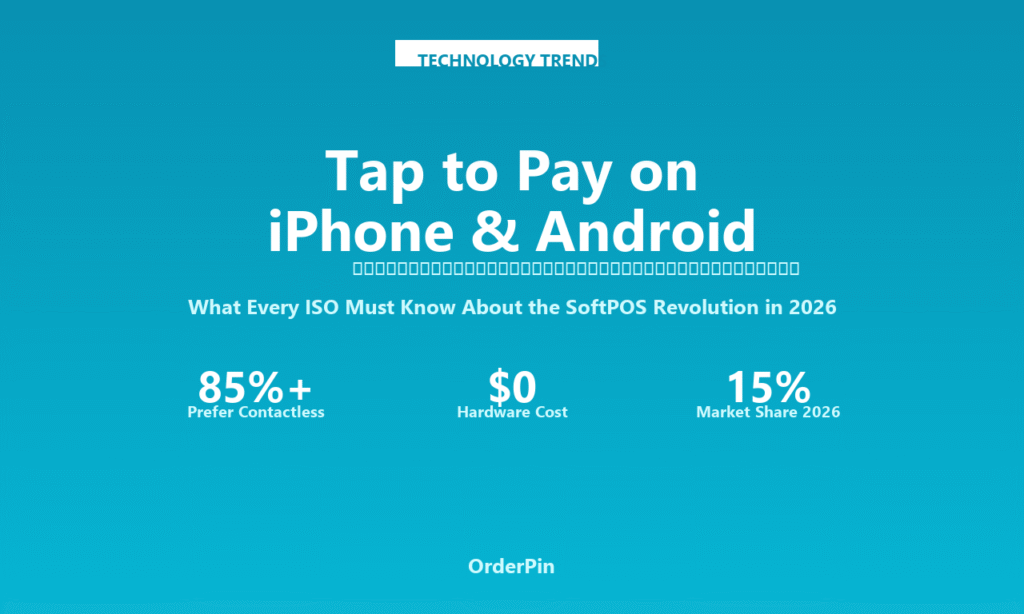
- SoftPOS — turning any NFC-capable smartphone into a payment terminal — is the fastest-growing segment in merchant acquiring, projected to reach 15% of global POS terminal shipments by 2026.
- Apple Tap to Pay on iPhone (launched 2022) and similar Android solutions eliminate hardware costs entirely for low-volume merchants — but create an ISO revenue challenge around hardware residuals.
- ISOs who pivot to software-revenue models (subscription fees, transaction dashboards, value-added services) will win in a SoftPOS-dominant world; those clinging to hardware margins will lose.
What Is SoftPOS — and Why Does It Matter Right Now?
SoftPOS (Software Point of Sale) is a technology that transforms any NFC-capable mobile device — smartphone or tablet — into a payment terminal using a downloadable app. No dedicated hardware terminal required. The phone or tablet communicates directly with contactless payment cards and digital wallets via NFC, processes the transaction through a payment app, and routes it to the acquiring bank.
The concept has existed since the early 2010s but only became viable for mainstream adoption when three conditions converged: (1) NFC became standard on all smartphones (now virtually 100% of new phones globally), (2) contactless payment adoption crossed the 50% threshold (accelerated by COVID-19 in 2020), and (3) card networks and issuing banks implemented Tap to Pay specifications that enable secure, tokenized NFC transactions without a dedicated PCI PTS terminal.
Apple Tap to Pay on iPhone vs. Android SoftPOS Solutions
There are two distinct categories of SoftPOS in the U.S. market. Understanding the difference is critical for ISOs planning their product roadmap:
| Feature | Apple Tap to Pay on iPhone | Android SoftPOS (Stax, SumUp, etc.) |
|---|---|---|
| Launch Year | 2022 (U.S.) | 2018–2020 |
| Device Requirements | iPhone 7+ with NFC (iOS 15.4+) | Android 10+ with NFC |
| Accepted Payments | contactless cards + Apple Pay only | contactless cards, Apple Pay, Google Pay, Samsung Pay |
| B2B Use Case | Strong (field service, retail) | Very strong (micro-merchants, SMB) |
| PCI Compliance | Apple handles NFC security (VPTS) | Vendor-dependent (some require added certification) |
| Typical Transaction Rate | 2.6% + $0 (varies by processor) | 2.65–3.5% flat (no interchange complexity) |
The ISO Impact Assessment: Threat or Opportunity?
ISOs face a strategic inflection point with SoftPOS. On one hand, it commoditizes the hardware terminal — the device that has generated hardware residuals and lock-in revenue for decades. On the other hand, it opens entirely new merchant segments that were previously unreachable due to hardware costs. Here is the honest assessment:
The Threat: Hardware Commoditization
The traditional ISO revenue model — sell a merchant a terminal for $200, receive a $50 monthly hardware residual, plus interchange — erodes when SoftPOS offers zero hardware cost. Merchants who switch to SoftPOS forgoing terminals eliminate the hardware residual entirely. For ISOs with large terminal portfolios, this is a material revenue risk as SoftPOS adoption climbs.
The Opportunity: Reaching the Previously Unreachable
The total addressable merchant population in the U.S. is approximately 33 million small businesses. The traditional POS/ISO channel reaches perhaps 8–10 million of them — the ones willing to commit to hardware costs, monthly fees, and contracts. The remaining 23 million are micro-merchants: freelancers, gig workers, farmers market vendors, part-time sellers, community events. SoftPOS lets ISOs reach these merchants for the first time at scale. No hardware to ship, no installation to schedule — just an app download and a 5-minute onboarding.
The Strategic Pivot: Software-First Revenue
ISOs who treat SoftPOS as a software platform — not just a payment channel — unlock recurring revenue independent of transaction margins. Invoicing, inventory tracking, multi-location dashboards, employee management, and customer loyalty tools delivered as SaaS subscriptions on top of the SoftPOS app create MRR that persists regardless of how transaction economics evolve.
The Top SoftPOS Use Cases for ISO Outreach
- Field Service Professionals: Plumbers, electricians, HVAC technicians, cleaners, and movers who collect payment on-site. Tap to Pay on iPhone turns their work phone into a payment terminal — no separate device to carry, charge, or maintain. Average transaction: $150–$400. Win rate with SoftPOS vs. traditional: 40% higher because there is no hardware friction.
- Farmers Markets and Craft Vendors: Micro-merchants who sell at markets 1–3 days per week and do not want a dedicated POS. SoftPOS apps with simple reporting and no monthly fee (flat-rate pricing) are ideal. Average monthly volume: $1,000–$5,000. High volume, low support burden.
- Professional Services on Location: Personal trainers, tutors, music teachers, pet groomers, and photographers who travel to clients. Tap to Pay enables payment collection at the client’s home or office. Average transaction: $50–$200. Strong word-of-mouth referral potential driving new merchant acquisition.
- Pop-Up and Event Retail: Seasonal businesses, food trucks, craft fairs, and pop-up stores that operate for limited periods. SoftPOS eliminates the need to buy or lease hardware for a business that may not exist in 6 months. Average transaction: $15–$75. High transaction count, low average ticket, strong volume during events.
About OrderPin
OrderPin’s white-label platform supports both traditional POS terminals and SoftPOS integration for ISOs building a diversified merchant portfolio. OrderPin’s merchant dashboard aggregates transactions across hardware and SoftPOS merchants into a single reporting view — simplifying ISO portfolio management as SoftPOS volume grows.
Frequently Asked Questions
Is Apple Tap to Pay on iPhone available for all merchants in the U.S.?
Apple Tap to Pay on iPhone requires: (1) a compatible iPhone (iPhone 7 or later, running iOS 15.4+), (2) a payment processor or ISO partner that has integrated Apple’s Tap to Pay SDK (currently Stripe, Adyen, and Worldpay are U.S. launch partners), and (3) a merchant agreement with that processor. As of 2026, adoption is growing but not yet universal across all ISOs and processors.
What are the PCI compliance implications of SoftPOS for merchants?
Both Apple Tap to Pay and certified Android SoftPOS solutions leverage host card emulation (HCE) and tokenization to keep card data off the device’s main memory, reducing the PCI DSS scope significantly. Merchants using certified SoftPOS apps are typically eligible for the SAQ (Self-Assessment Questionnaire) A — the simplest and shortest PCI compliance form, requiring only a few attestations about how the app is used.
Can SoftPOS handle tip adjustment and split tender?
Basic SoftPOS apps support pre-authorization and tip adjustment (where the customer adds a tip after the card is tapped but before final settlement). Split tender — paying with two different cards or part cash, part card — is supported in more sophisticated SoftPOS apps but is not universal. ISOs targeting restaurant or hospitality merchants should verify tip and split-tender capabilities before selling SoftPOS into those verticals.
How do ISO interchange fees compare between SoftPOS and traditional terminals?
Interchange rates for contactless (NFC) transactions are identical to those for chip or swipe transactions — the card network sets the rate, not the acceptance method. Where SoftPOS processors add cost is in their markup over interchange. Flat-rate SoftPOS processors (2.65–3.5% with no additional per-transaction fee) are often more expensive for merchants processing high volumes compared to traditional interchange-plus pricing, but cheaper for merchants doing fewer than $5,000/month.
Should ISOs replace their hardware terminal product entirely with SoftPOS?
No — at least not yet. Hardware terminals remain essential for: (1) merchants processing above $25,000/month (where interchange-plus pricing beats flat-rate), (2) businesses requiring receipt printing, cash drawer integration, or barcode scanning, (3) environments with unreliable internet connectivity (most SoftPOS requires stable WiFi or cellular), and (4) merchants who need PIN-based debit acceptance. The winning ISO strategy is to offer both and recommend the right fit based on the merchant’s actual volume and use case.
Data sources: Juniper Research Global POS Terminal Market Report 2025, Nilson Report 2025, Apple Developer Documentation Tap to Pay SDK, Visa Tap to Pay Merchant Guidance 2025, Juniper Research SoftPOS Market Forecast 2024–2028.