
TL;DR — Quick Summary
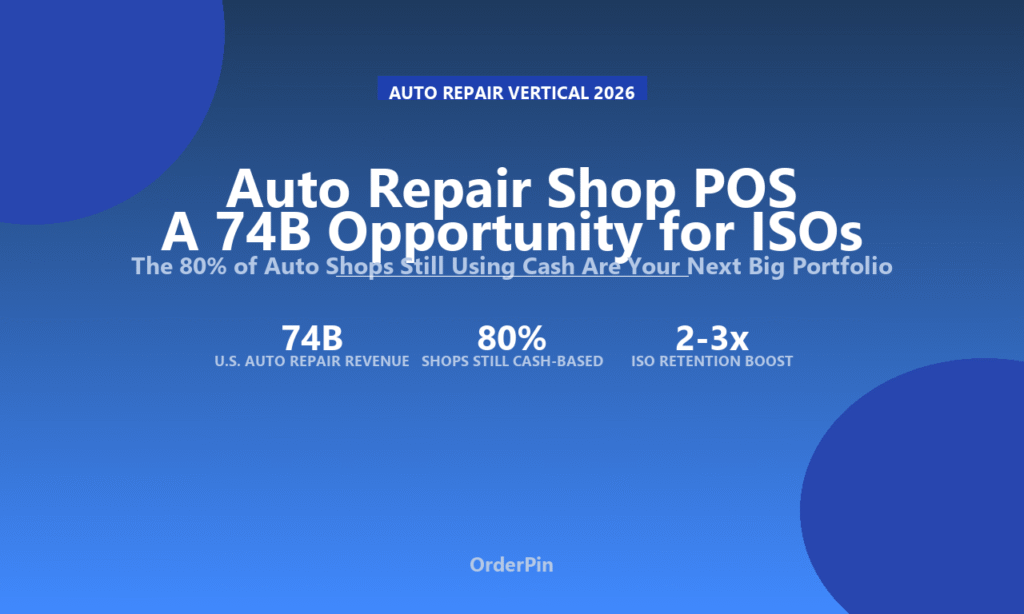
- The U.S. auto repair industry processes $74 billion annually, yet 80% of shops still use paper-based or legacy cash-only systems. This represents a massive, underserved market for ISOs who understand the unique needs of automotive service businesses.
- Auto repair shops have distinct payment patterns: high average tickets ($150-$600), mixed payment methods (cash, check, card, financing), multi-party invoicing (insurance, customers, fleet managers), and strong demand for parts inventory management.
- ISOs who target auto repair shops with purpose-built POS solutions can achieve 2-3x higher merchant retention compared to generic POS deployments, because the POS becomes mission-critical infrastructure rather than a commodity payment terminal.
Walk into most auto repair shops in America and you will see a cash register from 1995. Sticky notes on the wall with part numbers. A whiteboard with work orders. A stack of paper invoices for insurance claims. This is not a technology problem. It is a payment problem — and it is costing ISOs a fortune in missed opportunity.
The U.S. auto repair industry is worth $74 billion annually. Yet the majority of shops have been ignored by POS providers because they are seen as complicated, cash-heavy, and hard to serve. That complexity is exactly what makes them so valuable for ISOs who take the time to understand the vertical.
1. Why Auto Repair Shops Are Different
Auto repair shops have payment patterns that no generic restaurant or retail POS can handle well:
| Payment Challenge | Generic POS Limitation | Purpose-Built Auto POS Solution |
|---|---|---|
| High-ticket, multi-line invoices | Max line items feel clunky; no parts + labor split | Parts/inventory + labor hours + tax on one screen |
| Insurance claim processing | No insurer integration; paper-heavy | Digital claim submission, co-pay tracking, insurer records |
| Fleet account invoicing | No sub-account structure for fleet managers | Fleet sub-accounts, monthly billing, credit limits |
| Cash/check payment recording | Cash drawers not integrated; deposits untracked | Cash reconciliation, end-of-day deposit slips, check tracking |
| Parts inventory management | Inventory module costs extra; auto-specific parts unavailable | Built-in parts catalog, reorder alerts, supplier integration |
| Customer payment plans | No installment tracking; balance owed lost in paper | Installment tracking, automated reminders, partial payment receipts |
2. The Market Opportunity
The numbers tell a compelling story for ISOs willing to serve this vertical:
- Number of shops: Approximately 734,000 auto repair and maintenance businesses in the U.S. (NAICS 8111)
- Annual revenue: $74 billion in automotive repair and maintenance services
- Average ticket: $150-$600 per repair; specialty shops can exceed $2,000
- Payment method mix: 40% cash/check, 35% credit/debit card, 15% insurance billing, 10% fleet account
- Technology adoption: Only 20% have any form of modern POS; less than 5% have purpose-built auto repair POS
- Pain points: 65% cite “payment reconciliation and cash tracking” as their #1 operational headache
3. How ISOs Win Auto Repair Shop Deals
Step 1: Lead with inventory management, not payments
Auto repair shop owners care first about tracking parts, labor hours, and work orders. When you lead with “this POS tracks your parts inventory, alerts you when you are low, and connects to your supplier — oh, and by the way, it also handles payments better than your cash register,” you have their attention. Reversing the pitch will get you a polite “we already take cards.”
Step 2: Demonstrate the insurance workflow
Show how digital claim submission saves the shop owner hours of paperwork per week. Ask: “How many insurance claims do you process per month? How much time does each one take?” Most will say 20-50 claims at 30-60 minutes each. Show them the digital workflow.
Step 3: Address cash and check handling directly
Many auto shops still handle significant cash. They worry about PCI compliance for cash drawers. Address this head-on: explain end-of-day reconciliation, cash deposit tracking, and how to record check numbers for reconciliation.
Step 4: Offer fleet account management as a premium upsell
Fleet managers (courier services, delivery companies, local businesses with fleets) are a goldmine. Offer fleet sub-accounts, credit limits, and monthly consolidated invoices as a premium feature at $49-99/month.
4. Revenue Model for ISOs
| Revenue Source | Per Merchant/Year | Margin Type | Competitive Durability |
|---|---|---|---|
| Transaction processing (avg $3K/mo) | $540 | Recurring residual | Medium |
| Parts inventory SaaS ($49-99/mo) | $588-1,188 | High margin SaaS | High (mission-critical) |
| Fleet account management ($49-99/mo) | $588-1,188 | SaaS subscription | High |
| Hardware (terminal + printer) | $300-600 | One-time | Low |
| Total per merchant/year | $2,016-3,516 |
Bottom Line
Auto repair shops are one of the most underserved POS verticals in America. With $74 billion in annual revenue, 734,000 businesses, and an 80% technology gap, the opportunity for ISOs is massive — and most ISOs are not competing for it because they do not understand the vertical.
The ISOs who take the time to understand auto repair payment flows — parts inventory, labor hours, insurance claims, fleet accounts, cash reconciliation — can build sticky, high-value relationships that competitors cannot easily displace. Purpose-built auto POS becomes mission-critical infrastructure, not a commodity terminal.
With average annual revenue of $2,000-3,500 per shop and retention rates 2-3x higher than generic deployments, auto repair shops should be on every ISO’s target list.
Data sources: U.S. Census Bureau Business Patterns (NAICS 8111), IBISWorld Auto Repair Industry Report 2026, Auto Care Association industry data, The Strawhecker Group (TSG) vertical market analysis. All figures reflect U.S. market.