
TL;DR — Quick Summary
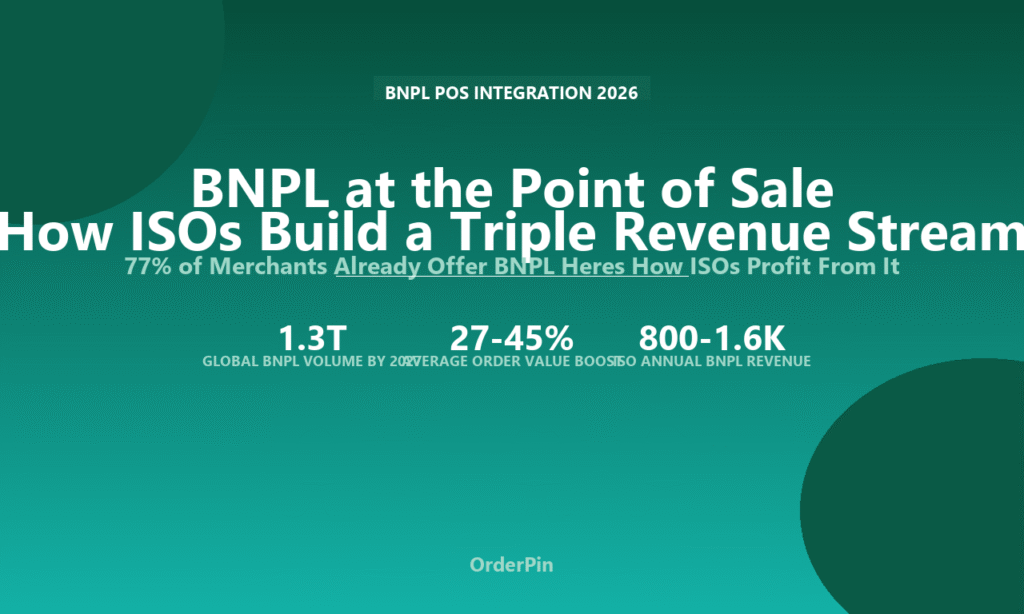
- BNPL (Buy Now Pay Later) at the point of sale is projected to reach $1.3 trillion in global transaction volume by 2027, with 77% of merchants now offering at least one BNPL option in-store. For ISOs, BNPL integration represents a new, high-margin revenue stream beyond traditional card processing.
- Restaurants and retailers adopting POS-integrated BNPL see average order value increases of 27-45%, conversion rate improvements of 20-35%, and repeat purchase rates 1.5x higher than non-BNPL transactions.
- ISOs who integrate BNPL into their POS offerings can earn 4-7% referral fees on BNPL transactions plus incremental SaaS revenue from the integration itself, adding $600-1,200 per merchant per year in ancillary income.
Buy Now Pay Later (BNPL) at the point of sale has evolved from an e-commerce novelty into a mainstream in-store payment method. In 2026, BNPL platforms like Affirm, Klarna, Afterpay, and PayPal Pay in 4 collectively process over $600 billion annually, with the in-store segment growing faster than online.
For ISOs, BNPL integration at the POS level offers a rare opportunity: earn on the transaction fee (card processing), the BNPL referral fee (4-7%), and the SaaS margin (if the BNPL module is a premium feature) — all from the same merchant and the same transaction.
1. How BNPL Works at the POS
When a customer checks out at a restaurant or retail store, they see a BNPL option alongside credit/debit cards and digital wallets. Here is what happens behind the scenes:
| Step | What Happens | ISO’s Role |
|---|---|---|
| 1. Customer selects BNPL | At POS, customer taps “Pay in 4” or similar option; POS sends request to BNPL provider | POS must be BNPL-aware — enabled via ISO partnership |
| 2. Soft credit check | BNPL provider runs instant soft check; approval in 2-5 seconds | Pass-through |
| 3. BNPL pays merchant | BNPL provider pays merchant in full minus a 4-7% discount fee | ISO earns referral split of BNPL discount |
| 4. Customer repays BNPL | Customer pays BNPL in installments (e.g., 4 payments over 6 weeks) — no interest typically | Revenue share continues per transaction |
| 5. Settlement | BNPL provider settles with merchant next business day; POS records the transaction | Transactions appear in ISO’s settlement report |
2. BNPL Provider Comparison for ISOs
| Provider | Merchant Discount | Installment Model | POS Integration | ISO Partner Program |
|---|---|---|---|---|
| Affirm | 4-7% | 4-24 months, interest-free or APR | API + POS plugins | Limited partner tiers |
| Klarna | 3-6% | Pay in 4, Pay in 30, financing | SDK + POS integration | Reseller program |
| Afterpay | 4-6% | 4 payments over 6 weeks | POS app marketplace | ISO referral tiers |
| PayPal Pay in 4 | 2-4% | 4 payments over 6 weeks | Venmo/PayPal POS | Limited ISO model |
3. ISO Revenue Opportunity
BNPL represents a triple-revenue opportunity for ISOs:
| Revenue Stream | Merchant Volume Impact | ISO Annual Revenue | Revenue Type |
|---|---|---|---|
| BNPL referral fee | 15-25% of total volume | $300-600 | Merchant discount split |
| Incremental card volume | +27-45% AOV | $200-400 | Processing residual |
| BNPL SaaS add-on | Premium feature | $300-600 | High-margin subscription |
| Total per merchant/year | $800-1,600 |
4. Integration Strategy for ISOs
Approach 1: White-label BNPL via your POS platform
If your POS platform supports BNPL integration (OrderPin supports BNPL API integration), you can offer BNPL as a built-in feature. The customer never sees a third-party BNPL brand — they see “Pay in 4” under your brand. This maximizes retention and revenue.
Approach 2: Referral partnership with BNPL providers
Refer your merchants to Affirm, Klarna, or Afterpay and earn a flat referral fee plus a small residual on their BNPL volume. This is the easiest entry point but limits your revenue upside and the merchant’s experience still routes through the BNPL brand.
Approach 3: Build BNPL into your pricing tier
Make BNPL integration a premium feature in your mid-tier or top-tier POS package. Menu analytics, multi-location reporting, and BNPL all cluster together as the “premium” tier. This moves merchants up the SaaS ladder and increases per-merchant revenue without raising processing fees.
Bottom Line
BNPL at the point of sale is no longer a nice-to-have — it is a merchant expectation. 77% of merchants now offer BNPL in-store, and that number will continue to rise as consumer demand for flexible payment options grows.
For ISOs, BNPL integration creates a triple-revenue stream: incremental processing volume from higher AOVs, referral fees from BNPL transaction volume, and additional SaaS revenue from premium-tier features. Across a 100-merchant portfolio, BNPL alone can add $80,000-160,000 in annual revenue.
OrderPin supports BNPL API integration as part of its white-label POS platform. ISOs can offer their merchants integrated BNPL options under their own brand, maximizing both revenue and merchant retention. Visit orderpin.co to learn more.
Data sources: Juniper Research BNPL Report 2026, Worldpay Global Payments Report 2026, Affirm/Klarna/Afterpay partner program data, The Strawhecker Group (TSG) POS analytics. All figures reflect 2026 U.S. market estimates.