
TL;DR
Most merchants subscribe to POS features they never use — and are missing
features they desperately need. A structured annual technology audit is the
highest-ROI service an ISO can offer: it costs 2 hours of time, generates
$500-2,000 in upsell revenue per merchant, and dramatically reduces churn.
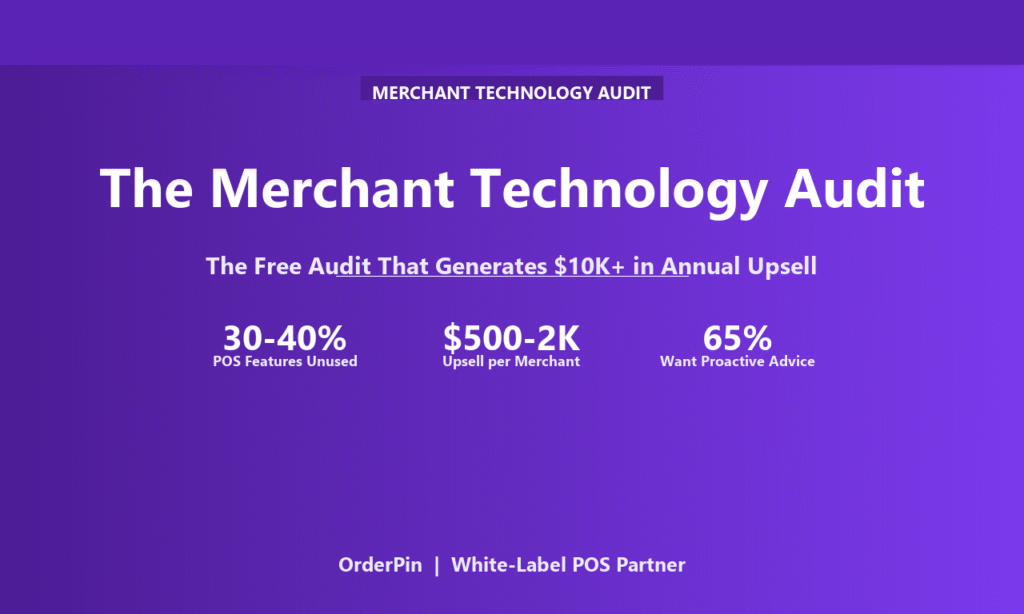
30-40%
of POS features go unused
$500-2K
upsell per merchant per audit
65%
want proactive advice
Why Merchants Never Explore Their Own POS
Here is a frustrating reality for ISOs: your average merchant is paying for
dozens of features each month that they have never clicked on.
The scheduling module. The inventory analytics dashboard. The loyalty program
builder. The API integrations tab. All sitting there, unused.
Why does this happen? Four reasons:
-
Fear of change. “If it is not broken, do not touch it”
is the default mindset of busy business owners. -
No time. Between managing staff and serving customers,
exploring POS features ranks dead last on the to-do list. -
The assumption of sufficiency. Most merchants assume what they
have is what the system can do. They do not know what they do not know. -
No one ever showed them. The original rep walked them through
setup and disappeared. No follow-up discovery session ever happened.
Each of these gaps represents a revenue opportunity for the
ISO who makes the first move.
The Audit Framework
A structured technology audit covers five key areas. Think of it as a
“POS physical” — systematic, repeatable, and valuable
every single time.
| Audit Area | What to Check | Expected Upsell |
|---|---|---|
| 1. Feature utilization | Which modules are active vs unused | $50-150/month |
| 2. Hardware condition | Terminal age, battery health, peripheral needs | $200-500 one-time |
| 3. Online ordering | Direct vs marketplace, commission structure | $100-300/month |
| 4. Payment methods | EMV, NFC, QR, ACH coverage | $50-200/month |
| 5. Reporting & analytics | Custom report usage, data export habits | $100-250/month |
How to Run the Audit in 60 Minutes
The technology audit can be conducted remotely or in person. Here is a
repeatable 60-minute agenda:
The 60-minute audit agenda:
-
Minutes 1-10: Ask open-ended questions about daily usage.
“What features do you use most?” “What frustrates you?” -
Minutes 11-30: Log into their dashboard and review
feature utilization data. Identify 2-3 unused features that solve real
problems they mentioned. -
Minutes 31-45: Demonstrate each feature live. Show the
merchant what they have been missing. -
Minutes 46-55: Present a prioritized upgrade plan. Start
with the highest-impact, easiest-to-implement change. -
Minutes 56-60: Close with next steps and schedule the
follow-up. Send a one-page written summary within 24 hours.
The key is to start with value. Do not walk in selling upgrades.
Walk in with the premise: “I want to make sure you are getting the most
out of your system.” The upgrades sell themselves when the merchant sees
what they are missing.
Monetizing the Audit
The audit itself creates multiple revenue streams for the ISO:
-
Premium audit service: Offer the audit as a standalone
service at $99-149. At a 50% close rate, every 100 audit appointments
generates $5,000-7,500 in direct revenue. -
Free as part of renewal: Bundle the audit into the annual
renewal conversation. It reduces price sensitivity and positions the audit
as part of ongoing value. -
Upsell pipeline: Every gap identified is a subscription
upsell. A merchant not using online ordering is a $100-300/month opportunity.
A merchant not using analytics is a $100-250/month opportunity. -
Referral engine: Merchants who receive genuine value from
an audit are 3x more likely to refer peers. “My POS rep just showed
me something I have been paying for for two years” is a powerful
referral trigger.
The Bottom Line
The technology audit is a three-for-one play for ISOs: it generates upsell
revenue, deepens merchant relationships, and creates referral opportunities.
Two hours of time invested per merchant yields $500-2,000 in upsell revenue
— making it the highest ROI activity in an ISO’s calendar.
OrderPin is a white-label POS platform designed to help ISOs launch, scale,
and differentiate their payment processing business. With tools for technology
audits, merchant insights, and portfolio management, OrderPin enables ISOs
to deliver proactive value at scale.