
TL;DR — Quick Summary
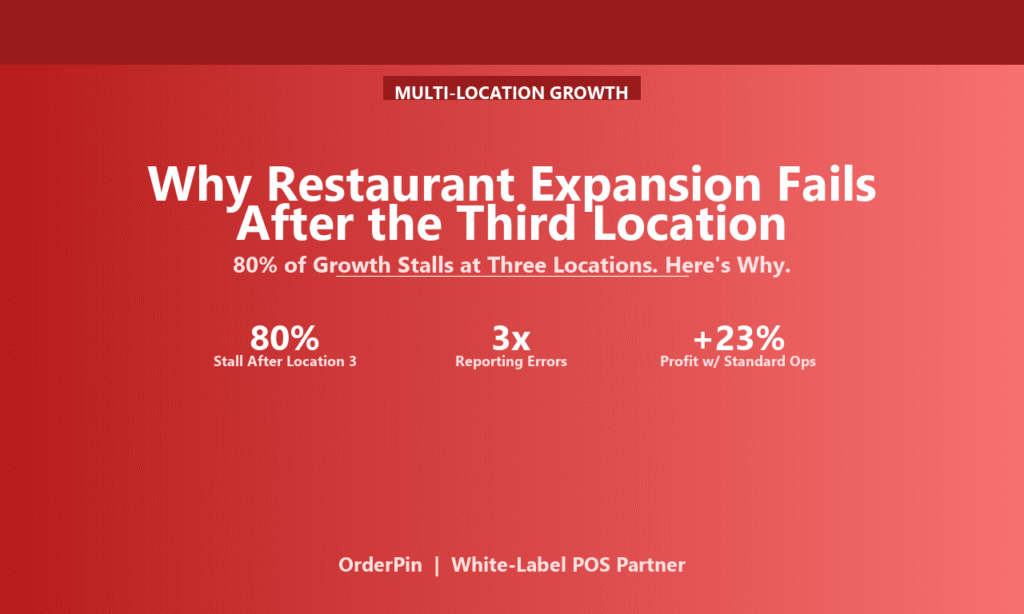
- Restaurant expansion failure spikes after the third location — roughly 80% of multi-unit growth stalls or reverses at this stage, and it’s almost never about food quality.
- The killer is operational complexity: fragmented technology, inconsistent reporting, and no standardized playbook turn one successful restaurant into three chaotic ones.
- For ISOs, the post-third-location crisis is the single best opening to sell consolidated, multi-location POS and reporting — the merchant is already feeling the pain.
The first restaurant works because the owner is everywhere — expediting on Friday nights, counting the drawer at close, reordering the right produce by memory. The second location works because the owner can still be in two places. The third location is where the model breaks.
This is not a story about bad food or bad luck. It’s a story about operational physics: beyond three locations, a restaurant group needs systems, not heroics. And the systems that matter most are the ones that handle data — sales, labor, inventory, and reporting — across every site from one place.
Why Location Three Breaks the Model
At one or two locations, informal management works. At three, four structural problems appear at once:
| Problem | What Happens | Cost |
|---|---|---|
| No standardized playbook | Each manager runs “their” restaurant their own way; recipes, scheduling, and service standards drift | Inconsistent guest experience & margins |
| Fragmented technology | Different POS, apps, and vendors at each site; data lives in silos that never talk | No single source of truth |
| Inconsistent reporting | Sales, labor, and food cost are compiled differently at each store — or by hand in spreadsheets | 2–3 hrs/week wasted; comparisons unreliable |
| Owner bottleneck | Owner becomes the only person who can make decisions, approve spend, or fix problems | Growth caps at owner’s available hours |
The Fragmentation Trap
Here’s how technology fragmentation actually plays out for a 3-location operator:
- Location A runs on an older POS with daily emailed sales reports.
- Location B uses a newer system, but labor is tracked in a separate app the manager picked up on his own.
- Location C is on the owner’s original system, and its reports are only exported manually, once a week, by the bookkeeper.
Three systems, three report formats, three definitions of “sales.” The owner can’t compare stores, can’t spot a labor problem in Location B, and can’t trust the numbers enough to delegate. Every decision lands back on the owner’s desk — the exact opposite of what expansion was supposed to achieve.
This is the moment when a lot of restaurant groups quietly stop growing. The third location doesn’t fail because it’s a bad restaurant — it fails because the group never built the operational spine to run three restaurants at once.
What Multi-Location Operators Need Instead
The ISO Opportunity: Show Up at the Inflection Point
For ISOs and POS partners, the third-location inflection point is the highest-leverage conversation in the restaurant vertical. Here’s the play:
| Stage | What to Do |
|---|---|
| 1–2 locations (seed) | Ask about growth plans at every review; plant the “one system for all stores” idea early |
| Location 3 (crisis) | Offer a consolidated reporting walkthrough; show side-by-side store P&L the owner can’t get today |
| 4+ locations (scale) | Move to centralized menu/pricing management and multi-role dashboards; become the platform the group grows on |
Merchants at this stage are actively looking for a way out of the chaos. The ISO who arrives with a consolidated-reporting answer — not a pitch, a solution — wins the whole account, all locations, for a decade.
Frequently Asked Questions
1. Why is the third location specifically the breaking point?
One location runs on the owner’s presence; two on the owner’s stamina; three requires systems. At three, an owner physically cannot be the decision-maker for every site, and groups without standardized operations hit the wall.
2. Isn’t expansion failure usually about financing?
Money is the symptom; operational drag is the disease. Fragmented reporting hides which store is actually profitable, so owners can’t see problems coming until cash runs short.
3. Can different POS systems at different stores be fixed without ripping everything out?
The cleanest fix is consolidating to one platform, but even before a migration, an ISO can standardize the reporting layer — same KPIs, same formats — so the owner gets one view across stores.
4. How do I start the consolidation conversation without insulting the owner’s current setup?
Frame it as growth enablement, not criticism: “You’re about to run three restaurants — let me show you how groups your size keep one clean set of numbers.” Show the side-by-side report; the pain sells itself.
5. What’s the realistic timeline for fixing a fragmented 3-location group?
Standardized reporting can be live in weeks; a full platform consolidation typically takes 30–90 days per location if data migration is handled well. The owner feels relief in the first month — that’s the retention win.
The ISO’s Edge: Be the Platform They Grow On
OrderPin is a restaurant POS software ISV specializing in omni-channel ordering, all-in-one POS solutions, and full integrations with payment processors, payroll systems, and delivery platforms. For ISOs and MSP partners, a white-label restaurant POS gives multi-location merchants one system, one set of reports, and one partner — from location one to location twenty.
Every restaurant group hits the third-location wall. The question isn’t whether they’ll need consolidated operations — it’s which partner will be standing there when they do. Position yourself as the multi-location expert now, and the expansion wave will carry your portfolio with it.