
TL;DR — Quick Summary
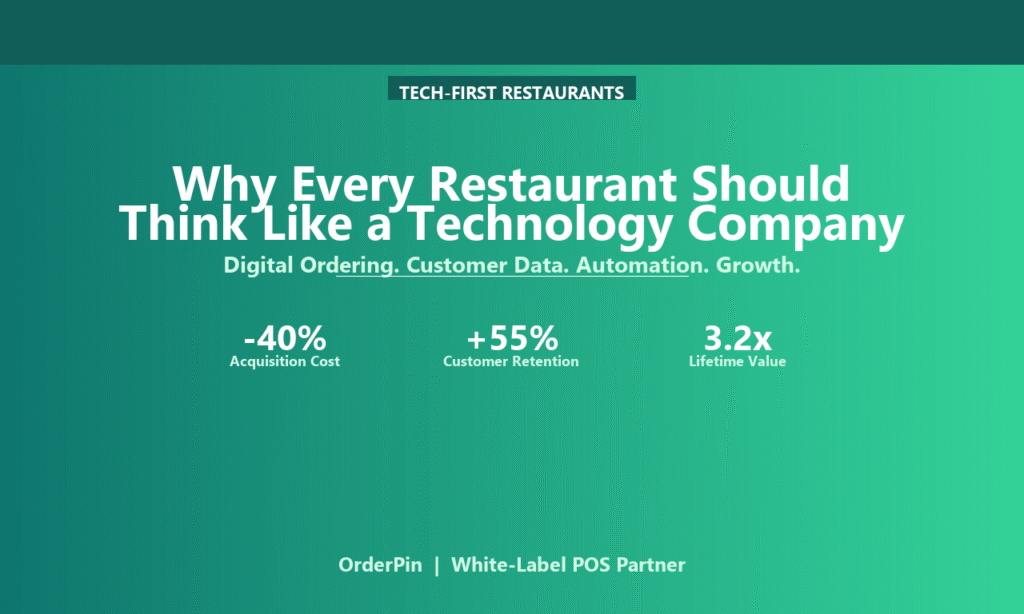
- Restaurants that adopt a technology-company mindset — digital ordering, customer data ownership, process automation — acquire customers at up to 40% lower cost and retain them at up to 55% higher rates.
- The mindset shift is not about buying more software. It’s about treating the restaurant as a platform: every order captured digitally, every customer known, every process measured.
- For ISOs, the technology-company restaurant is the best possible merchant: higher volumes, more integrations, deeper loyalty, and a partner who understands the value of what you sell.
There is a scene in every restaurant owner’s week: the phone rings, a customer orders takeout, the order is scribbled on a notepad, and the customer’s name disappears into the ether the moment the food leaves. Repeat that 40 times a week, 52 weeks a year — and the restaurant has served thousands of anonymous transactions it can never follow up on, never learn from, never turn into a repeat customer.
A technology company would consider that scene a data disaster. And that is precisely the point: the most successful restaurants of the next decade will operate like technology companies — not because they build software, but because they treat every order as data, every customer as an asset, and every process as something to automate and improve.
What “Thinking Like a Technology Company” Actually Means
It is not about drones delivering burgers. It is four concrete operating principles any restaurant can adopt this quarter:
| Principle | What It Looks Like in a Restaurant | Why It Wins |
|---|---|---|
| Digital-first ordering | QR, online, kiosk, and app ordering capture every order digitally — no notepads | Every order becomes data: who ordered, what, when, how often |
| Customer data ownership | Loyalty programs and digital receipts build a first-party customer list | Own the relationship; market to known guests at near-zero cost |
| Process automation | Automated inventory, scheduling, and reconciliation replace manual weekly chores | Staff hours go to guests, not spreadsheets |
| Measure everything | Sales, labor, food cost, and marketing ROI tracked per item, per channel, per day | Decisions based on data beat decisions based on gut, every quarter |
The 40/55 Math: Why Digital Wins
The headline numbers — up to 40% lower acquisition cost and 55% higher retention — come from a simple mechanism: knowing the customer.
- Acquisition cost drops because digital channels are measurable. A restaurant that knows its cost per online order can double down on what works and cut what doesn’t — instead of spraying money at generic ads.
- Retention rises because known customers can be brought back. A birthday offer, a “we miss you” message, a loyalty tier — these are impossible with anonymous notepad orders and trivial with a first-party customer list.
- Lifetime value compounds. A known customer who orders 2.3 times per month for four years is worth dramatically more than a walk-in who comes twice and is never seen again.
None of this requires a data science team. It requires a POS and ordering stack that captures the data automatically — and an owner who treats that data as an asset instead of a byproduct.
Where Restaurants Waste the Technology Advantage
Most restaurants already own the tools — they just don’t use them like a technology company would:
How ISOs Help Restaurants Make the Shift
Most owners don’t need convincing that digital is the future — they need a partner to make it practical. That’s the ISO’s lane:
| ISO Move | Merchant Outcome |
|---|---|
| Audit the order channels | Find the notepad orders and disconnected apps; show what digital capture is worth |
| Stand up loyalty & digital receipts | Owner starts building a first-party customer list from day one |
| Automate one process per quarter | Inventory or scheduling automation frees hours weekly; measurable ROI per quarter |
| Review numbers together monthly | Owner builds the data habit; ISO becomes the trusted technology advisor |
The restaurants that adopt this mindset become exactly the merchants ISOs want: they transact more, integrate more, and value the technology partner who helped them get there.
Frequently Asked Questions
1. Does thinking like a tech company mean replacing staff with software?
No — it means automating the administrative work (counting, reconciling, scheduling) so staff and owners spend their time on guests, food, and growth. The goal is more human attention, not less.
2. What’s the fastest first step for a restaurant owner?
Digitize the ordering channels that are still analog — typically phone and walk-up takeout. QR and online ordering capture that data with almost no training required.
3. Isn’t a customer list just another marketing cost?
A first-party list is the opposite of a cost — it’s the cheapest marketing channel that exists. Messaging your own regulars costs near zero and converts far better than paid ads to strangers.
4. How much data does a small restaurant really need?
Three numbers daily (sales, labor %, food cost) plus a growing customer list is 80% of the value. The rest is refinement — start with the habit, not the dashboard.
5. Will customers notice if a restaurant becomes more “techy”?
They’ll notice the good parts: faster ordering, personalized offers, loyalty rewards, and consistent quality. The tech disappears into the experience — which is exactly how a technology company designs it.
The ISO’s Edge: Sell the Mindset, Own the Merchant
OrderPin is a restaurant POS software ISV specializing in omni-channel ordering, all-in-one POS solutions, and full integrations with payment processors, payroll systems, and delivery platforms. For ISOs and MSP partners, a white-label restaurant POS turns any restaurant into a technology-company-style operator — and turns the ISO into the partner who made it possible.
The restaurants that win the next decade won’t be the ones with the most gadgets — they’ll be the ones that treat every order as data, every customer as an asset, and every process as improvable. Help your merchants make that shift, and you won’t just keep their business — you’ll grow with them.