
TL;DR — Quick Summary
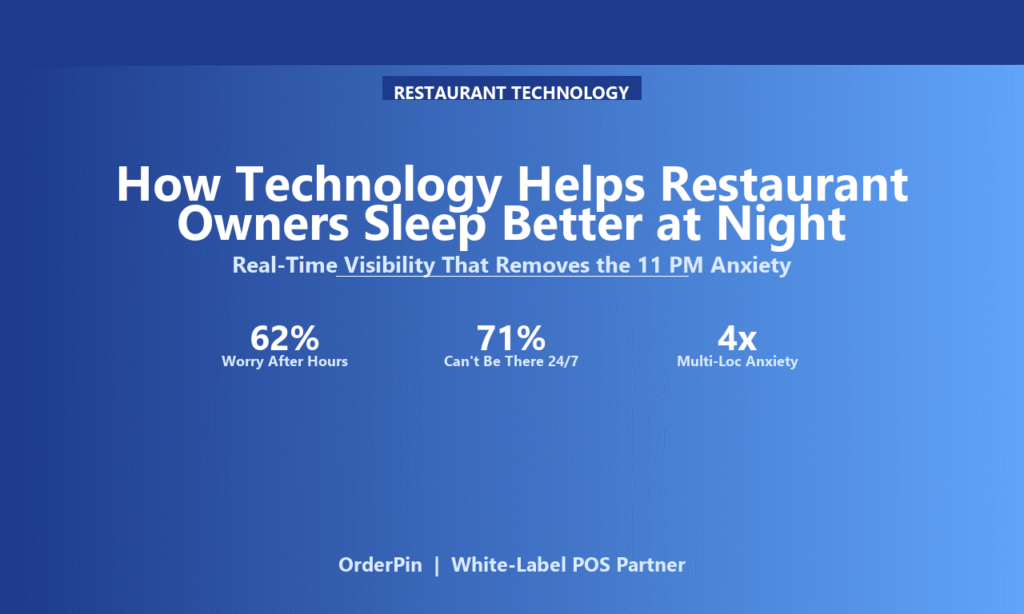
- 62% of restaurant owners lie awake worrying about what’s happening at their restaurant when they’re not there — and that anxiety is a direct result of not having real-time operational visibility.
- The technology that removes that anxiety isn’t exotic: real-time alerts, remote reporting, inventory tracking, and camera-integrated POS give owners the confidence to step away without losing control.
- For ISOs, selling peace of mind is more powerful than selling features — and it opens the door to every upsell, integration, and premium tier in the portfolio.
It’s 11 PM on a Saturday. The restaurant closed two hours ago. You’re at home, but you’re not really home — you’re running last night’s numbers in your head. Did the drawer come up short? Did the new server know what he was doing? Did someone pocket cash from table seven? You won’t know until Tuesday, when the bookkeeper gets around to reconciling.
This is the anxiety loop that eats restaurant owners alive — and it’s entirely a visibility problem. Technology doesn’t make restaurants more profitable because of the features; it makes them more profitable because it makes owners stop lying awake at night. And an owner who sleeps well is an owner who runs a better restaurant, keeps their staff accountable, and renews their contract year after year.
What Owners Lose Sleep Over (And Why Technology Fixes It)
The after-hours anxiety falls into five distinct buckets. Each one has a technology answer:
| Fear | Reality | Technology Answer |
|---|---|---|
| Theft & drawer gaps | 43% of restaurants report monthly cash discrepancies; most never find out when or how | Digital payment capture + drawer reconciliation; void and comp tracking |
| Staff underperformance | Problems at the service level don’t surface until reviews come in — weeks later | Real-time sales and labor tracking; flag drops in check average, table turns |
| Inventory running out | Running out of a best-seller on a Friday night is a revenue and reputation disaster | Low-stock alerts and integrated inventory management |
| Multi-location spread too thin | Owners with 3+ locations report 4x higher after-hours anxiety | Consolidated portfolio dashboard: all locations, one view |
| Vendor & equipment issues | An unseen equipment failure on a Saturday night can close a location | Real-time system uptime alerts; payment gateway status monitoring |
The Four Technologies That Actually Change Sleep Quality
The ROI of Peace of Mind (Yes, It Has Numbers)
Sellers who frame technology around peace of mind often hesitate to put numbers behind it. Here’s why they should — because the numbers are real:
- Drawer shortage reduction: Digital reconciliation cuts cash discrepancies by 60–80%. On a $5,000/day cash restaurant, that’s $3,000–$4,000/month recovered.
- Early theft detection: Void and comp tracking surfaces patterns — the same server, the same shift, the same discount — before significant loss accumulates.
- Inventory shrinkage: Integrated inventory tracking typically reduces food cost by 2–4% by eliminating over-ordering and spoilage.
- Owner time: An owner who can do an end-of-day review in 5 minutes from their phone vs. 45 minutes with paper and spreadsheets reclaims 3–4 hours per week — for a $1M restaurant, that’s $5,000–$10,000/year in time value.
How ISOs Should Sell Peace of Mind
The feature-first pitch is weak: “Our POS has real-time alerts.” The outcome-first pitch is powerful: “Imagine closing at 10 PM and knowing exactly how much you sold, how much labor cost, and whether the drawer was clean — without calling anyone.”
| Conversation Starter | What It Unlocks |
|---|---|
| “What was your last cash shortage, and how did you find out?” | Digital reconciliation conversation |
| “What time do you usually know yesterday’s numbers?” | Real-time reporting upsell |
| “How do you keep track of which locations are doing well?” | Multi-location portfolio dashboard |
| “Have you ever been surprised by a big inventory bill?” | Inventory management add-on |
Frequently Asked Questions
1. Is “peace of mind” really enough to justify a POS upgrade?
Yes — for the right owner. Multi-location operators, owners who travel, and owners who have experienced theft or major inventory waste will pay a premium for the confidence that comes with real-time visibility. Quantify the downside: what did the last cash shortage cost them?
2. How do you quantify peace of mind for a skeptical owner?
Don’t sell peace of mind directly. Sell the specific downside the owner has already experienced — the drawer shortage, the Friday night shortage, the inventory surprise. Then show how the technology eliminates it. The peace of mind is the result; the story is the problem.
3. Does real-time alerting actually help, or does it just create anxiety?
Real-time data reduces anxiety — it doesn’t increase it. Owners who know the numbers at 10 PM make fewer panicked calls to their managers at 11 PM. The key is daily digest format: one text, three numbers, end of day.
4. What about owners who don’t want to be “always on”?
Technology should give them the choice. An owner who wants to check in once a day can; an owner who wants to see everything real-time can. The value is in having the data available — not in being forced to look at it constantly.
5. How does a single-location owner benefit from remote visibility?
Single-location owners benefit from the same daily summary and drawer reconciliation as multi-location owners — they just don’t need the portfolio view. The 11 PM text that says “today: $4,200, labor 31%, drawer +$12” changes how every owner sleeps.
The ISO’s Edge: Sell the Outcome, Not the Feature
OrderPin is a restaurant POS software ISV specializing in omni-channel ordering, all-in-one POS solutions, and full integrations with payment processors, payroll systems, and delivery platforms. For ISOs and MSP partners, a white-label restaurant POS gives merchants the real-time visibility to run their restaurant from anywhere — and gives the ISO a story that goes beyond transactions.
The best restaurant technology doesn’t make owners work harder — it makes them worry less. And an owner who sleeps well runs a better restaurant the next day. Sell the outcome, quantify the downside of the problem, and let the technology do the rest.