
The operators defining restaurant management in 2027 have stopped treating technology as a back-office convenience and started treating it as a co-pilot. AI-assisted scheduling, predictive analytics, intelligent inventory, and real-time coaching are no longer science fiction; they are the new baseline for anyone who wants healthy margins. The restaurants adopting these tools early are rewriting what a profitable location looks like.
Quick Stats
AI-Assisted Operations
The defining shift in modern restaurant management is the move from systems that merely record what happened to systems that actively recommend what to do next. AI-assisted operations sit at the center of this change. Instead of a manager staring at yesterday’s sales trying to infer a pattern, an AI layer analyzes years of transaction data, weather, local events, and day-part trends to suggest actions before the rush arrives. These recommendations are practical: prep more of the item that historically sells out on rainy Friday nights, or shift a server from the patio to the dining room based on the reservation curve.
The point is not to remove human judgment but to sharpen it with context that no single person could hold in their head. Early adopters report that the biggest value of AI assistance is consistency; the system applies the same logic on a slow Tuesday that it would on a packed Saturday, removing the mood-driven decisions that quietly erode margin. Importantly, AI-assisted operations only deliver when they are wired into the tools the team already uses, surfacing a suggestion inside the scheduling or inventory screen rather than in a separate report nobody opens.
The restaurants winning in this generation are those that treat AI as a relentless junior analyst who never sleeps, surfaces the exception, and lets the human focus on the hospitality that machines cannot replicate. When the co-pilot handles the math, the operator is free to spend the saved hours on the floor, where guest experience is actually won or lost. The return on this approach shows up quickly: teams report fewer firefights, calmer shifts, and a measurable lift in covers served per labor hour once the recommendations become part of the daily routine.
Predictive Analytics
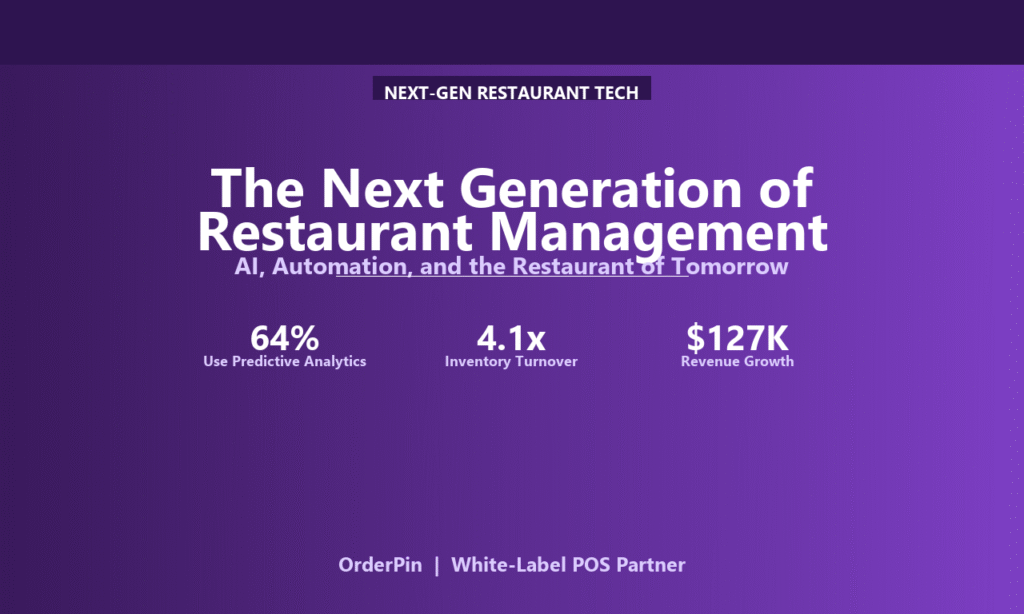
Predictive analytics is the engine underneath most of the next-generation gains, and adoption has crossed a meaningful threshold: roughly 64% of forward-leaning operators now use some form of predictive modeling in their planning. The concept is straightforward but powerful. Rather than planning labor, purchasing, and promotions from last month’s rough memory, operators feed historical and external signals into models that project demand with useful accuracy. A location can anticipate a 30% spike around a stadium event two miles away, or recognize that a menu item’s sales dip every third week correlates with a pay-cycle pattern.
The advantage compounds because predictions improve as more data accumulates; the system gets smarter about your specific location, not just restaurants in general. For operators, the practical payoff is fewer expensive mistakes: over-staffed shifts, spoiled stock, and promotions aimed at the wrong day all decline. Predictive analytics also changes the conversation with investors and lenders, who increasingly expect data-backed forecasts rather than optimistic spreadsheets. The barrier to entry has dropped sharply.
You no longer need a data science team to benefit, because modern restaurant management software embeds these models and presents them as plain-language guidance. The operators who treat predictions as a planning partner, and who still validate them against local knowledge, are the ones converting foresight into margin. Prediction is not a crystal ball; it is a disciplined edge that compounds week after week. Used consistently, it also reduces the emotional rollercoaster of running a restaurant, replacing anxious guesswork with a calm, evidence-based plan that the whole team can rally behind.
Automated Scheduling
Labor is typically the largest controllable cost in a restaurant, and it is also the area most exposed to human error and favoritism. Automated scheduling uses demand forecasts to build shifts that match expected covers, then layers in employee availability, skill mix, and labor-law compliance automatically. The result is a schedule that protects margin without the manager spending Sunday night manually dragging names across a grid. Beyond cost control, automated scheduling improves retention, because staff get fairer, more predictable shifts and can swap within rules without bureaucratic friction.
The system can warn when a schedule is trending toward overtime or when a required role is uncovered during a projected peak. When integrated with POS data, scheduling closes the loop: actual sales feed back into the model, so next week’s forecast reflects what really happened, not just what was assumed. Operators often find that the time saved is itself valuable; a task that took hours now takes minutes, freeing managers to be on the floor where they influence guest experience.
The next generation of restaurants treats scheduling as a living optimization rather than a static weekly chore. The managers who embrace it stop guessing how many hands they need and start matching capacity to demand with quiet precision, which is exactly the kind of discipline that protects profitability during uncertain economic conditions. Scheduling stops being a headache and becomes a strategic lever. The restaurants that master this earliest often find scheduling becomes a recruiting advantage too, because reliable, transparent shifts are exactly what today’s workforce asks for before accepting a job.
Intelligent Inventory Control
Inventory has historically been where good restaurants lose money quietly, through over-ordering, spoilage, and theft that hides inside messy counts. Intelligent inventory control changes the math by connecting purchases, recipes, and sales so that par levels adjust automatically to predicted demand. Operators using these systems report inventory turnover improving as much as 4.1x, which means cash is not sitting on shelves and waste drops sharply. The intelligence comes from linking each menu item to its ingredient cost in real time.
So a price change from a supplier or a recipe tweak shows up immediately in theoretical food cost. When actual counts diverge from theoretical, the system flags the gap, pointing managers to the station or shift where loss is occurring instead of leaving it as an unexplained monthly variance. Intelligent control also streamlines ordering: the system can suggest vendor quantities that match the forecast, reduce emergency runs, and prevent the double-ordering that happens when two managers both place an order. For multi-location groups, this visibility rolls up so an area manager can spot a location bleeding inventory before it becomes a P&L problem.
The restaurants leading this generation treat inventory as a controllable, measurable system rather than a periodic guessing game, and the margin recovery funds everything from wage increases to expansion. What used to be a back-room chore becomes a front-line advantage that directly protects the bottom line. And because the data is shared with purchasing and prep automatically, the kitchen stops over-producing for a demand that never materialized, which is where a surprising share of the 4.1x turnover gain actually originates.
Real-Time Business Coaching
Perhaps the most underrated next-generation tool is real-time business coaching, which takes the insights from AI, analytics, scheduling, and inventory and delivers them as timely, plain-language guidance to the people who can act. Rather than a monthly meeting where an owner lectures on numbers nobody remembers, coaching surfaces a single relevant nudge at the moment it matters: labor is trending 4% over target, here is the lever; tonight’s attachment rate is below last week, here is a prompt for servers. This form of coaching scales expertise that used to live only in the owner’s head.
It distributes that expertise to every shift leader regardless of experience. It also removes the shame factor from underperformance by framing every alert as an opportunity rather than a reprimand. Operators using real-time coaching describe a noticeable lift in manager confidence, because newer leaders now have a trusted advisor whispering the next best move. The aggregate effect on revenue is significant; businesses attributing growth to AI-enabled tools report averages around $127K in additional annual revenue.
Much of that comes from capturing demand they previously left on the table. The next generation of restaurant management is less about replacing people and more about giving every person on the team the judgment of a seasoned operator, delivered in real time. That is the future arriving early for those willing to adopt it, and the window to build the advantage is open now. Operators who wait risk watching competitors train their models on years of data they will never get back, widening a gap that grows harder to close with every passing quarter.
Frequently Asked Questions
Do I need a data science team to use AI in my restaurant?
No. Modern restaurant management software embeds predictive models and presents them as plain-language recommendations inside the tools your team already uses. You provide the operational knowledge and local context; the system handles the pattern recognition across large volumes of historical and external data.
Is automated scheduling fair to employees?
Done well, it is fairer than manual scheduling because it applies consistent rules around availability, seniority, and coverage instead of relying on who the manager likes. Staff also gain self-service swap and availability tools, which improve predictability and reduce scheduling friction that drives turnover.
How much can intelligent inventory control actually save?
Operators using demand-linked inventory systems report turnover improvements up to 4.1x, which frees cash and cuts spoilage. Savings vary by concept, but the combination of tighter pars, automated ordering suggestions, and variance alerts typically recovers meaningful margin within the first few months.
What is real-time business coaching, exactly?
It is timely, plain-language guidance delivered inside your management tools, surfacing one relevant action at the moment it matters, such as a labor warning or an upsell prompt. It scales the owner’s expertise to every shift leader and frames alerts as opportunities rather than criticisms.
Will AI replace restaurant managers?
No. The next generation of tools augment managers by handling repetitive analysis and surfacing exceptions, which frees them to focus on hospitality, team development, and the judgment calls machines cannot make. The operators winning in 2027 pair AI co-pilots with experienced human leadership.
Conclusion
The next generation of restaurant management is already here for the operators willing to adopt it. AI-assisted operations, predictive analytics, automated scheduling, intelligent inventory, and real-time coaching are rewriting what healthy margins look like, with early adopters reporting revenue gains around $127K a year from AI-enabled tools. The competitive gap is widening between those who treat technology as a co-pilot and those still running on gut feel and paper tickets. OrderPin is a restaurant POS software ISV focused on helping merchants streamline operations. The restaurants that move first will define what is possible in 2027 and beyond.