
TL;DR — Quick Summary
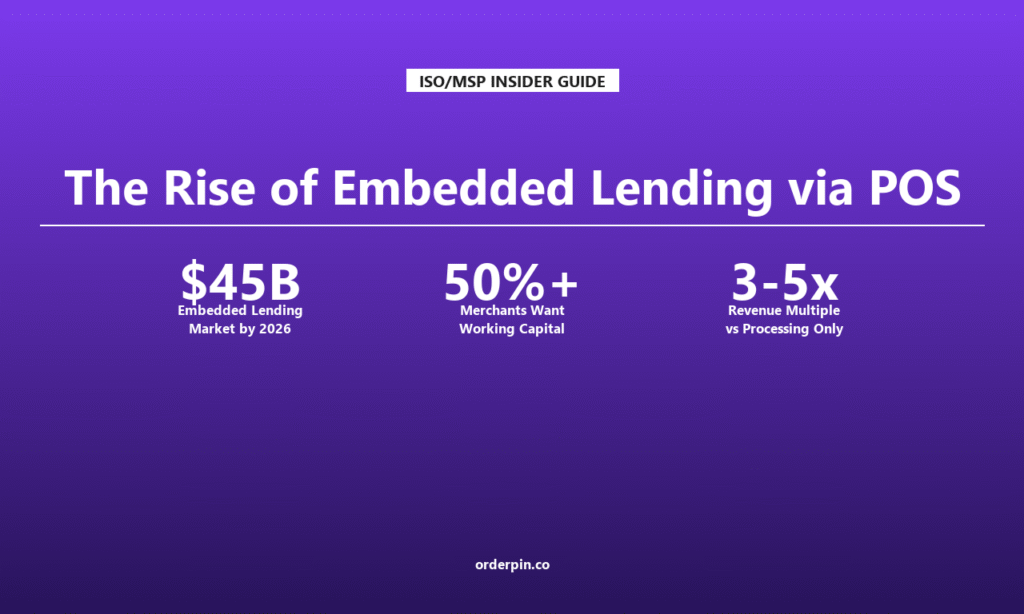
- The $45B embedded lending market is growing 50%+ annually: More than half of all small and medium-sized businesses want access to working capital through their existing POS platform — and most are not getting it through their current payment provider.
- ISOs have a structural advantage in embedded lending: You already have the merchant relationship, the payment history, and the trust. You don’t need a lending license — you need a lending partner and the right POS platform to distribute financing at the point of sale.
- The economics are compelling: 15–30% IRR on merchant cash advances: Revenue-based financing offers to your existing book can generate 3–5x the revenue per merchant versus processing alone — without adding headcount or regulatory complexity.
Market by 2026
Capital via POS
Cash Advances
What Is Embedded Lending, and Why Does It Matter for ISOs?
Embedded lending is the integration of financing products — merchant cash advances, revenue-based loans, installment credit — directly into the tools merchants already use. Instead of a business owner going to a bank, filling out an application, and waiting weeks for a decision, the financing offer appears inside their POS dashboard, their payment portal, or at the moment of a large purchase.
For independent sales organizations, embedded lending represents a structural revenue opportunity that requires no new license, no new headcount, and no significant investment — if you have the right platform and the right lending partner. The ISO’s existing merchant base is already pre-qualified through years of payment history. The trust relationship is already established. The distribution channel is already open.
The opportunity is large and growing. More than half of all small and medium-sized businesses in the United States report difficulty accessing working capital through traditional lending channels. Banks have tightened SMB lending standards since 2020. The result is a massive gap between SMB financing demand and supply — a gap that payment technology is uniquely positioned to fill.
Market by 2026
Traditional Banks
Cash Advances
Processing Only
1. Why Merchants Need Working Capital Through Their POS
Small and medium-sized businesses face a persistent working capital challenge. Seasonal fluctuations, unexpected equipment repairs, inventory purchases ahead of peak season, staffing surges during holidays — the cash flow needs are constant and often unpredictable. Traditional bank lending is rarely accessible: most SMBs lack the collateral, the credit history, or the time to navigate a bank application process.
The result is a massive financing gap. Industry data suggests that more than half of all SMBs in the United States report difficulty accessing working capital through traditional channels — even when they have strong, consistent revenue. A restaurant with $2 million in annual revenue and a five-year record of on-time payment processing is, by any reasonable measure, creditworthy. But that restaurant owner may spend weeks trying to get a $50,000 line of credit from a bank, and be rejected or offered unfavorable terms.
The POS has the data: Your POS platform already knows the merchant’s revenue volume, transaction patterns, average ticket size, peak and off-peak seasons, and growth trajectory. That data is a far better indicator of creditworthiness than a bank statement or tax return — and it updates in real time.
The moment of need is at the point of sale: When a restaurant owner is contemplating a new location, a major equipment purchase, or a seasonal inventory buy, the decision is made at the counter, in the back office, or during a conversation with their payment advisor. That is the moment when an embedded lending offer — pre-approved, amount based on real revenue data, terms clearly stated — has the highest conversion rate.
How OrderPin Helps ISOs Participate in Embedded Lending
OrderPin is a restaurant POS software ISV whose API-first architecture makes it the ideal platform for embedding lending products. ISOs who distribute OrderPin can integrate working capital offers, merchant cash advance triggers, and revenue-based financing directly into the merchant’s POS dashboard — creating a seamless experience that lenders pay to access.
- Real-time merchant data: OrderPin’s platform generates the revenue intelligence that lenders need to underwrite embedded loans — without additional merchant paperwork.
- API-first architecture: Lending partners can integrate directly with OrderPin’s API to access live transaction data, enabling automated underwriting and instant approval decisions.
- ISO controls the relationship: You own the merchant relationship; lenders access your merchants through your platform on your terms.
- Recurring revenue from financing: Revenue share or referral fees from lending partners create a new recurring income stream from your existing book of merchants.
2. How the ISO Embedded Lending Model Works
The ISO embedded lending model has three components: the technology platform, the lending partner, and the distribution relationship. The ISO provides the distribution — the merchant relationships, the platform access, and the trust — while the lending partner provides the capital, the underwriting engine, and the regulatory infrastructure.
Step 1 — Data access: The merchant’s POS transaction data — processed through your platform — is shared with the lending partner through an API integration. This data powers the underwriting model, replacing traditional financial statements and credit bureau pulls.
Step 2 — Instant underwriting: The lending partner’s automated underwriting model processes the POS data and generates a pre-approved offer — typically within minutes, not weeks. The merchant sees the offer in their POS dashboard or receives it via email or SMS from the ISO.
Step 3 — Revenue share: When a merchant accepts the financing offer, the ISO earns a referral fee, a revenue share on the loan repayments, or both. Typical ISO economics on embedded lending range from 1–3% of the loan amount upfront plus 0.5–2% of repayments over the loan term — generating 15–30% IRR on the referral effort.
Step 4 — Ongoing relationship: The ISO remains the merchant’s primary payment advisor. As the merchant grows, additional financing rounds become possible — the same merchant may take three or four loans over a two-year relationship, each generating additional revenue for the ISO.
ISO Embedded Lending: How It Compares to Traditional Processing
| Factor | Processing Only | Processing + Embedded Lending | Winner |
|---|---|---|---|
| Revenue Per Merchant | $30–80/month | $100–400+/month | Both |
| Merchant Retention | 75–85% annual | 90%+ annual | Both |
| Regulatory Complexity | Low | Low (lender handles) | Both |
| ISO Added Effort | Base level | Minimal (platform integration) | Both |
| Revenue Recurrence | Monthly processing | Monthly + loan repayments | Both |
3. The Revenue Math: Why Embedded Lending Changes Your Economics
Consider a simple model. An ISO with 100 restaurant merchants, each generating an average of $50 per month in residual income from processing, earns $60,000 per year from their book. If that same ISO embeds a lending program and converts just 15% of their merchants (15 restaurants) to take an average merchant cash advance of $50,000, the economics shift dramatically.
At a conservative 1.5% referral fee on the loan amount and 1% of repayments over a 12-month term, the ISO earns $7,500 upfront plus $7,500 over the first year — $15,000 total from 15 loans, or an average of $1,000 per merchant on top of their existing processing income. Scale that across a 200-merchant book with a 20% conversion rate, and the annual embedded lending revenue approaches $100,000 — on top of existing processing residuals.
Merchant cash advances (MCA): Repaid from a fixed percentage of daily card receipts (typically 15–25%). The ISO earns revenue on every repayment transaction — for the entire duration of the loan, often 6–18 months.
Revenue-based financing: Loans sized to the merchant’s monthly revenue. Repayment scales with actual revenue, reducing default risk during slow months. ISOs earn referral fees and revenue shares on each draw.
Installment credit: Point-of-sale installment plans for large purchases — new kitchen equipment, HVAC, a second location. The ISO earns a referral fee per transaction and ongoing revenue share. Particularly high-value in restaurant and hospitality verticals.
4. Finding the Right Lending Partner
The ISO’s role in embedded lending is distribution and data, not underwriting or capital deployment. Finding the right lending partner is the critical strategic decision. The ideal lending partner for an ISO embedded lending program has four characteristics:
API-first infrastructure: The lender must be able to integrate directly with your POS platform’s API to access live transaction data for automated underwriting. If they require manual data submission or paper applications, you lose the primary advantage of embedded lending.
Aligned incentives: The lender should be willing to share meaningful economics with the ISO — not just a referral fee, but a share of the loan repayment stream. If they’re offering a flat fee per loan, negotiate for a revenue share component that creates long-term alignment.
SMB-focused underwriting: The lender’s underwriting model must be designed for small business risk — not scaled-down versions of consumer credit models. Restaurant-specific underwriting models that account for seasonal patterns, ticket size, and industry-specific risk factors will approve more of your merchants and generate better loss rates.
Speed of execution: From application to funds in the merchant’s account in 24–48 hours is the benchmark. Anything longer and you lose the primary advantage over traditional bank lending. Test the lender’s process with a few merchant pilots before committing to a full program.
5. Getting Started: A Practical Roadmap for ISOs
Starting an embedded lending program doesn’t require a technology overhaul or months of business development. Here’s a practical roadmap to get your first embedded lending revenue within 60–90 days:
Step 1 — Identify your merchant base’s financing needs (Week 1–2).
Talk to 10–20 of your top merchants about their working capital needs. Ask about recent equipment purchases, expansion plans, and the experience of getting financing through traditional channels. You don’t need formal research — a few conversations will tell you whether your merchants have the financing gap that embedded lending addresses.
Step 2 — Evaluate and select a lending partner (Week 2–4).
Interview two to three embedded lending platforms that work with POS distributors. Ask for their API documentation, their underwriting approach, their revenue share terms, and references from other ISOs in their network. Negotiate for a revenue-share component — not just a flat referral fee.
Step 3 — Pilot with five to ten top merchants (Week 4–6).
Select your most creditworthy and engaged merchants for a pilot program. Present the financing offer personally, with the pre-approval details from the lender. Track conversion rates, loan performance, and merchant satisfaction. Use the pilot to refine your pitch and identify the financing use cases that resonate most with your merchant base.
Step 4 — Embed into your platform and scale (Week 6–12). Once the pilot validates the model, work with your POS platform to embed the lending offer into the merchant dashboard. Add the financing conversation to your standard merchant review process. Set a goal: every annual merchant review includes a review of the merchant’s financing needs and an active offer where appropriate.
Frequently Asked Questions
Do ISOs need a lending license to offer embedded financing?
No. Under the embedded lending model, the ISO acts as a distribution partner, not a lender. The lending partner holds the license and assumes the credit risk. The ISO earns referral fees and revenue shares for directing qualified merchants to the lender’s platform. Compliance, underwriting, and regulatory obligations rest with the lending partner — not the ISO.
What types of financing can be embedded in a POS platform?
The most common embedded financing products for ISOs are merchant cash advances (MCAs), revenue-based financing, and point-of-sale installment credit. MCAs are repaid from a percentage of daily card receipts — simplest to administer and lowest default risk. Revenue-based loans are sized to monthly revenue. POS installments are used for large equipment purchases and are repaid over 6–24 months.
How much revenue can an ISO generate from embedded lending?
Conservative estimates suggest 15–30% IRR on the referral effort. For a 100-merchant book with 15% loan conversion, annual embedded lending revenue of $15,000–$25,000 is achievable in year one, growing as the loan book renews and referral volume increases. A 200-merchant book with a mature program can generate $80,000–$150,000 annually in embedded lending revenue.
What happens if a merchant defaults on an embedded loan?
The lending partner absorbs the default loss. Under a standard referral agreement, the ISO’s revenue share stops when a loan goes into default, but the ISO does not bear any loss on the principal. This is why selecting a lender with strong SMB underwriting expertise — and a track record of low loss rates — is critical. A lender with poor underwriting creates default risk for the program, even if the ISO doesn’t carry the balance sheet.
How does embedded lending affect merchant retention?
Positively. Merchants who have received a working capital advance through their ISO are significantly less likely to switch providers. The financing relationship deepens the ISO’s role from a payment vendor to a business advisor — a relationship that has significantly higher switching costs than a processing-only relationship.
What POS platform capabilities are required for embedded lending?
The POS platform needs an API that can share merchant transaction data with the lending partner in real time — revenue volume, average ticket, transaction count, and seasonal patterns. An API-first architecture, which OrderPin provides, makes this integration straightforward. The platform also needs a dashboard or merchant portal where the financing offer can be displayed directly to the merchant.
Embedded lending is the fastest-growing revenue opportunity in the payments ecosystem — and ISOs have the merchant relationships, the data, and the trust to distribute it without becoming lenders themselves. The $45B embedded lending market is growing 50%+ annually, and ISOs who move now will earn 15–30% IRR on their existing book of merchants. Find a lending partner with API-first infrastructure and strong SMB underwriting, embed the offer in your POS platform, and start with five to ten pilot merchants. OrderPin is a restaurant POS software ISV whose API-first architecture makes it the ideal platform for ISOs ready to enter embedded lending — with real-time merchant data, white-label integration, and full merchant relationship control.
About OrderPin
OrderPin is a white-label POS platform built for ISO and MSP partners. We offer full data ownership, flexible pricing, and seamless API integrations to help you build a recurring revenue business under your own brand. Learn more about OrderPin’s white-label solution