
TL;DR — Quick Summary
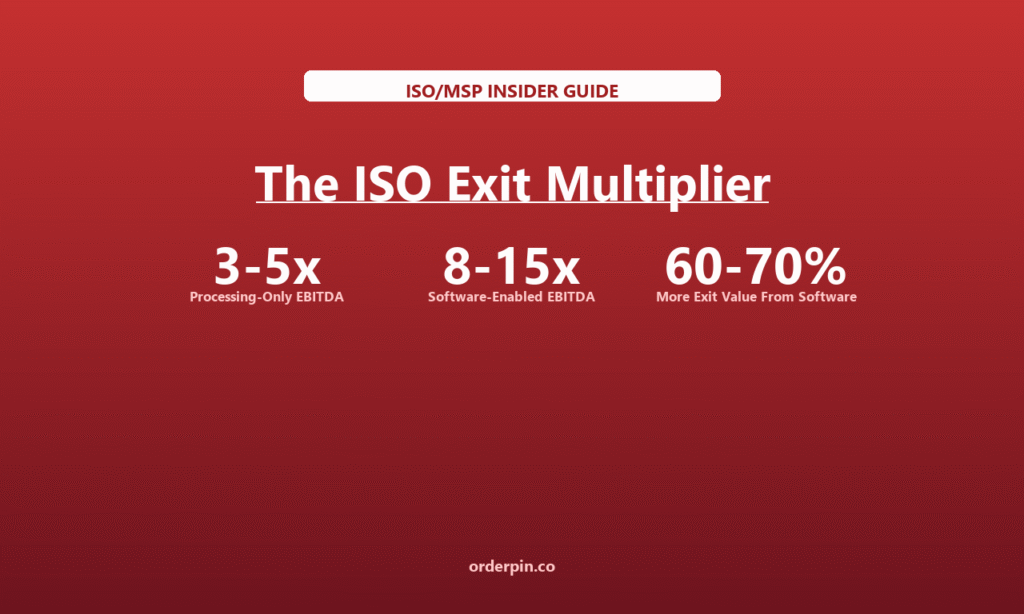
- Valuation gap is real and large: Processing-only ISOs typically sell for 3-5x EBITDA, while ISOs with genuine software capability command 8-15x EBITDA — a 2-3x exit multiplier that transforms the value of the same book of business.
- Software is the differentiator, not volume: Buyers pay premiums for recurring, defensible, technology-driven revenue because it survives the founder and keeps merchants sticky. A processing book alone is a commodity that depreciates.
- You can build the multiplier deliberately: White-label SaaS, strategic partnerships, or in-house builds all create software-enabled value — and the earlier you start, the more exit value you compound before you decide to sell.
EBITDA Multiple
EBITDA Multiple
From Software
What Is the ISO Exit Multiplier — and Why Does It Matter?
Every ISO owner will eventually exit — through a sale, a merger, a succession, or simply winding down. The timing varies, but the outcome is the same: at some point, the business changes hands, and the founder gets paid for what they built. The size of that payment is not determined by luck. It’s determined by a single structural factor that most ISO owners never optimize for.
That factor is the exit multiplier: the EBITDA multiple a buyer assigns to your business. A processing-only ISO with solid residuals might sell for 3-5x EBITDA. An ISO that has built genuine software capability into its model — recurring SaaS revenue, proprietary merchant relationships powered by technology, defensible integrations — can command 8-15x EBITDA. On the same $2 million of profit, that’s the difference between a $10 million exit and a $30 million exit.
The exit multiplier is the single highest-leverage number in an ISO owner’s financial life. Understanding it — and building toward the higher end before you go to market — is the difference between a decent payday and a life-changing one.
EBITDA Multiple
EBITDA Multiple
Multiple Achievable
Value Before Exit
1. Why Buyers Pay More for Software-Enabled ISOs
To understand the exit multiplier, you have to think like a buyer. A strategic acquirer or PE firm isn’t buying your residuals — they’re buying a predictable, defensible, growth-oriented cash flow stream they can scale. The more your revenue looks like that, the higher the multiple.
Processing-only revenue has three problems from a buyer’s perspective:
It’s tied to the founder: If the owner is the one with the merchant relationships, the revenue walks out the door when they leave. Buyers discount founder-dependent businesses heavily.
It’s a commodity: Processing margins compress over time. A book of pure residuals is a depreciating asset — buyers know this and price it conservatively.
It’s undifferentiated: Every ISO has residuals. There’s nothing proprietary to defend the book against competitor poaching.
Software capability flips all three. Recurring SaaS revenue is contractual and survives the founder. Technology creates switching costs that protect the book. And proprietary software is a genuine differentiator buyers will pay a premium to acquire — because they can’t easily build it themselves.
2. The EBITDA Multiple Gap, Quantified
The valuation difference between processing-only and software-enabled ISOs is not marginal — it’s structural.Industry transaction data on payments and fintech acquisitions consistently shows this pattern:
Processing-only ISO: 3-5x EBITDA. A $2M EBITDA business sells for $6M-$10M. Buyers treat it as a cash-flow stream with limited growth and defensive moat.
Software-enabled ISO: 8-15x EBITDA. That same $2M EBITDA business sells for $16M-$30M. Buyers treat it as a scalable, defensible platform.
The multiplier effect: A 2-3x higher multiple on identical profit means software capability doesn’t just add revenue — it multiplies the value of everything you already have.
Processing-Only vs. Software-Enabled ISO at Exit
| Factor | Processing-Only | Software-Enabled |
|---|---|---|
| EBITDA Multiple | 3-5x | 8-15x |
| Revenue Recurring? | Partially (residuals) | Yes (SaaS + residuals) |
| Founder Dependency | High (discounted) | Low (systematic) |
| Defensibility | Weak (commodity) | Strong (switching costs) |
| $2M EBITDA Exit Value | $6M-$10M | $16M-$30M |
3. Three Paths to Build Software Capability
The good news: you don’t need to become a software company to capture the exit multiplier. You need to build genuine software capability into your ISO — and there are three proven paths, each with different cost, speed, and control tradeoffs.
Path 1: White-Label SaaS Partnership
Partner with an ISV that offers a white-label POS or merchant software platform. You sell it under your brand, earn recurring SaaS revenue, and own the merchant relationship. Lowest cost, fastest to market, moderate control. Ideal for ISOs that want software revenue without building technology.
Path 2: Strategic Technology Partnerships
Integrate third-party tools — loyalty, analytics, scheduling, delivery — into your merchant offering through APIs. You don’t build, but you assemble a technology stack your merchants can’t easily replicate elsewhere. Moderate cost, fast, high flexibility. Ideal for ISOs with technical partners already in their network.
Build proprietary software in-house. Highest control and defensibility, but highest cost, slowest, and requires engineering talent. Reserved for ISOs with scale and a clear product thesis. Most ISOs don’t need this path to capture the multiplier — white-label and partnership routes deliver most of the value.
How OrderPin Helps ISOs Build the Exit Multiplier
OrderPin is a restaurant POS software ISV with a white-label program built specifically for ISO and MSP partners. By deploying OrderPin under your own brand, you create recurring SaaS revenue, deepen merchant stickiness, and build the software-enabled profile that buyers pay 8-15x EBITDA to acquire.
- Recurring SaaS revenue: Every merchant on your white-label platform generates monthly software revenue on top of processing — exactly the revenue profile buyers pay premiums for.
- Full data ownership: You own all merchant data and the relationship. The software value stays with you, not the vendor, when you exit.
- Switching costs: Merchants running operations on your platform don’t leave easily — defensibility that protects your book and lifts your multiple.
- Brand equity: You build a software brand, not just a processing book — a far more attractive acquisition target.
4. Your Exit Preparation Checklist
Building software capability is the foundation. But capturing the multiplier at sale time requires deliberate preparation. Here’s the checklist serious ISO owners use 2-3 years before going to market.
Separate founder from revenue: Document processes, build a management layer, and ensure merchant relationships are company-owned, not founder-owned.
Build recurring revenue streams: White-label SaaS, subscription add-ons, and advisory services that show up as predictable monthly line items.
Clean financials: 3+ years of auditable, normalized EBITDA with clear revenue segmentation between processing and software.
Start early: Software value compounds over years. The ISOs that capture 8-15x started building capability 3-5 years before their exit, not 3 months.
5. The Multiplier Mindset
The ISO exit multiplier isn’t a tax trick or a financial engineering game. It’s the natural result of building a business that looks like a platform rather than a book of residuals. Buyers pay more for businesses that will still be strong after the founder leaves — and software capability is the clearest signal that yours will be.
The practical takeaway is simple but powerful: every software decision you make today — what you deploy, what you partner with, what you own — is quietly setting your exit multiple 3-5 years from now. ISOs who understand this build differently. They don’t just accumulate merchants; they accumulate defensible, recurring, technology-powered value. And when they finally go to market, that value shows up as a 2-3x larger check.
Across payments and fintech M&A, the consistent pattern is that recurring, software-driven revenue commands materially higher EBITDA multiples than transactional, founder-dependent revenue — often 2-3x higher on otherwise comparable businesses.
Frequently Asked Questions
What EBITDA multiple does a typical processing-only ISO sell for?
Processing-only ISOs — those whose value is primarily monthly residuals with no software or recurring revenue component — typically sell in the 3-5x EBITDA range. The exact multiple depends on book size, merchant quality, churn, and contract terms, but buyers consistently discount pure processing books because the revenue is commodity-priced and founder-dependent.
How much more does a software-enabled ISO command?
ISOs with genuine software capability — recurring SaaS revenue, proprietary merchant technology, defensible integrations — commonly command 8-15x EBITDA. That’s a 2-3x higher multiple than a processing-only shop on identical profit. The software doesn’t just add revenue; it multiplies the value of the entire business.
Do I need to build software myself to capture the multiplier?
No. The most common and efficient path is a white-label partnership with an ISV — you deploy their software under your brand, earn recurring revenue, and own the merchant relationship. Strategic API partnerships and in-house builds are alternatives, but white-label routes deliver most of the exit-value benefit without the engineering cost or risk.
How far in advance should I start building software capability?
Software value compounds over time, so earlier is better. ISOs that capture the highest multiples typically began building software capability 3-5 years before their exit. Starting 2-3 years out is workable; starting 3 months before a sale is far too late to materially change your multiple.
Will adding software revenue really change how buyers value my ISO?
Yes — because it changes the nature of your revenue, not just the amount. Recurring SaaS revenue is contractual, survives the founder, and creates switching costs that protect the merchant book. Buyers pay a premium for exactly those characteristics, which is why the multiple — not just the absolute revenue — rises when software is part of the model.
The ISO exit multiplier is the highest-leverage number in an owner’s financial life. Processing-only ISOs sell for 3-5x EBITDA; software-enabled ISOs sell for 8-15x — a 2-3x difference on the same profit. That gap isn’t luck; it’s built deliberately, years in advance, by deploying software capability that creates recurring, defensible, founder-independent revenue. You don’t have to become a software company to capture it — a white-label partnership gets you most of the way. The question isn’t whether you’ll exit. It’s whether you’ll exit at 3x or at 12x. OrderPin is a restaurant POS software ISV with a white-label program designed to help ISOs build exactly this kind of exit-multiplying, recurring revenue under their own brand.
About OrderPin
OrderPin is a white-label POS platform built for ISO and MSP partners. We offer full data ownership, flexible pricing, and seamless API integrations to help you build a recurring revenue business under your own brand. Learn more about OrderPin’s white-label solution