
TL;DR — Quick Summary
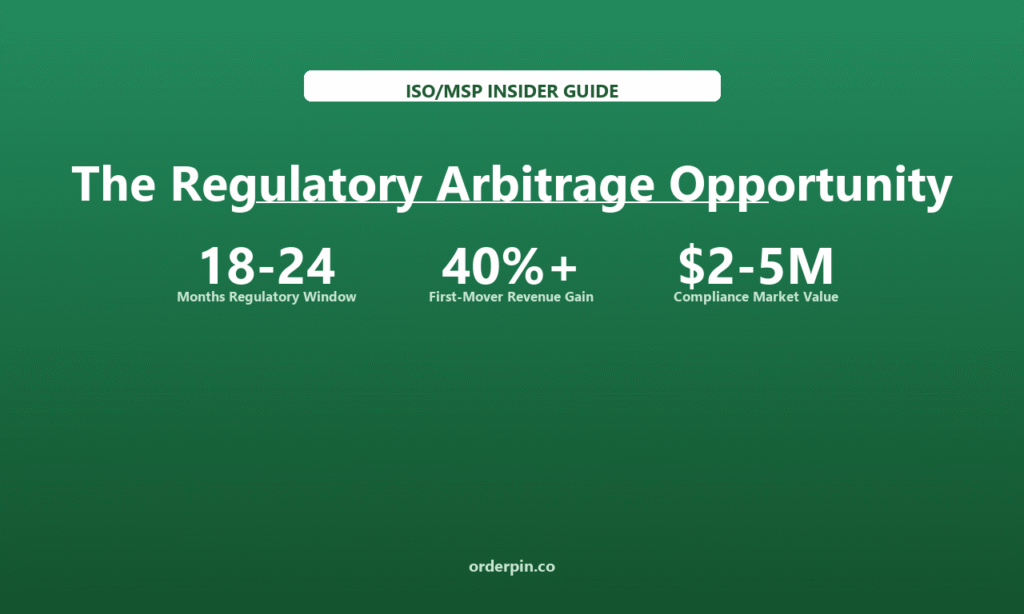
- Regulatory windows are temporary but lucrative: Every major payment regulation creates an 18-24 month window where early movers capture 40%+ more market share than late entrants who wait for clarity. The ISOs who move first win; the rest compete for scraps.
- Current opportunities are real and immediate: BNPL compliance rules, CFPB oversight expansion, and state-level payment licensing are all creating compliance gaps that fast-moving ISOs can fill with compliant products, risk-mitigation tools, and advisory services.
- Arbitrage is a capability, not luck: ISOs who systematically monitor regulations, maintain compliance infrastructure, and can deploy solutions quickly will capture these opportunities repeatedly. It’s a learnable competitive advantage that compounds over time.
Arbitrage Window
Revenue Gain
Value Per State
What Is Regulatory Arbitrage in Payments — and Why Does It Matter for ISOs?
Regulatory arbitrage is the practice of exploiting differences in regulatory treatment across products, jurisdictions, or time periods to gain competitive advantage. In payments, it shows up when new rules create compliance gaps, when existing players can’t adapt quickly, or when certain merchant segments suddenly need help navigating a new legal landscape.
For ISOs, regulatory arbitrage isn’t about avoiding rules — it’s about being faster and better at compliance than competitors. When BNPL regulations tighten, ISOs who already have compliant underwriting models win the merchants who can no longer use non-compliant alternatives. When state licensing requirements expand, ISOs with multi-state infrastructure capture merchants who can’t find approved providers. When CFPB oversight extends to new payment categories, ISOs with transparent pricing and documentation tools become the safe choice for risk-averse merchants.
The pattern is consistent across payment history: regulation creates a temporary window where fast movers capture outsized market share, and then the window closes as everyone catches up. The ISOs who recognize the window, move quickly, and build sustainable advantages during the transition period end up with permanent gains that persist long after the regulation becomes business-as-usual.
Arbitrage Window
for First Movers
Sustainability
Per Major State
1. Why Regulations Create Competitive Windows
To understand regulatory arbitrage, you have to understand how regulations actually impact the payment industry. A new rule doesn’t affect everyone equally or instantly. It creates a transition period where some players are ready, some are scrambling, and some exit the market entirely. That transition period is the arbitrage window.
Three dynamics create these windows:
Compliance capacity gaps: Small ISOs and independent agents often lack the legal and operational resources to adapt quickly to new rules. When a regulation requires new documentation, new pricing disclosures, or new underwriting practices, these players fall behind while larger or better-prepared competitors capture their merchants.
Product dislocation: Regulations sometimes make certain products uneconomical or outright prohibited. The merchants using those products suddenly need alternatives — and ISOs who have compliant alternatives ready win that displaced volume.
Trust and credibility shifts: When regulators publicly crack down on a practice (for example, undisclosed fees or aggressive collection tactics), merchants become wary of any provider associated with that practice. ISOs who can demonstrate clean, compliant operations gain a trust premium that lasts beyond the immediate regulatory moment.
The ISOs who consistently win regulatory arbitrage opportunities aren’t lucky — they’ve built the monitoring, compliance, and deployment capabilities to recognize windows early and move faster than competitors who are still figuring out what the regulation means.
2. Current Regulatory Arbitrage Opportunities (2026)
The payment industry is in a period of intense regulatory change. Three major areas are creating active arbitrage windows right now:
BNPL Regulation and Compliance Gaps
Buy Now Pay Later products are facing new disclosure requirements, underwriting standards, and consumer protection rules in multiple jurisdictions. Many BNPL providers — especially smaller, newer entrants — are struggling to adapt their systems and processes to comply. ISOs who can offer compliant installment payment solutions, transparent fee structures, and proper credit assessment workflows are capturing merchants who need alternatives to non-compliant BNPL providers. The window is open now and likely extends through 2026 as regulations phase in across different states and countries.
CFPB Oversight Expansion
The Consumer Financial Protection Bureau is extending supervisory authority to more payment providers, including certain non-bank payment processors and digital wallet providers. This creates demand for compliance documentation, consumer complaint handling systems, and transparent pricing models that many smaller providers lack. ISOs who already have these capabilities — or who can help merchants implement them — are positioned as the safe, credible choice in a market where regulatory risk is suddenly visible.
State-Level Licensing and Registration Requirements
Individual states are increasingly requiring money transmitter licenses, payment processor registrations, and specific disclosures for companies operating in their jurisdiction. This fragmentation creates opportunity for ISOs with multi-state licensing infrastructure to serve merchants who can’t find locally-approved providers — especially in states with newer or more stringent requirements. The compliance gap between national players with resources and regional players without is widening, and that gap is monetizable.
Regulatory Arbitrage Opportunity Matrix
| Regulation Area | Window Length | Opportunity Type | ISO Action |
|---|---|---|---|
| BNPL Compliance | 18-24 months | Compliant alternatives | Deploy compliant installment products |
| CFPB Oversight | 12-18 months | Trust and credibility | Offer compliance documentation services |
| State Licensing | 24-36 months | Infrastructure gaps | Build multi-state approval capability |
| Data Privacy Rules | 18-30 months | Merchant data handling | Provide privacy-compliant POS systems |
3. How to Build Regulatory Arbitrage Capability
Regulatory arbitrage isn’t a one-time opportunity — it’s a recurring pattern in the payment industry. ISOs who build systematic capability to recognize and exploit these windows will capture advantages repeatedly over their career. Here’s how to build that capability:
Monitor systematically: Subscribe to regulatory updates from CFPB, state financial regulators, and industry associations. Set up alerts for proposed rules, comment periods, and implementation dates. The earlier you know a regulation is coming, the more time you have to prepare.
Maintain compliance infrastructure: Build documentation systems, pricing disclosure tools, and consumer complaint handling processes before you need them. ISOs with compliance infrastructure ready to deploy can move in weeks; ISOs building from scratch need months they don’t have.
Develop rapid deployment capability: When a regulation creates an opportunity, speed matters. The ISOs who can roll out compliant products, retrain sales staff, and update merchant contracts in 30-60 days capture the bulk of the arbitrage value before the window narrows.
Quantify the market: Before investing in a regulatory arbitrage play, estimate the size of the displaced market, the number of merchants affected, and the revenue potential. Not every regulation creates a monetizable opportunity — but the ones that do are worth pursuing aggressively.
How OrderPin Helps ISOs Navigate Regulatory Change
OrderPin is a restaurant POS software ISV whose white-label platform includes built-in compliance features for pricing transparency, data handling, and merchant documentation — exactly the capabilities ISOs need to capitalize on regulatory arbitrage opportunities without building compliance infrastructure from scratch.
- Built-in compliance documentation: Automatic fee disclosure, merchant statements, and transaction records that meet CFPB and state-level requirements out of the box.
- Data privacy controls: Merchant and consumer data handling features aligned with emerging privacy regulations — you don’t need to retrofit compliance later.
- Transparent pricing infrastructure: Pricing disclosure tools and contract documentation that help you demonstrate compliance credibility to merchants navigating regulatory uncertainty.
- Rapid deployment: White-label setup that lets you roll out compliant POS solutions to merchants in weeks, not months — crucial for capturing regulatory arbitrage windows before they close.
4. Risks and Guardrails for Regulatory Arbitrage
Regulatory arbitrage is not about skirting rules or exploiting loopholes — it’s about being faster and better at compliance than competitors. The ISOs who approach this opportunistically but ethically build sustainable advantages. Those who cut corners create legal and reputational risk that outweighs any short-term gain.
Stay on the right side of the regulation: Your arbitrage advantage comes from compliance speed and quality, not from finding ways to avoid the regulation’s intent. If you’re stretching the interpretation, you’re not arbitraging — you’re creating liability.
Build permanent capability, not temporary tricks: The best regulatory arbitrage plays create lasting advantages — merchant relationships, compliance infrastructure, and credibility that persist after the window closes. Quick fixes that don’t build capability are wasted effort.
Document everything: Regulatory arbitrage plays attract scrutiny. If you’re gaining market share during a compliance transition, regulators may look at how you did it. Having clear documentation that you met or exceeded requirements protects you and reinforces your credibility with merchants.
5. The Arbitrage Mindset: Seeing Regulation as Opportunity
Most ISOs view regulation as a cost — something to comply with, minimize, and move on from. A smaller group sees it as an opportunity: a moment when market dynamics shift, competitors falter, and fast movers capture advantages that would be impossible in a stable regulatory environment.
The difference isn’t luck or resources — it’s mindset and preparation. ISOs who systematically monitor regulatory developments, maintain compliance infrastructure, and can deploy solutions quickly will see every major payment regulation as a potential arbitrage window. Those who wait for clarity before acting will always be competing for scraps after the window closes.
The practical takeaway is straightforward: regulations are coming faster and affecting more of the payment industry. BNPL, CFPB oversight, state licensing, and data privacy are just the current wave. ISOs who build the capability to recognize and exploit these opportunities will capture compounding advantages over time. The question isn’t whether you’ll face regulatory change — it’s whether you’ll treat that change as a threat or an opportunity.
Industry analysis of regulatory transitions consistently shows that early movers capture 40%+ more market share during 18-24 month compliance windows, with advantages that persist for 3-5 years after the regulation becomes standard practice.
Frequently Asked Questions
What is regulatory arbitrage in payments?
Regulatory arbitrage in payments is the practice of gaining competitive advantage by being faster and better at adapting to new regulations than competitors. When a regulation creates compliance gaps, product dislocation, or trust shifts, ISOs who are prepared can capture merchants and market share that would otherwise be unavailable.
How long do regulatory arbitrage windows typically last?
Most regulatory arbitrage windows in payments last 18-24 months from the time a regulation is announced or implemented to when most competitors have adapted and the market stabilizes. Early movers in the first 6-12 months capture the bulk of the advantage.
What current regulations are creating arbitrage opportunities?
As of 2026, the main areas are BNPL compliance rules (creating demand for transparent, compliant installment products), CFPB oversight expansion (creating demand for compliance documentation and transparent pricing), and state-level licensing requirements (creating infrastructure gaps for multi-state ISOs to fill).
Is regulatory arbitrage legal and ethical?
Yes — when it means complying faster and better than competitors. Regulatory arbitrage is not about avoiding regulations or exploiting loopholes; it’s about having the compliance infrastructure and deployment capability to meet new requirements quickly while competitors are still scrambling. The advantage comes from speed and quality of compliance, not evasion.
How can ISOs build regulatory arbitrage capability?
Systematically monitor regulatory developments through CFPB updates, state financial regulator notices, and industry associations. Maintain compliance infrastructure (documentation systems, disclosure tools, complaint handling) ready to deploy. Develop rapid deployment capability so you can roll out compliant products in weeks, not months. And quantify the market before investing — estimate displaced volume and revenue potential to focus on the most valuable opportunities.
Regulatory arbitrage is a recurring competitive advantage in payments. Every major regulation creates a temporary window where early movers capture 40%+ more market share, and those advantages often persist for years after the window closes. The ISOs who systematically monitor regulations, maintain compliance infrastructure, and can deploy solutions quickly will see every regulatory change as an opportunity rather than a cost. The current wave — BNPL rules, CFPB oversight, state licensing — is creating active arbitrage windows now. OrderPin is a restaurant POS software ISV whose white-label platform includes built-in compliance features for pricing transparency, data handling, and merchant documentation, helping ISOs capture these opportunities without building compliance infrastructure from scratch.
About OrderPin
OrderPin is a white-label POS platform built for ISO and MSP partners. We offer full data ownership, flexible pricing, and seamless API integrations to help you build a recurring revenue business under your own brand. Learn more about OrderPin’s white-label solution