
TL;DR — Quick Summary
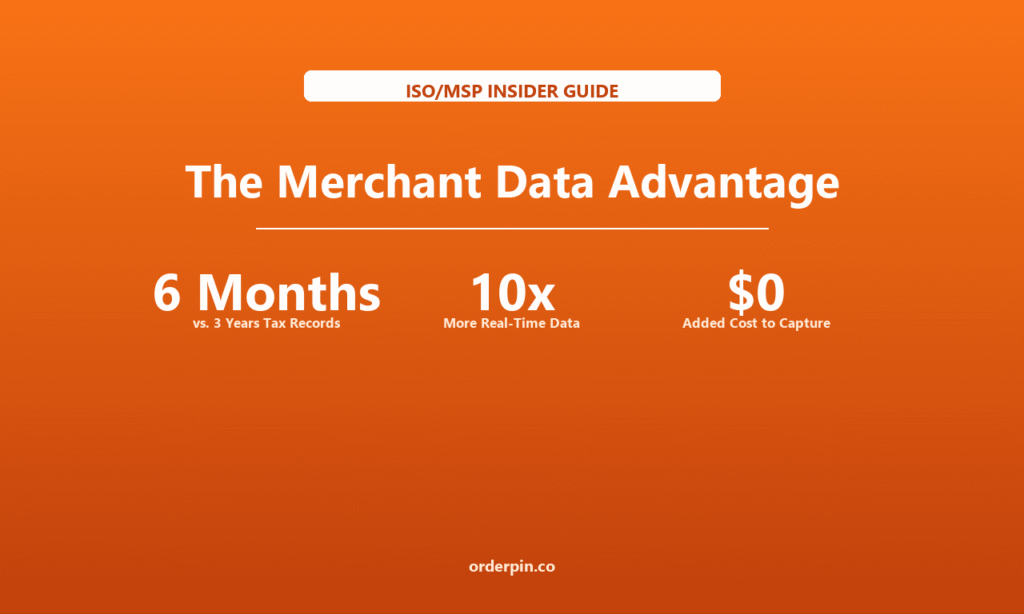
- Six months of payment history is more predictive than three years of tax records: Real-time transaction data shows current revenue, seasonality, and cash flow health — the things lenders and suppliers actually care about — at a granularity tax filings can never match.
- The asset is already captured at zero marginal cost: Every ISO already processes its merchants’ transactions. The data exists. The only missing piece is treating it as a strategic asset rather than a processing byproduct.
- Data becomes a moat through products, not storage: Standardized data, benchmarking reports, and business intelligence tools convert raw transactions into merchant value — and into switching costs that retain merchants and differentiate your ISO.
Credit Power
Than Tax Filings
Capture the Data
What Is the Merchant Data Advantage?
Every merchant you process generates a continuous stream of transaction data — what they sell, when they sell it, how much, from which channels, to which customers. This data is more current, more detailed, and more behaviorally accurate than any credit report or tax return. Yet for most ISOs, it flows in, gets used for settlement and risk monitoring, and disappears. It is the most undermonetized asset in SMB finance.
The opportunity is not to sell the data — that’s a compliance and trust nightmare. The opportunity is to use the data to build products and insights your merchants value, which in turn make your ISO indispensable. A merchant who receives a monthly performance benchmark from you is far less likely to switch providers than one who only sees you at renewal.
This reframes data from a byproduct into infrastructure. ISOs that build data products don’t just process payments — they become the merchant’s source of operational truth. That position is defensible, recurring, and difficult for competitors to dislodge.
Underwriting Power
Than Annual Filings
Traditional Credit
Capture the Data
1. Why Payment History Beats Bank Credit and Tax Records
Traditional SMB credit assessment relies on two imperfect sources: bank credit reports (which reflect past behavior with a lag and limited granularity) and tax returns (which are annual, backward-looking, and easily gamed). Both are snapshots taken months after the fact. Payment history is a live feed.
Currency: A tax return tells you what a merchant earned nine months ago. Transaction data tells you what they earned yesterday. For assessing current health, current is everything.
Granularity: Payment data shows daily, weekly, and seasonal patterns — peak hours, best-selling items, channel mix, customer repeat rates. Tax filings collapse all of that into a single annual number.
Behavioral accuracy: How a merchant actually runs their business — cash flow timing, margin pressure, growth trajectory — is visible in transactions long before it shows up in a credit score or a filed return.
Coverage: Roughly 73% of small businesses are underserved by traditional credit. Payment data gives them a credit identity they didn’t have — and gives you an underwriting lens competitors lack.
2. The Asset Is Already Captured — You’re Just Not Using It
The most important fact about merchant data is that you already have it. Every ISO processes transactions for its merchants, which means the raw material for a data advantage is sitting in your systems at zero marginal acquisition cost. The gap is not collection — it’s activation.
Most ISOs use transaction data only for two things: settlement and basic risk monitoring. That’s like owning a gold mine and using the gold only to weigh the carts. The data can power merchant benchmarking, performance reporting, inventory insights, customer analytics, and cash-flow forecasting — all of which create merchant value and, by extension, ISO stickiness.
Activation requires three things most ISOs haven’t built: data standardization (cleaning and structuring raw transactions), a delivery mechanism (a dashboard, report, or API), and a merchant-facing narrative (showing the merchant why this matters to them). The ISOs that build these three layers turn a passive byproduct into a product.
Credit Signal Comparison: Payment Data vs. Alternatives
| Signal Source | Recency | Granularity | Capture Cost | ISO Advantage |
|---|---|---|---|---|
| Tax Returns | Annual | Single number | High (CPA) | LOW |
| Bank Credit Report | Lag 30-90d | Limited | Per pull | LOW |
| Payment History (ISO) | Real-time | Daily / item-level | $0 (existing) | HIGH |
| POS Operational Data | Real-time | Item + table level | $0 (existing) | HIGHEST |
3. How to Turn Data Into a Competitive Moat
Data itself is not a moat — your competitors have similar data. The moat comes from what you build on top of it. Three layers convert raw transactions into defensible advantage:
Standardization: Clean, structure, and normalize transaction data across merchants so it’s comparable and analyzable. Raw data is noise; standardized data is signal.
Benchmarking: Show each merchant how they compare to peers in their category and region. “You’re in the top 20% for repeat-customer rate” is a powerful retention and advisory tool.
Business intelligence delivery: Put the insights in front of the merchant through a dashboard or regular report. The merchant who logs in to see their numbers is engaging with your brand weekly — not just at renewal.
How OrderPin Helps ISOs Activate Merchant Data
OrderPin is a restaurant POS software ISV whose white-label platform captures rich, item-level operational data — orders, tables, inventory, customer behavior — that processing-only ISOs never see. That data depth is exactly what turns a generic transaction feed into merchant intelligence.
- Item-level transaction detail: Processing data shows amount and time. OrderPin data shows what was sold, to whom, at which table, through which channel — the granularity that powers real benchmarking.
- Built-in merchant analytics: The platform delivers dashboards and reports directly to the merchant, so the data advantage is visible to them weekly — reinforcing the relationship with your ISO brand.
- White-label data ownership: The merchant’s analytics experience carries your brand, not OrderPin’s. The insight relationship belongs to your ISO, not a third party.
- API-ready for your own products: OrderPin’s API lets your ISO build custom data products, benchmarking tools, and advisory services on top of the raw feed — turning data into differentiated offerings.
4. Data Products That Monetize the Advantage
Once data is standardized and delivered, it becomes a product — and products generate revenue and retention. The highest-value data products for ISOs:
Merchant performance benchmarking: A quarterly or monthly report showing the merchant’s metrics vs. peers. High perceived value, low delivery cost, strong retention effect.
Cash-flow forecasting: Use historical patterns to project next-quarter revenue and seasonal dips. Merchants use this for inventory, staffing, and financing decisions.
Customer analytics: Repeat-rate, frequency, and average-order-value reporting helps merchants improve marketing — and makes your ISO a growth partner, not a vendor.
Embedded underwriting insights: Offer merchant customers faster, data-backed access to working capital by sharing (with consent) verified payment history — a service layer that competitors without the data can’t match.
5. The Data-First ISO
The ISOs building durable advantages in 2026 share a trait: they treat merchant data as a core asset, not a byproduct. They standardize it, deliver it as a product, and use it to deepen merchant relationships. The result is a moat that processing-only competitors cannot cross.
The practical starting point is small: pick one data product — merchant benchmarking is the easiest — and ship it to your top 20 merchants. Measure engagement and retention. If the merchant logs in to see their numbers, they’re not leaving for a competitor who only sends them a statement. That single behavior change is worth more than most ISOs realize.
Industry data consistently shows that merchants who receive regular performance insights from their provider churn at roughly half the rate of those who don’t — the data relationship is itself a retention tool.
Frequently Asked Questions
Why is payment history more valuable than tax records for assessing a merchant?
Tax returns are annual, backward-looking, and easily smoothed. Payment history is real-time, granular, and behaviorally accurate. Six months of transaction data reveals current revenue, seasonality, cash-flow timing, and growth trajectory — the things that actually predict a merchant’s near-term health — with a precision tax filings can’t match.
Does building a data advantage require new data collection?
No. Every ISO already captures transaction data through processing. The asset exists at zero marginal cost — the gap is activation, not collection. You need data standardization, a delivery mechanism (dashboard or report), and a merchant-facing narrative. None require new data sources; they require using the data you already have.
What’s the easiest data product an ISO can launch?
Merchant performance benchmarking. Take standardized transaction data, compare each merchant’s metrics (repeat rate, average ticket, peak hours) to peers in their category and region, and deliver a quarterly report. It’s high perceived value, low delivery cost, and strongly correlated with retention — merchants who see their numbers regularly churn at roughly half the rate of those who don’t.
Is it safe or compliant to use merchant payment data?
The safe and effective model is to use data to build products and insights for the merchant themselves — not to sell or share raw data externally. Internal analytics, benchmarking, and (with consent) underwriting insights are standard and compliant practices. The advantage comes from delivering value to the merchant, which builds the relationship and the moat, without compromising data privacy.
How does POS data differ from processing data for this purpose?
Processing data shows amount and timestamp. POS operational data shows what was sold, to whom, at which table, through which channel, with which modifier — item and table-level detail. That granularity powers far richer benchmarking and customer analytics. ISOs on a POS platform capture both layers; processing-only ISOs capture just the first. The deeper the data, the stronger the potential moat.
Can a small ISO realistically compete on data?
Yes — more easily than on price or processing scale. Data advantages are built on the merchant relationship you already own, not on infrastructure you don’t. A 50-merchant ISO can deliver benchmarking and insights to those 50 merchants with off-the-shelf tools or a white-label POS platform’s built-in analytics. The moat is about depth of relationship, which favors focused ISOs over giant processors.
Payment history is the most undermonetized asset in SMB finance: six months of real-time transaction data is more predictive than three years of tax records, and most ISOs already capture it at zero marginal cost. The advantage isn’t the data itself — it’s what you build on top of it: standardized benchmarks, performance reports, and business intelligence that merchants actually use. ISOs that deliver data products turn a processing byproduct into a relationship moat, cutting churn roughly in half versus merchants who only see a statement at renewal. The data-first ISO treats merchant data as core infrastructure, not noise. OrderPin is a restaurant POS software ISV whose white-label platform captures rich item-level operational data and delivers built-in merchant analytics — giving ISOs the data depth and API access to build differentiated data products under their own brand.
About OrderPin
OrderPin is a white-label POS platform built for ISO and MSP partners. We offer full data ownership, flexible pricing, and seamless API integrations to help you build a recurring revenue business under your own brand. Learn more about OrderPin’s white-label solution