
TL;DR — Quick Summary
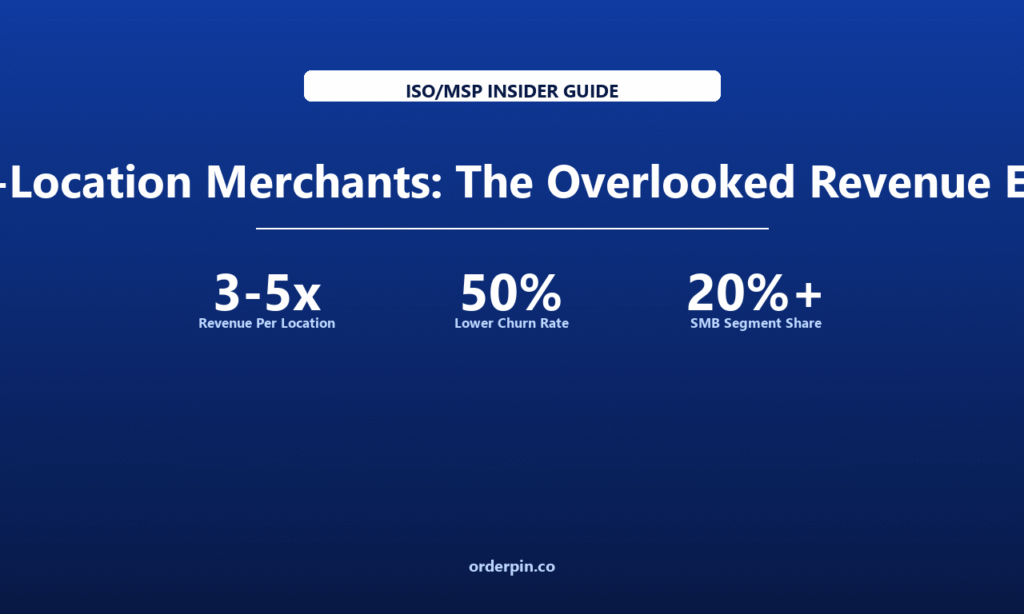
- Multi-location merchants generate 3-5x the revenue of single-location accounts: One franchise with 15 locations is not 15 merchants — it’s one account that can contribute the revenue of an entire merchant segment. The account management cost is roughly the same; the upside is multiples higher.
- They churn at roughly half the rate: The switching cost for a multi-location operator isn’t just the pain of moving one terminal — it’s coordinating a transition across 5, 10, or 50 locations. Multi-location merchants are structurally stickier.
- Most ISOs lack a systematic multi-location playbook: Selling to multi-location requires enterprise sales discipline, dedicated support, and POS features (centralized reporting, location management, menu control) that most processing-only ISOs don’t offer. That’s the gap — and the opportunity.
Per Relationship
Churn Rate
Revenue Share
What Is the Multi-Location Opportunity?
Multi-location operators are businesses with two or more physical locations — chain restaurants, franchise groups, convenience store chains, medical and dental practices, fitness studios, and retail chains. They are not simply “bigger merchants.” They have fundamentally different needs, buying processes, and value dynamics than single-location businesses.
A single-location restaurant needs a good terminal and a reasonable rate. A 12-location franchise needs centralized reporting across all 12 sites, unified menu management, consolidated billing, a dedicated support contact who understands their system, and the ability to add locations without renegotiating each contract. These are enterprise requirements wrapped in an SMB envelope — and most ISOs are not equipped to serve them.
The irony is that multi-location operators are often easier to acquire and far more valuable to retain than their single-location counterparts. The acquisition cost is lower (one sale covers many locations), the revenue per account is multiples higher, and the structural switching cost is substantially greater. Yet most ISOs default to single-location hunting and miss the compounding value of multi-location accounts.
Single Location
Churn Rate
Revenue Share
per Enterprise Acct
1. Why Multi-Location Merchants Are Worth 3-5x More
The math is straightforward: a 10-location franchise is not 10 merchants — it’s 10 locations attached to one relationship, one contract, one account manager, and one renegotiation cycle. The operational cost of serving that account is roughly equal to serving a single-location merchant. The revenue is 10x.
Revenue concentration: In most merchant services portfolios, the top 10% of accounts by volume drive 40-60% of total revenue. Multi-location operators are disproportionately represented in that top tier — they process high volumes across multiple sites and generate interchange income on every transaction at every location.
Account efficiency: The cost of sales, onboarding, support, and renewal management is amortized across all locations. One site visit covers one operator’s entire network. One renewal conversation covers the whole book. The unit economics of multi-location are categorically better than single-location.
Expansion upside: A multi-location operator that opens a new location is not a new merchant acquisition — it’s a free add-on to an existing relationship. Your ISO grows with the merchant’s growth without additional sales investment.
2. The Structural Stickiness Advantage
Single-location merchants switch providers for three reasons: they got a better rate, they had a bad experience, or their current provider failed them at a critical moment. Multi-location operators add a fourth reason: coordination cost. Switching a single location is inconvenient. Coordinating the switch of 15 locations simultaneously — retraining staff at each site, reinstalling terminals, updating menus, renegotiating contracts, managing downtime — is a multi-month project that most operators simply don’t undertake.
This structural stickiness means that multi-location operators who are initially won on price tend to stay even when better rates appear elsewhere. The switching cost premium exceeds the price differential. ISOs that understand this can profitably compete on value rather than rate — a far more sustainable positioning.
The retention dynamic is reinforced by the operational integration that develops over time. As the operator’s menus, reporting, and workflows become configured around your system, the switching cost grows. Early in the relationship, it’s a pricing conversation. Three years in, it’s a systems integration project. Your ISO benefits from the passage of time by default.
Multi-Location vs. Single-Location: The ISO Value Comparison
| Metric | Single-Location | Multi-Location (5+) |
|---|---|---|
| Avg. Revenue per Merchant | 1x | 3-5x |
| Annual Churn Rate | 15-25% | 7-12% |
| Switching Cost | Low | High (per location) |
| Acquisition Cost | Full sales cycle | 1 sale / many locations |
| Expansion Upside | New merchant only | Free add-on locations |
| Account Mgmt Cost per Location | High | Low (amortized) |
3. Why Most ISOs Miss the Segment
If multi-location merchants are so valuable, why are most ISOs still focused on single-location hunting? Three structural reasons:
Wrong sales motion: Single-location selling is a transactional pitch — rate, service, terminal. Multi-location selling is an enterprise sales process — stakeholder mapping, procurement, IT, operations, finance — that most merchant services sales teams are not trained to run.
Wrong product: Processing-only ISOs cannot serve multi-location operators — the operators need centralized POS management, menu control, consolidated reporting, and location-level analytics. A terminal fleet doesn’t solve that problem. A POS platform does.
Wrong support model: Multi-location operators need a dedicated account contact who knows their system. The shared-support model that works for single-location merchants falls apart when a franchise is managing 15 locations and needs same-day escalation.
How OrderPin Helps ISOs Win Multi-Location Operators
OrderPin is a restaurant POS software ISV whose white-label platform is purpose-built for multi-location management — centralized menu control, real-time location analytics, franchise-level reporting, and white-label apps. ISOs that deploy OrderPin have a genuine multi-location product; those without one are limited to single-location hunting.
- Centralized multi-location management: Push menu updates, pricing changes, and promotional offers to all locations simultaneously from one dashboard — eliminating the per-location change cycle that kills efficiency for franchise operators.
- Location-level analytics: Real-time transaction data at the individual location level, plus consolidated reporting across the entire network. Operators can see top-performing locations and underperformers at a glance.
- White-label deployment: The franchise operator works with your ISO brand, not OrderPin’s. The relationship, the contract, and the support experience all carry your brand identity — strengthening your account ownership.
- Scalable infrastructure: Add new locations without renegotiating contracts or reconfiguring terminals. The platform handles the operational complexity so your ISO can focus on account growth, not administration.
4. Building a Multi-Location Sales Motion
Winning multi-location merchants requires a different sales approach than single-location hunting. The key components of a systematic multi-location motion:
Target identification: Multi-location operators are identifiable before you call. Franchise disclosure documents, restaurant franchise directories, and industry databases list multi-location operators by brand, location count, and geography. Build a target list — don’t cold-call random restaurants.
Enterprise stakeholder mapping: At 5+ locations, the decision involves more than the owner — it includes operations, IT, finance, and procurement. Map the stakeholders, understand their priorities, and build a business case that addresses each person’s concerns.
Pilot with one location: Multi-location operators are risk-averse — they won’t roll out a new payment system across 15 sites without proof it works at one. Propose a pilot at their worst-performing or most operationally complex location. A successful pilot at one site is the most effective enterprise sales tool in the industry.
Dedicated account management: Once won, multi-location accounts need a named account manager — not a shared support queue. The personal relationship is the structural moat. Invest in it.
Frequently Asked Questions
What types of businesses qualify as multi-location operators?
Any business with two or more physical locations qualifies. The highest-value segment for most ISOs includes chain restaurants and franchises (QSR, casual dining, coffee), convenience stores and fuel retail, medical and dental practices, fitness studios, and regional retail chains. Franchisors (the brand that sells franchises to individual operators) are a distinct sub-segment with their own buying dynamics.
Is the multi-location opportunity only for large ISOs with enterprise sales teams?
No — but it does require the right product. A 10-merchant ISO with a white-label POS platform that supports multi-location management can compete for and win multi-location accounts. What a small ISO cannot do is serve multi-location operators with processing-only products. The product has to come first. Once the POS platform is in place, the sales motion for a 10-location account is not categorically harder than a single-location sale.
How do you win a multi-location account when a competitor already serves them?
Three approaches: (1) Target multi-location operators who are underserved — fragmented operators with 3-10 locations who are too small for enterprise processors but underserved by the ISOs chasing single-location merchants. (2) Win the pilot at one location with a differentiated product — a better POS platform, superior reporting, or stronger support. (3) Leverage expansion — operators who are opening new locations are often willing to give a new provider a shot at those locations, even if the existing locations stay with the incumbent.
What POS features do multi-location operators need that single-location merchants don’t?
Centralized menu and pricing management (push updates to all locations), location-level transaction analytics with consolidated reporting, franchise-level loyalty programs, consolidated billing and merchant statements, role-based access control (HQ vs. individual location managers), and the ability to add new locations without renegotiating the master agreement. These are enterprise-grade requirements that standard processing doesn’t address.
How do franchise operators differ from company-owned chains?
Franchisors (the brand owner) and franchisees (the individual operators who own the locations) are often two separate purchasing decisions. The franchisor may set system standards, but the franchisees are independent business owners who make their own payment processing decisions. Company-owned chains are a single purchasing decision for the entire network. Understanding which type of multi-location operator you’re targeting is critical to structuring the sale correctly.
What’s the realistic timeline for converting a multi-location prospect?
Multi-location enterprise sales typically run 6-18 months from first contact to signed contract. The sales cycle is longer because it involves more stakeholders, procurement processes, IT evaluation, and risk-averse operators who need proof before committing. The ROI justifies the wait: one won multi-location account replaces 3-5 single-location merchants in revenue and is worth multiples more in long-term account value. Plan accordingly and build a pipeline.
Multi-location operators generate 3-5x more revenue, churn at roughly half the rate, and carry structural switching costs that make them far stickier than single-location merchants. Most ISOs miss this segment not because the opportunity isn’t there, but because they lack the product (multi-location POS) and the sales motion (enterprise discipline) to compete for it. Building those two capabilities — a POS platform that supports multi-location management, and an enterprise sales approach that targets franchise and chain operators — is the single highest-leverage investment an ISO can make in 2026. OrderPin is a restaurant POS software ISV whose white-label platform is purpose-built for multi-location management, giving ISOs the product foundation to compete for this segment under their own brand.
About OrderPin
OrderPin is a white-label POS platform built for ISO and MSP partners. We offer full data ownership, flexible pricing, and seamless API integrations to help you build a recurring revenue business under your own brand. Learn more about OrderPin’s white-label solution