
TL;DR — Quick Summary
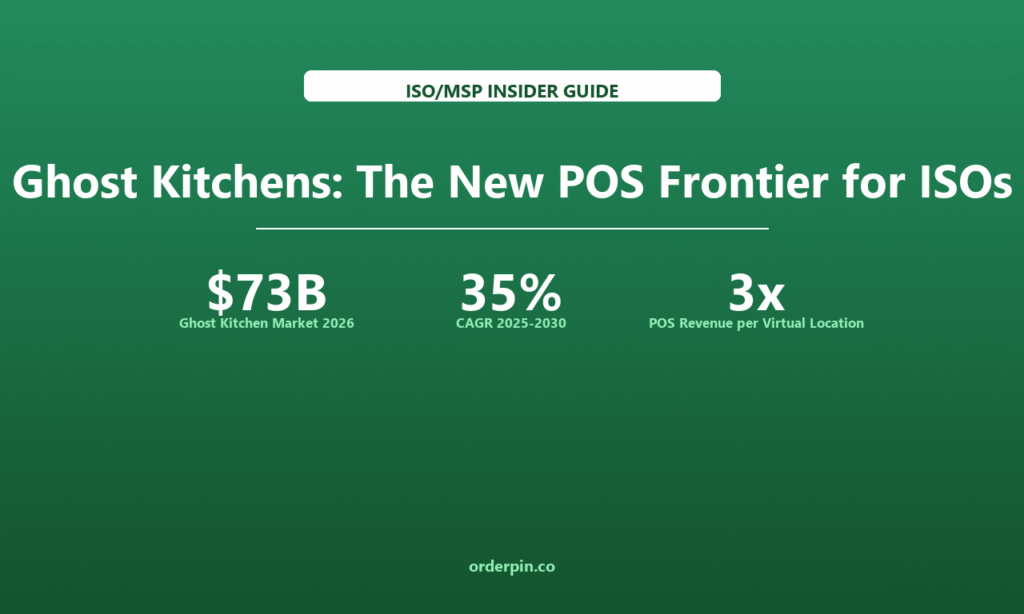
- Ghost kitchens and virtual restaurants are a $73B market growing at 35% CAGR: Delivery-only concepts — brands with no front-of-house, operating from shared kitchen spaces — are one of the fastest-growing restaurant segments. They are not a pandemic quirk; they are a durable structural shift in how food reaches consumers.
- Ghost kitchens need POS systems built for a completely different model: No front-of-house, no host, no server, no tipping — but complex multi-channel order aggregation, third-party delivery integration, real-time kitchen display, and split-tender management across DoorDash, Uber Eats, and proprietary channels simultaneously. Standard restaurant POS systems were not designed for this.
- Most ISOs haven’t built a ghost kitchen playbook: The segment requires a distinct product offering (cloud-based, delivery-native, multi-channel), a different sales pitch (no installation cost, fast onboarding, commission-rate optimization), and a different support model. ISOs who build this capability now are creating a durable competitive advantage before the market matures.
Market 2026
2025-2030
per Virtual Location
What Is the Ghost Economy?
The “ghost economy” is the umbrella term for restaurant business models that exist without a traditional front-of-house — delivery-only brands operating from shared commercial kitchens, virtual restaurants (brands created within existing kitchens to serve a single delivery channel), dark kitchens (commercial cooking spaces with no retail presence), pop-up restaurants, and micro-fulfillment centers for grocery and convenience delivery. Together, they represent a structural shift in food production, not a temporary reaction to external disruption.
The market has grown from roughly $45B in 2021 to an estimated $73B in 2026, with a projected CAGR of 35% through 2030, according to Euromonitor and Statista. Major delivery aggregators — DoorDash, Uber Eats, and Grab — have invested heavily in ghost kitchen infrastructure. Cloud kitchen operators like Reef Technology, Kitchen United, and Zuul Kitchens have raised billions to build shared kitchen networks in major metropolitan areas. The ghost economy is not a trend — it’s a new segment of the restaurant industry with its own economics, its own operational requirements, and its own POS needs.
What makes ghost kitchens particularly interesting for ISOs is the revenue model: each virtual brand in a shared kitchen is a separate merchant account opportunity. A shared kitchen operating 8 virtual brands from one physical location can generate 8 separate POS activations — each with its own processing volume, its own delivery channel integration, and its own renewal relationship.
Market Size 2026
2025-2030
Per Shared Kitchen
No Install Cost
1. Why Ghost Kitchen POS Requirements Are Fundamentally Different
A traditional table-service restaurant POS is built around the front-of-house: table management, server order entry, tipping, guest checks, split payments, and waitlist integration. None of these features are relevant to a ghost kitchen. The operational model is inverted — the kitchen is the entire business, and the “front of house” is a digital aggregator layer (DoorDash, Uber Eats, Grubhub) that funnels orders into a kitchen display.
Multi-channel order aggregation: A ghost kitchen operating across 4 delivery platforms receives orders from DoorDash, Uber Eats, Grubhub, and its own direct ordering channel simultaneously. The POS must aggregate all incoming orders into a single kitchen display, deduplicate them, and route them to the appropriate prep station — in real time, with no manual re-entry. This is not a feature standard POS systems provide by default.
Third-party delivery commission optimization: Delivery aggregator commission rates range from 15% to 35% of order value. Ghost kitchen operators are intensely focused on driving direct orders (0% commission) vs. aggregator orders. The POS needs a native direct ordering channel — website, app, or QR-code ordering — to help ghost kitchen operators shift mix away from high-commission aggregator orders toward direct ones.
Split tender and multi-brand management: In a shared ghost kitchen with multiple virtual brands, a single customer transaction may need to be split across multiple brands (one order, multiple restaurant brands). The POS must handle this at the transaction level, not as a workaround. It must also provide per-brand reporting — each virtual brand has its own revenue, its own cost structure, its own delivery channel performance.
No terminal installation, no hardware burden: Ghost kitchen operators want to activate in days, not weeks. They are often in shared spaces where installing dedicated hardware is impractical. Cloud-based, tablet-only POS with no hardware installation requirement is the baseline expectation, not a premium feature.
2. The Revenue Opportunity: 3x Per Location, 8 Brands Per Kitchen
The ghost kitchen model creates a fundamentally different revenue math for ISOs than traditional restaurant POS. The key variables:
Multiple brands per physical location: A shared kitchen with 8 virtual brands is 8 potential merchant accounts from one physical space. Each brand has its own revenue stream, its own processing volume, and its own renewal relationship. The ISO that wins the shared kitchen operator wins 8 accounts in one sale.
Higher processing volume per brand: Delivery-only restaurants typically have higher ticket counts and lower average tickets than table-service restaurants. A ghost kitchen doing 200 orders per day at $22 average ticket generates $4,400 in daily processing volume — higher velocity than a comparable casual dining location. Ghost kitchens are high-volume, high-frequency merchants by nature.
Rapid brand turnover = recurring acquisition: Ghost kitchen brands have a short lifecycle — operators test concepts, iterate on menus, and close underperformers quickly. This means ongoing new merchant acquisition within your existing accounts. Every time an operator launches a new virtual brand, it’s a new activation opportunity. The churn of brands within a shared kitchen creates a built-in pipeline for new POS activations.
No hardware friction: Cloud POS activation in a shared kitchen is a software install — no terminal shipping, no installation appointment, no PCI compliance overhead from dedicated hardware. Activation can happen in 48 hours. This reduces your cost of onboarding and makes ghost kitchen merchants viable even at smaller volume thresholds.
Traditional Restaurant vs. Ghost Kitchen: The ISO Comparison
| Metric | Traditional Restaurant | Ghost Kitchen |
|---|---|---|
| Activation timeline | 2-4 weeks | 48 hours |
| Hardware requirement | Full terminal + hub | Tablet + cloud only |
| Delivery channel integration | Optional add-on | Core requirement |
| Revenue per location | 1x per physical site | Up to 8x per physical site |
| Processing volume per order | Medium-high, low frequency | Low-medium, high frequency |
| New brand churn = new activations | Rare | Frequent pipeline |
3. How ISOs Can Build a Ghost Kitchen Sales Motion
The ghost kitchen segment requires a different sales approach, a different product pitch, and a different support model. Here’s how to build it:
Target the cloud kitchen operators: The primary targets are shared kitchen operators (Reef Technology, Kitchen United, Zuul Kitchens, local commercial kitchen operators) who manage the physical infrastructure and lease kitchen space to individual virtual restaurant brands. These operators often bundle services — including payment processing — as part of their operator agreements. Winning the shared kitchen operator gives you access to all their virtual brands under one relationship.
Also target direct ghost kitchen entrepreneurs: Independent ghost kitchen operators — restaurant owners transitioning from brick-and-mortar to delivery-only, food hall tenants, pop-up operators building toward permanent locations — are a secondary but valuable target. They are more price-sensitive but also more relationship-driven. A direct ghost kitchen operator who is growing fast is a candidate for multiple activations as they scale.
Pitch activation speed, not hardware: The ghost kitchen sales pitch leads with activation timeline — “we can have you processing in 48 hours” — not with rate sheets or terminal specs. These operators move fast and they evaluate vendors on speed and simplicity, not on processing rate differentials.
Lead with multi-channel aggregation: The POS must handle DoorDash, Uber Eats, and direct ordering in one display. This is the product feature that separates a delivery-native POS from a traditional restaurant POS retrofitted with a delivery plugin. If your platform supports this natively, lead with it. If not, build or partner to get there — the native integration is the core product requirement for this segment.
How OrderPin Helps ISOs Win the Ghost Kitchen Segment
OrderPin is a restaurant POS software ISV whose platform is cloud-native, tablet-first, and delivery-aggregator-ready — giving ISOs the product foundation to serve ghost kitchen operators without hardware installation, without multi-week onboarding, and with native multi-channel order aggregation.
- Cloud-native, tablet-first deployment: OrderPin activates in 48 hours with no hardware installation — exactly what ghost kitchen operators need. Shared kitchen operators can onboard new virtual brands in hours, not weeks.
- Multi-channel order aggregation: Native integration with DoorDash, Uber Eats, Grubhub, and direct ordering in a single kitchen display. Orders from all channels appear in one queue, routed to the correct prep station, with no manual re-entry.
- Native direct ordering: Built-in QR-code and web-based direct ordering reduces operator reliance on high-commission aggregator orders. ISOs who deploy OrderPin can show ghost kitchen operators exactly how much they save by shifting 10-20% of volume from aggregator to direct orders.
- Multi-brand management: A single OrderPin deployment handles multiple virtual restaurant brands from one kitchen space — with per-brand revenue reporting, per-brand menu management, and per-brand delivery channel analytics.
Frequently Asked Questions
What exactly is a ghost kitchen, and how does it differ from a dark kitchen or virtual restaurant?
The terms are often used interchangeably but have distinct meanings. A ghost kitchen (also called dark kitchen) is a commercial cooking space with no customer-facing front of house — orders come in only through delivery apps or direct ordering. A virtual restaurant is a delivery-only brand that operates from an existing restaurant’s kitchen (often during off-peak hours) — it may share equipment and staff with the host restaurant. Both are delivery-only models with the same POS requirements. Pop-up restaurants are temporary concepts that may have a physical presence but no permanent location. All three are distinct business models with POS needs that differ significantly from traditional restaurants.
Are ghost kitchens a durable trend or a pandemic-related anomaly?
Durable structural shift, not a temporary anomaly. Delivery accounted for approximately 40% of total restaurant orders in 2020. That share has settled at around 30-35% in most markets — well above pre-pandemic levels of 10-15%. Consumer habits formed during the pandemic have not reversed. The ghost kitchen model is optimized for this permanent shift in consumer ordering behavior, and investment in shared kitchen infrastructure continues to grow. The segment will continue to expand as food delivery becomes a standard channel alongside dine-in and takeout.
What is the typical processing volume for a ghost kitchen?
It varies significantly by concept and market. A well-run ghost kitchen brand doing 150-200 orders per day at an average ticket of $20-28 generates approximately $90,000-$140,000 in monthly processing volume. A shared kitchen operating 5 brands at this volume generates $450,000-$700,000 in monthly processing volume across its portfolio. Ghost kitchen operators are high-frequency, moderate-ticket merchants — the volume per activation is comparable to or exceeds a traditional restaurant, and the activation speed is faster.
How do ghost kitchen operators manage aggregator commission costs?
Aggregator commissions range from 15% (for very high-volume operators with negotiating leverage) to 35% (for small independent operators). Commission rates significantly compress gross margins for ghost kitchen operators — the model only works at scale or with a strong direct ordering channel to offset aggregator fees. The POS plays a critical role here: a native direct ordering solution (website, QR-code ordering, app) reduces the percentage of orders going through high-commission aggregator channels. ISOs who can demonstrate commission savings from direct ordering adoption have a powerful ROI case for ghost kitchen merchants.
Is the ghost kitchen opportunity only in major metro areas?
The highest concentration of ghost kitchen operators is in major metropolitan areas — New York, Los Angeles, Chicago, Houston, Miami, Seattle — where delivery app penetration is highest and shared kitchen infrastructure is most developed. But ghost kitchen concepts are spreading to secondary markets as delivery app coverage expands. The virtual restaurant model (operating a delivery-only brand from an existing restaurant’s kitchen) is viable in any market with a delivery app presence. ISOs in mid-size markets can pursue virtual restaurant opportunities with local restaurant operators without needing shared kitchen infrastructure.
How should an ISO prioritize building a ghost kitchen capability?
Start with the product: confirm your POS platform supports cloud-native activation, multi-channel delivery aggregation, and direct ordering. If it doesn’t, these are the features to prioritize in partnership discussions with your POS provider. Then build the pipeline: identify shared kitchen operators in your market, map the virtual brands operating in those spaces, and develop a targeted outreach approach. Finally, develop the pitch: the ghost kitchen value proposition is activation speed plus delivery-channel optimization — not rate and hardware. Practice that pitch with your sales team before taking it to market.
Ghost kitchens, virtual restaurants, and delivery-only concepts are a $73B market growing at 35% CAGR — not a pandemic trend but a durable structural shift in how food reaches consumers. The POS needs of this segment are fundamentally different from traditional restaurants: cloud-native activation, multi-channel delivery aggregation, direct ordering to reduce aggregator commissions, and multi-brand management in shared kitchen environments. ISOs who build a ghost kitchen product and sales motion now are creating a competitive advantage before the segment matures. The revenue math is compelling: one shared kitchen can generate 8 merchant account activations; one ghost kitchen brand can generate comparable processing volume to a brick-and-mortar restaurant with faster activation and lower hardware cost. OrderPin is a restaurant POS software ISV whose cloud-native, delivery-aggregator-ready platform gives ISOs the product foundation to compete in the ghost economy — tablet-first activation in 48 hours, native multi-channel order aggregation, and multi-brand management built in.
About OrderPin
OrderPin is a white-label POS platform built for ISO and MSP partners. We offer full data ownership, flexible pricing, and seamless API integrations to help you build a recurring revenue business under your own brand. Learn more about OrderPin’s white-label solution