
TL;DR — Quick Summary
- The payment ecosystem is structurally biased against ISOs at the margin layer: ISOs earn the residual — what’s left after networks, issuers, and processors have taken theirs. This makes ISO margin inherently thin and inherently compressible. The business model is not broken; it is structurally designed this way. Understanding this is the first step to escaping it.
- Software companies have found the exploit in the ISO business model: By embedding payments into their software platforms, vertical SaaS companies (Toast, Mindbody, ShopVOX) bypass the ISO layer entirely, own the merchant relationship, and capture the margin the ISO used to earn. The ISO becomes a commodity backend — the dumb pipe that moves money without anyone noticing it exists.
- Escaping the dumb pipe trap requires owning something the merchant cannot easily replace: A white-label POS platform, a proprietary data layer, a genuine advisory relationship — these create the switching costs and relationship depth that prevent the ISO from becoming interchangeable. Without platform ownership, every ISO is one rate negotiation away from being commoditized into irrelevance.
for 0.1% Rate Cut
Payment Ecosystem
Platform Threat
What Is the Dumb Pipe Trap?
The dumb pipe trap describes a situation in which a business provides a critical underlying service — one that is valuable and even essential — but captures almost none of the economic value that flows through it. The service is used; the provider is not valued. The pipe is dumb because it carries everything but understands nothing about what it is carrying.
This is exactly what is happening to a growing number of ISOs in the payment ecosystem. As embedded payment platforms and vertical SaaS companies have grown, they have taken the merchant relationship layer — the part of the payment chain where the ISO operated — and made it invisible. The ISO still processes transactions, still provides the technical infrastructure for card acceptance, but the merchant views the ISO as interchangeable: a utility, not a partner.
The consequences of this shift are not hypothetical. ISOs that have fallen into the dumb pipe trap report: declining per-transaction margins, increased merchant churn driven by rate shopping, reduced negotiating leverage, and an inability to justify premium pricing for services merchants do not recognize as valuable. The trap is not that the ISO fails — it is that the ISO succeeds at being a payment processor while being treated as a commodity infrastructure provider. Revenue is earned; profit is elusive.
The dumb pipe trap is particularly insidious because it does not arrive suddenly. It accumulates gradually: one merchant switches for a lower rate, another migrates to an embedded platform, another consolidates through a software company that handles processing internally. Each loss seems individually explicable — but the cumulative pattern reveals the trap. The ISO’s merchant base erodes not from a single dramatic failure but from a thousand small disintermediations, each one shaving off margin and relationship depth until what remains is a commodity book of processing business with no strategic defensibility.
at ISO Layer
Dumb Pipe Risk
Merchant Segment
Value Captured
1. Why the ISO Business Model Is Structurally Vulnerable to Commoditization
The dumb pipe trap is not primarily a competitive problem — it is a structural problem rooted in how the payment ecosystem distributes value. Understanding the structural bias is essential before attempting to escape it.
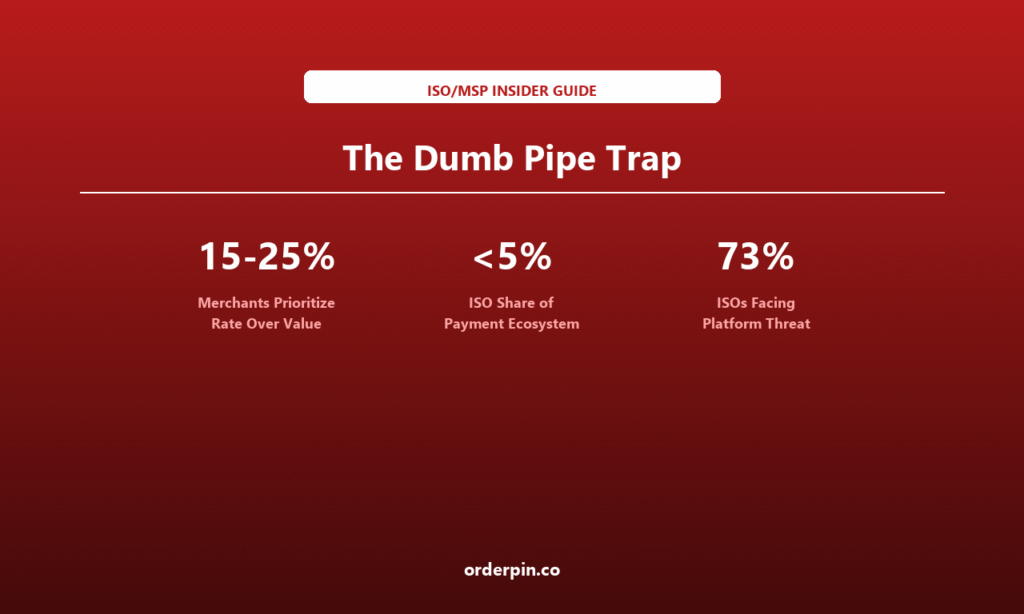
The residual margin problem: In a card transaction, networks take their assessment fees, issuers take interchange, and processors take their margin. What is left — the residual — is what the ISO earns. The ISO’s margin is structurally the last slice of the payment economics pie, not the first. This is not an accident: it is how the ecosystem is designed. Networks and issuers are essential — the rails do not work without them. Processors provide critical infrastructure. The ISO provides the merchant interface — valuable, but replaceable by any number of competitors willing to offer a lower rate.
The 15-25% rate-sensitive segment: Research across merchant services portfolios consistently shows that 15-25% of SMB merchants will switch processors for a rate decrease of as little as 0.1%. For this segment, the ISO is a pure commodity — interchangeable with any competitor offering a lower rate. ISOs that serve this segment disproportionately are structurally at the highest risk of dumb pipe commoditization. The margin earned from rate-sensitive merchants is earned only until a competitor undercuts by 5 basis points.
The value perception gap: Most SMB merchants perceive the ISO’s value as the rate they pay — and nothing more. They do not account for the onboarding, support, dispute resolution, compliance guidance, and strategic advisory that a good ISO provides. The result is a massive value perception gap: ISOs deliver perhaps 10 times the economic value they capture, but merchants pay for only the rate. This gap is the dumb pipe trap in its purest form — and it is self-inflicted by ISOs who compete on rate alone and never articulate the full scope of their value.
2. The Invisible Processor Problem: How Software Companies Disappeared the ISO
The dumb pipe trap has been dramatically accelerated by a specific competitive dynamic: the rise of vertical SaaS platforms with embedded payments. The mechanism is straightforward, but its implications for the ISO business model are profound.
Embedded payment absorption: A restaurant POS company like Toast, a beauty salon platform like Mindbody, or an auto repair management system like ShopVOX embeds payment processing directly into its software platform. The merchant no longer needs a separate payment processor — the platform handles it. The ISO that was processing that merchant’s payments is simply removed from the relationship. The merchant may not even notice: the platform handles everything, and the ISO’s name never appeared on a statement.
The invisible displacement: What makes this particularly dangerous for ISOs is that the displacement is invisible to the merchant. A merchant using Toast’s embedded payments does not feel that they have “lost” an ISO relationship — they feel that they have simplified their software stack. The ISO is displaced not through a competitor offering better terms but through the platform making the ISO irrelevant. This is why the threat is structural, not competitive: it cannot be defeated by offering a better rate.
The 73% who feel it: Industry surveys consistently find that approximately 73% of ISOs report that they have lost merchant relationships to embedded payment platforms or vertical SaaS competitors in the past three years — and most expect this trend to accelerate. The dumb pipe trap is not a future risk for most ISOs; it is a current reality. The question is not whether it is coming but how far it has already progressed in your book.
3. Software Is Controlling the Distribution — and the ISO Is Losing It
In the traditional merchant services model, the ISO controlled the most valuable thing in the relationship: the merchant relationship itself. The ISO introduced the merchant to payment processing, managed the onboarding, provided ongoing support, and was the human interface between the merchant and a complex, opaque payment system. This relationship was the ISO’s core asset — the thing that made merchants sticky and switching costs real.
Vertical SaaS platforms have systematically taken control of this distribution layer. By building an all-in-one software platform — POS, inventory, scheduling, CRM, customer loyalty, and now payments — these platforms become the operating system for the merchant’s business. The ISO is not part of that operating system. The platform distributes the relationship; the ISO processes transactions in the background. The ISO becomes infrastructure — and infrastructure, by definition, is invisible, interchangeable, and under constant price pressure.
The pattern is accelerating across every vertical. In restaurants: Toast, Lightspeed, Square for Restaurants. In beauty and wellness: Mindbody, Boulevard, Vagaro. In automotive: CDK Global, Reynolds and Reynolds (now CDK Connect). In healthcare: DrChrono, SimplePractice with integrated payments. Each platform embeds payments; each platform displaces the ISO from the merchant relationship. The ISO who serves these verticals without owning a software layer is serving merchants who are being migrated off their platform by the week.
Dumb Pipe ISO vs. Platform ISO: A Structural Comparison
| Dimension | Processing-Only (Dumb Pipe) | Platform-Owning ISO |
|---|---|---|
| Revenue Model | Residual margin (rate-based) | Platform fees + processing + data |
| Merchant Switching Cost | Low — easy to migrate | High — platform migration required |
| Value Perception | Rate only | Operations platform + advisory |
| Disintermediation Risk | High — easy target | Low — platform ownership |
| Valuation Multiple | 3-5x EBITDA | 8-15x EBITDA |
| Data Ownership | None — aggregator data | Full — POS-level operational data |
How OrderPin Gives ISOs the Platform Ownership to Escape the Dumb Pipe Trap
OrderPin is a restaurant POS software ISV whose white-label platform gives ISOs the infrastructure ownership that is the only reliable escape from the dumb pipe trap. Platform ownership transforms the ISO from a rate-based residual earner into a platform infrastructure provider — and that changes everything about the ISO’s structural position.
- Platform ownership = real switching costs: An ISO on the OrderPin white-label platform does not sell payment processing to merchants — it provides the operating system for their business. Switching payment processors is a negotiation; switching POS infrastructure is a full migration. The platform creates switching costs that rate competitors cannot overcome.
- Data layer immune to aggregation: OrderPin captures POS-level operational data — item sales, customer behavior, labor patterns, peak hours. This data is not accessible through aggregator APIs or processor data feeds. It belongs to the ISO’s platform and cannot be stripped away by a processor or a platform migrating to embedded payments.
- Advisory position backed by operational data: With POS-level data, the ISO can provide genuine operational advisory — not just payment rate benchmarking but actual insight into merchant performance, opportunity identification, and growth recommendations. This transforms the ISO from a rate vendor into a business advisor — the only position in the payment ecosystem that is genuinely resistant to commoditization.
- White-label brand: the ISO’s face, not OrderPin’s: On the OrderPin white-label platform, the merchant’s daily interface carries the ISO’s brand — not OrderPin’s, not the processor’s. The ISO owns the brand relationship. As platforms compete for merchant loyalty, brand ownership in the operating relationship is the ultimate defense against being made invisible.
Frequently Asked Questions
Is the dumb pipe trap inevitable for all ISOs?
No — but it is the default trajectory for processing-only ISOs who do not build structural defenses. The trap is not inevitable; it is probable. Every ISO that competes on rate alone, serves a rate-sensitive merchant segment, and lacks platform or data ownership is on a path toward commoditization. The ISOs that escape it are the ones who build switching costs, own a platform or data layer, and cultivate advisory relationships that merchants genuinely value beyond the rate.
How is the dumb pipe trap different from normal price competition?
Normal price competition is competitive: you compete on rate, you win or lose deals, and the market clears at a competitive price. The dumb pipe trap is structural: the ISO is not beaten by a competitor — it is made irrelevant by a platform that removes the need for the ISO entirely. You cannot win a rate war against a platform that has made your rate irrelevant by making you invisible. The dumb pipe trap requires a structural response, not a competitive one.
Can an ISO escape the dumb pipe trap without becoming a software company?
Yes — through a white-label platform partnership. The ISO does not need to build its own POS software from scratch. A white-label partnership with a platform like OrderPin gives the ISO platform ownership — under their own brand, with their own data, serving their own merchant relationships — without the capital expenditure and development timeline of building software. The ISO becomes a platform provider through partnership, not through becoming a software company. This is the fastest and most capital-efficient path to escaping the dumb pipe trap.
How do I know if my ISO is already in the dumb pipe trap?
Three warning signs: (1) Your merchants negotiate primarily on rate, and the primary reason they leave is to get a lower rate from a competitor. (2) You cannot articulate the specific, measurable value you provide beyond the rate — if asked “why should I stay with you instead of switching for 5 basis points less?”, you have no clear answer beyond “we provide good service.” (3) You have no platform or data asset that would be costly for merchants to replace. If all three apply, the trap has already closed. The question is how far along the path toward full commoditization you are.
Does advisory positioning actually prevent commoditization?
Yes — but only when it is backed by genuine data and operational insight that the merchant cannot get elsewhere. Generic advisory (“have you considered optimizing your interchange rates?”) is not enough; every processor and ISO says the same thing. Advisory that is backed by POS-level operational data — actual sales trends, customer behavior patterns, labor optimization opportunities — is genuinely hard to replicate. The key is that the advisory must be built on a data foundation that the ISO owns and competitors cannot easily access. Without data ownership, advisory is a positioning statement, not a structural moat.
What is the single most important action an ISO should take to escape the dumb pipe trap?
Own a platform — or partner with one. A white-label POS platform under the ISO’s brand, with the ISO’s data, serving the ISO’s merchant relationships is the structural answer to the dumb pipe trap. Platform ownership changes the ISO’s position in the ecosystem: from a rate-based service provider to an infrastructure provider. From interchangeable to essential. From the dumb pipe to the operating system. Every ISO that does not own a platform is on borrowed time in the embedded payments era — and the clock is moving faster than most ISOs realize.
The dumb pipe trap is not a failure of management or strategy — it is the predictable outcome of operating in the payment ecosystem’s most competitive, most replaceable layer without building structural defenses. ISOs that earn only the residual margin, serve a rate-sensitive merchant base, and lack platform or data ownership are on the path to commoditization whether they know it or not. The escape is not better salesmanship or a lower rate — it is building the switching costs, data ownership, and advisory depth that make the ISO genuinely irreplaceable. White-label platform ownership is the fastest path: it gives ISOs the infrastructure position, the data layer, and the brand relationship that transform the dumb pipe into an operating system. The ISOs that make this transition before their merchant base is fully eroded will own the next decade of merchant services. The ones that wait will become cautionary tales. OrderPin is a restaurant POS software ISV whose white-label platform gives ISOs the platform ownership to escape the dumb pipe trap — switching costs, proprietary data, and advisory depth that make the ISO position genuinely essential, not just structurally necessary.
About OrderPin
OrderPin is a white-label POS platform built for ISO and MSP partners. We offer full data ownership, flexible pricing, and seamless API integrations to help you build a recurring revenue business under your own brand. Learn more about OrderPin’s white-label solution