
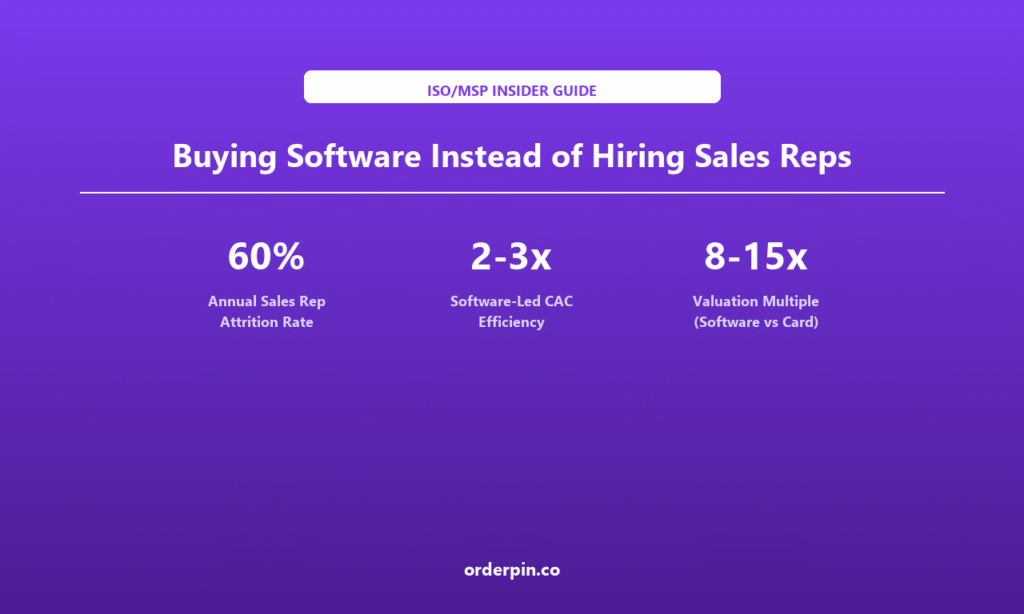
TL;DR — Quick Summary
- The sales-rep growth model has hit a wall: Every additional rep adds linear cost and linear revenue, but also carries 40-60% annual attrition, 6-12 month ramp time, and a customer acquisition cost that rises as the easy prospects get exhausted. At a certain scale, adding reps stops improving unit economics — it just adds overhead. The model does not compound; it plateaus.
- Software-led acquisition has fundamentally better unit economics: A software platform or ISV partnership acquires merchants at a fraction of the cost of a human rep, retains them at far higher rates because switching software is painful, and scales with adoption rather than payroll. The same dollar invested in software-driven acquisition returns more merchants, stickier merchants, and a defensible moat — not a revolving door of reps.
- The valuation arbitrage is the real prize: A processing-only ISO sells for 3-5x EBITDA. A software-enabled ISO sells for 8-15x. The ISO that buys software instead of hiring reps is not just growing more efficiently — it is buying its own exit multiple. The rep-driven book and the software-driven book may produce similar revenue, but they command radically different prices when it is time to sell.
Attrition Rate
Efficiency
(Software vs Card)
The Reckoning: Why the Rep Model Stalls
For decades, the default ISO growth playbook was simple: hire more sales reps. More reps meant more merchant meetings, more sign-ups, more processing volume. It worked when the market was under-penetrated and the cost of a rep was low relative to the lifetime value of the merchants they brought in. That arithmetic has broken down, and most ISOs have not updated the model to match the new reality.
Three forces have eroded the rep model. First, customer acquisition cost has risen as the easy merchants get exhausted and competition for the remaining prospects intensifies — the same rep now costs more to acquire a merchant worth the same. Second, sales rep attrition runs 40-60% annually in payments, which means a large share of every recruiting dollar is spent replacing reps who leave before they produce, and ramp time (6-12 months) means new hires are a net cost long before they are a net contributor. Third, the model is structurally linear: revenue scales with headcount, and headcount scales with cash — there is no compounding. A software platform, by contrast, compounds: every merchant it acquires makes the next one cheaper to get.
The strategic question is no longer “how many reps should we hire?” It is “what should we buy instead?” The ISOs making the smartest moves are redirecting the budget they would have spent on a larger sales org into software acquisitions — buying ISVs, white-label platforms, or vertical software that acquires merchants on their behalf. The merchant volume is similar; the economics, retention, and exit value are not. This article shows the math.
None of this means sales reps disappear. It means the marginal dollar shifts. The ISO that keeps a lean, high-skill team for enterprise relationships and deploys capital into software-driven acquisition builds a book that grows faster, retains better, and sells for more. The ISO that keeps hiring reps into a broken model buys plateau and churn.
Attrition (Payments)
Software-Led Model
Exit Multiple (EBITDA)
Exit Multiple (EBITDA)
1. The Unit Economics: Reps vs. Software
Acquisition cost per merchant: A human rep carries salary, commission, benefits, management overhead, and ramp-time cost before producing a single merchant — and loses 40-60% of them annually to attrition. A software platform or embedded ISV acquires merchants at near-zero marginal cost per account, because the software is already sold. On a per-merchant basis, software-led acquisition runs 2-3x more cost-efficient than a rep-driven team.
Retention: Merchants acquired by a rep churn at 15-25% annually — they were sold on price or relationship and leave when either changes. Merchants acquired through software are locked in by the operational dependency: switching payment providers means ripping out the software they run their business on. Retention runs 90%+, which compounds the value of every acquisition dollar over time.
Scalability: Rep-driven growth is linear and capped at your ability to recruit, train, and manage people. Software-driven growth compounds with adoption — every new ISV partner or platform feature lowers the cost of the next merchant. The same capital deployed into software yields a growth curve that reps physically cannot match.
2. The Valuation Arbitrage: Buying Your Own Exit Multiple
The multiple gap is the strategy: A processing-only ISO — one that acquires merchants purely through reps and resells processing — typically sells for 3-5x EBITDA. A software-enabled ISO, which owns platforms, embedded ISV channels, and merchant data, sells for 8-15x. The revenue can be identical; the price is not. Buying software is, in effect, buying a higher exit multiple on the revenue you already have.
Compounding the arbitrage: Every dollar shifted from rep hiring to software acquisition does two things at once: it improves the growth engine (cheaper, stickier merchants) and it reclassifies the business toward the higher-multiple bucket. The ISO that starts this shift early builds a book that, at exit, is valued on software-enabled metrics rather than processing-only metrics — often a 2-3x difference in enterprise value on the same EBITDA.
Why acquirers pay the premium: Software-enabled ISOs have defensible moats — owned data, embedded distribution, switch-cost-protected merchants — that processing-only ISOs lack. Acquirers pay 8-15x because they are buying a durable, compounding asset, not a book of price-sensitive merchants that another ISO can poach next quarter. The premium is the market pricing the moat.
3. How to Execute: Redirecting the Rep Budget Into Software
Keep a lean enterprise team: Do not fire your best reps. Keep a small, high-skill team focused on large, complex, high-value merchant relationships where human trust still wins. Redirect the budget that would have gone to expanding the junior rep layer into software acquisition instead.
Acquire or partner with ISVs in your vertical: The fastest path to software-led acquisition is an ISV whose software already serves your merchants. A tuck-in acquisition or embedded partnership gives you their distribution instantly. Start with one well-matched ISV; expand the portfolio as the model proves out.
Own the platform, not just the processing: A white-label platform (like OrderPin) lets the ISO present software as its own brand and own the merchant relationship and data. This is what converts a software purchase from a cost center into a permanent, equity-building asset — and what drives the exit multiple up.
Measure the right metric: Stop judging growth by merchant count added per rep. Judge it by cost per acquired merchant, retention, and — most importantly — the trajectory of your exit multiple. The rep model wins on activity; the software model wins on value.
Hiring Reps vs. Buying Software: The Math
| Dimension | Buying Software / ISV | Hiring More Reps |
|---|---|---|
| Cost per Acquired Merchant | Low (2-3x better) | High and rising |
| Merchant Retention | 90%+ (software-locked) | 15-25% annual churn |
| Growth Curve | Compounding | Linear, capped at payroll |
| Competitive Moat | Owned data + switch costs | Relationship (easily poached) |
| Rep Attrition Risk | None | 40-60% annually |
| Exit Multiple (EBITDA) | 8-15x | 3-5x |
How OrderPin Lets ISOs Buy Software Instead of Hiring Reps
OrderPin is a white-label POS platform that lets an ISO deploy software-led merchant acquisition without building a software company. For the ISO deciding between another rep class and a software asset, OrderPin is the asset.
- Software acquisition without the build cost: Building a POS platform from scratch costs millions and years. OrderPin gives the ISO a finished, API-first platform under its own brand — the software asset, without the engineering. The ISO redirects rep-hire budget into owned software overnight.
- Embedded ISV partnerships on day one: Because OrderPin is API-first, the ISO can embed payments inside ISV software immediately — the gold-standard acquisition model that acquires merchants at near-zero cost. The ISO becomes a software channel player, not a reseller of someone else’s stack.
- Owned merchant relationship and data: Every merchant runs on the ISO’s branded platform, so the ISO owns the relationship and the operational data. This is what converts the software purchase into a permanent, equity-building portfolio asset — and what drives the 8-15x exit multiple.
- Lean team, compounded growth: The ISO keeps a small enterprise sales team for high-value relationships and lets OrderPin drive volume acquisition. Growth compounds with adoption instead of capping at payroll — exactly the shift this article argues for.
Frequently Asked Questions
Does this mean ISOs should stop hiring sales reps entirely?
No. It means the marginal growth dollar should shift from rep expansion to software acquisition. A lean, high-skill enterprise team remains valuable for complex, high-value merchant relationships where human trust wins. The argument is against scaling the junior rep layer into a model with broken unit economics — not against having reps at all.
Is buying software really cheaper than hiring reps?
On a per-acquired-merchant basis, yes — typically 2-3x more cost-efficient, and the gap widens over time because software-led merchants retain at 90%+ while rep-acquired merchants churn 15-25% annually. The upfront cost of a software acquisition is higher, but the lifetime value of the merchants it brings is dramatically better. The rep model looks cheap quarterly and expensive at exit; the software model is the reverse.
What is the “valuation arbitrage” in plain terms?
It means a software-enabled ISO sells for 8-15x EBITDA while a processing-only ISO sells for 3-5x. If two ISOs have the same profit, the software-enabled one is worth roughly double to triple at sale. Shifting budget from reps to software lifts the exit multiple on the revenue you already have — you are, in effect, buying a higher price for your business before you sell it.
Can a small ISO afford a software acquisition?
A full ISV acquisition may be out of reach for a small ISO, but a white-label platform partnership (like OrderPin) delivers the software-led acquisition engine at a fraction of the cost — no build, no acquisition premium. The ISO gets the owned platform, the embedded ISV channel, and the data, for the price of a partnership rather than a buyout. This is the accessible entry point to the same arbitrage.
What if my merchants prefer working with a person?
Many do — for onboarding and problem-solving. That is exactly why the model keeps a lean human team for relationship and support, while software handles high-volume acquisition. The ISO is not removing humans; it is removing humans from the part of the funnel where they are the most expensive and the least scalable, and keeping them where they add the most value.
How long before the valuation arbitrage shows up?
The arbitrage shows up at exit, but the signals appear immediately: lower cost per merchant, higher retention, and owned data all build the profile acquirers pay a premium for. The earlier an ISO starts, the more compounding time it has — and the more defensible the moat becomes before a competitor builds one. Waiting delays both the growth benefit and the valuation benefit, and the exit multiple is set by the business you built, not the one you plan to build.
The rep-driven growth model has broken: rising acquisition cost, 40-60% annual attrition, and a hard scalability ceiling mean every new rep adds less value than the last. Software-led acquisition — through ISV partnerships, embedded channels, and owned platforms — acquires merchants at 2-3x lower cost, retains them at 90%+, and compounds instead of plateauing. The decisive advantage, though, is the valuation arbitrage: a software-enabled ISO sells for 8-15x EBITDA versus 3-5x for processing-only. Buying software instead of hiring reps is not just a cheaper way to grow — it is a way to buy a higher exit multiple on the revenue you already have. The ISOs making this shift keep a lean enterprise team, redirect expansion budget into software, own the platform and the data, and measure success by cost per merchant and exit trajectory rather than activity. The ones that keep hiring into a broken model buy plateau and churn. OrderPin is a white-label POS platform that lets ISOs make this shift without building a software company — owned software, embedded ISV acquisition, and full data control, deployed under the ISO’s brand for the cost of a partnership rather than a buyout.
About OrderPin
OrderPin is a white-label POS platform built for ISO and MSP partners. We offer full data ownership, flexible pricing, and seamless API integrations to help you build a recurring revenue business under your own brand. Learn more about OrderPin’s white-label solution